


Kevin O'Brien
-
Posts
858 -
Joined
-
Last visited
-
Days Won
41
Content Type
Profiles
Forums
Blogs
Events
News
2026 Kansas City Royals Top Prospects Ranking
Kansas City Royals Videos
Kansas City Royals Free Agent & Trade Rumors, Notes, & Tidbits
Guides & Resources
The Kansas City Royals Players Project
2026 Kansas City Royals Draft Tracker: Picks & Bonuses
Store
Downloads
Gallery
Everything posted by Kevin O'Brien
-
 That has definitely been a challenge for him. I think looking at his release point data will be key for him this spring. Here's a look at what he did in his last outing, release point-wise. It's a small sample, but you can see some differences between similar pitches, suggesting a lack of consistency in throwing mechanics. How Sweeney and McFerran help him keep consistent mechanics and release points will determine whether he is a sleeper or serves as a Triple-A reliever in 2026.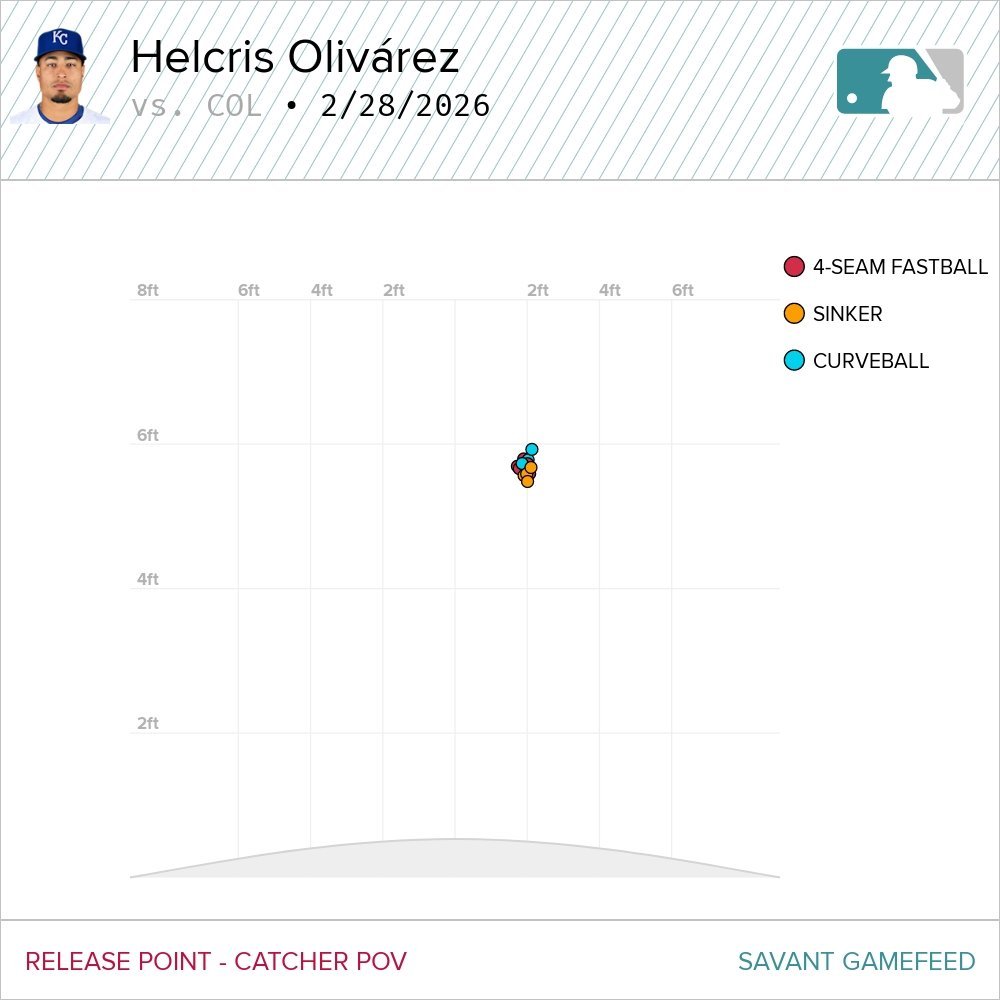
- 2 replies
-
- 1
-

-
- helcris olivarez
- daniel lynch iv
- (and 3 more)
-
Image courtesy of Jayne Kamin-Oncea-Imagn Images A big key for the Royals last year was the improvement in the bullpen from 2024 to 2025. While the bullpen improved after the Trade Deadline acquisition of Lucas Erceg, it was an inconsistent group in 2024, and the metrics proved it. Royals relievers ranked 20th in bullpen ERA (4.13), 28th in K/9 (8.06), 23rd in K/BB ratio (2.36), and 26th in SIERA (4.02). It's honestly amazing that the Royals won 86 games and made the playoffs with a bullpen that mediocre. In 2025, thanks to the acquisition of Carlos Estevez and the improvement of some other relievers, Kansas City's bullpen showed some growth in terms of results. They ranked 7th in bullpen ERA (3.63), 19th in K-BB ratio (2.46), and 21st in SIERA (3.99). However, the only blemish for this bullpen was the lack of strikeouts, as they actually ranked worse in K/9 with a 7.76 mark (which ranked 29th). Thus, Royals GM JJ Picollo made it a priority to acquire relievers who could get strikeouts and whiffs. Trades for Philadelphia's Matt Strahm and Milwaukee's Nick Mears confirmed that priority. That said, one intriguing Minor League signing this spring has been Helcris Olivarez, who pitched in the San Francisco Giants organization a season ago. In four outings and four IP, Olivarez has a 2.25 ERA, 1.50 WHIP, 3.87 FIP, and 3.00 K/BB ratio. The strikeouts haven't been great, as he has a 16.7% K% so far in Cactus League play. That said, he's limited the walks (5.6% BB%), something that has plagued him in the past in the Minor Leagues. For context, in 37 appearances in Double-A and Triple-A combined last year, he had a 24.6% BB% and 1.7% K-BB%. Safe to say, those kinds of numbers aren't going to cut it in the Majors. However, what has been different with Olivarez so far this spring? What kind of role could Olivarez have in the Royals' bullpen in 2026? What are some recent Royals bullpen success stories that are similar to Olivarez? Let's break down those questions using Fangraphs and TJ Stats data and applications. Olivarez's Four-Seamer and Curve Have Been Key This Spring The 25-year-old Dominican lefty hasn't generated a ton of strikeouts this spring, with only three strikeouts so far. That said, he's producing a decent chase and whiff, while minimizing hard contact, as illustrated by his reasonable xwOBACON. Those metrics can be seen via his TJ Stats summary of his performance this spring below. When it comes to TJ Stuff+, there's a lot to be encouraged about with Olivarez's profile. While his overall TJ Stuff+ is 100 and he has only one pitch with a TJ Stuff+ over 100 (his curve, which has a 106 mark), all four of his offerings have pitching grades over 50. That shows that he has a balanced profile, and he does have one elite pitch in his curveball, which has a pitching grade of 64 and a whiff rate of 66.7%. Olivarez hasn't generated an outstanding chase rate (28.6%), and his whiff rate has been below average (21.4%). That said, his four-seamer chase has been solid (31.6%), and he's been limiting hard contact on his fastball, with his four-seamer posting a .362 xwOBACON and his sinker posting a .107 xwOBACON. I believe a reason for the lower chase and whiff rates is due to his erratic control, as he has a 44.4% zone rate so far this spring. Below is Olivarez's pitch chart from yesterday's Cactus League game. Notice that it was feast or famine for him when it came to locating his pitches against the Rockies on Saturday. Once Olivarez is able to find the strike zone more this spring, the more effective his chase and whiff rates will be. His most thrown pitch this spring has been his four-seamer, and it's typically been a good pitch for him in terms of TJ Stuff+ and whiff profiles. Here's a look at his TJ Stats summary from last year in Triple-A Sacramento, and take a look at the data on the four-seamer from a season ago. The four-seamer not only averaged 97.3 MPH, but it also had a 99 TJ Stuff+, 52 grade, 36.5% whiff rate, and .248 xwOBACON. So, what can we say about that data on the fastball from last season? Yes, it is. Conversely, it had a 39.8% zone rate and 18.4% chase rate. Considering he threw the pitch 47.8% of the time, that erratic control of the four-seamer probably led to his 24.4% BB% in Sacramento. What's interesting about Olivarez's four-seamer is that it doesn't sport the characteristics of a normal four-seam fastball. It only had a 13.1 iVB and an 11.7 HB. Thus, it's more of a horizontal moving pitch with more armside movement than typical for a four-seamer. One can see that in the pitch below from his time in Double-A Portland (when he was in the Red Sox organization), which hovers on the line being a sinker (though I don't have the exact metrics of the pitch). Despite that unique profile, Olivarez located it up, which one would do with the typical four-seamer. Based on the TJ Stats heatmap data, the approach worked for Olivarez in Sacramento last season. He produced a 33.3% CSW, 21.7% whiff rate, and .230 xwOBACON against lefties and a 29.8% CSW, 41.1% whiff rate, and .258 xwOBACON against righties. Thus, his four-seamer was a better strike-generating pitch against lefties but a better swing-and-miss pitch against righties last year in Triple-A. Let's see how that heatmap data looks so far this spring. The location hasn't been quite as sharp for Olivarez, based on his heatmap. His four-seamer has been located more in the middle of the plate than it was a season ago, when it was located up and armside against both lefties and righties. Against lefties, whom he has a 55.6% four-seamer usage against, it's produced similar trends with a 26.7% CSW and 0.0% whiff, but .269 xwOBACON. Against righties, it's been even better when it comes to generating strikes (36.8% CSW) and whiffs (42.9%), but it's been hit a lot harder, as illustrated by a .487 xwOBACON. The four-seamer will be key for Olivarez this spring because it can effectively set up his curve, which may be his best put-away pitch. Here's a look at the TJ Stats heatmap data this spring on his primary breaking offering, especially against lefties. He's only thrown it 22.2% of the time against lefties (and 5.6% against righties). However, against lefties, it's been a stellar offering with a 33.3% CSW, 40% O-Swing (chase), and 66.7% whiff. He hasn't located it all that well either, with the curve being located more up and in than typical. Here's a look at his curveball heatmap data from 2025 with the Triple-A Rivercats. Olivarez located the curve primarily away and glove-side against lefties and righties last year. It was far more effective against righties with a 28% CSW, 57.1% whiff, and .120 xwOBACON. Command of the pitch is probably the reason for that difference, as his curve against righties was located more in the lower zone 7 portion of the strike zone, while against lefties, it was more up in zone 6. The curve breaking hard and in on hitters foot is always going to lead to more whiffs. It would be nice to see Olivarez get to commanding that curveball back in that area of the strikezone this spring in Cactus League play, but he would likely need his four-seam command to improve first so he can get in more ideal counts to utilize his effective curveball. What Kind of Role Can Olivarez Play in the Bullpen? The Royals lack lefty depth on the 40-man roster. The only lefties who could pitch out of the bullpen are Strahm, Daniel Lynch IV, and Bailey Falter. That said, Falter is more of a starter and only moved to the bullpen after struggling initially with the Royals last season. Lynch has looked solid this spring, with his stuff playing more up than it did a season ago, as illustrated by his TJ Stats summary in Cactus League play. Thus, Strahm and Lynch could probably hold things down in the bullpen from a lefty perspective. However, as for Falter? I'm not quite as sure, though the TJ Stuff+, his pitch extension, and xwOBACON have been fine so far in Spring Training, as illustrated below. It would be nice for the Royals to get one more lefty in the bullpen, especially with Angel Zerpa going to Milwaukee this offseason (in the Mears and Isaac Collins trade). Strahm is a workhorse, but he is another year older. Lynch IV has produced good numbers so far, but his 4.76 FIP was much higher than his 3.06 ERA last year. Thus, the former 34th overall pick of the 2018 MLB Draft could be due for regression in 2026. Olivarez is far from dependable, considering his track record. That said, he's a lefty with velocity and swing-and-miss stuff who could give the Royals the punch from the left side they desperately need in 2026, as long as he is able to harness the control a bit better. What Are Some Similar Situations to Olivarez? I don't think Olivarez will make the Opening Day roster. However, he still has a Minor League option, and he's still under-the-radar, so I don't think there will be a tremendous market for him to opt out (he likely wouldn't make another club's Opening Day roster either). However, while he will start the year in Triple-A Omaha, he has a chance to be a Royals reliever who started the year in the Minors but later became a key contributor to the Royals bullpen. Two examples of that archetype are Sam Long in 2024 and Taylor Clarke last year. Neither made the Royals' Opening Day roster that season. However, they ended up being key relievers for Kansas City when they got called up. Here's a look at what Long did in 2024. In 42.2 IP, Long posted a 3.16 ERA and 1.20 WHIP with a 15.3% K-BB%. He ended up being the Royals' most dependable left-handed reliever that season, with some key innings in the postseason. Like Olivarez, Long has control issues, as evidenced by his 45.7% zone rate. However, he generated strong chase (30.2%) and whiff rates (27.5%), and his four-seamer was his most effective pitch with a 55 grade. Long fell apart a bit in 2025, but the Royals would take a similar campaign from Olivarez in 2026. Now, let's take a look at Clarke, who returned to the Royals after being traded away after the 2023 season. Clarke didn't have a great four-seamer (97 TJ Stuff+ and 50 grade), but his slider was elite with a 108 TJ Stuff+ and 59 grade. The breaking offering that he threw 39.7% of the time also had a 50.9% zone rate, a 33.1% chase-and-whiff rate, and a .312 xwOBACON. As a result, in 55.1 IP, he posted a 3.25 ERA, 0.85 WHIP, 3.97 FIP, and 17% K-BB%. It may be unfair to compare Olivarez to either Long or Clarke, mainly because Olivarez's control issues are way worse than those of the two former Kansas City relievers. However, both are examples of pitchers who weren't taken seriously by fans in the offseason, had good Spring Training campaigns, started in the Minors, and parlayed that success into strong Major League campaigns. Success may look a little different for Olivarez in 2026. However, if the stuff continues and if he can continue to hone his command and control with each and every outing, both in Spring Training and in the Minor Leagues to begin the year, then it wouldn't be surprising to see Olivarez turn into some kind of dark-horse impact reliever for the Royals by mid-season. Hopefully, if that happens, he can have a longer, more successful tenure in Kansas City than Long or Clarke. View full article
-
Is Helcris Olivarez This Year's Sleeper in the Royals Bullpen?
Kevin O'Brien posted an article in Royals
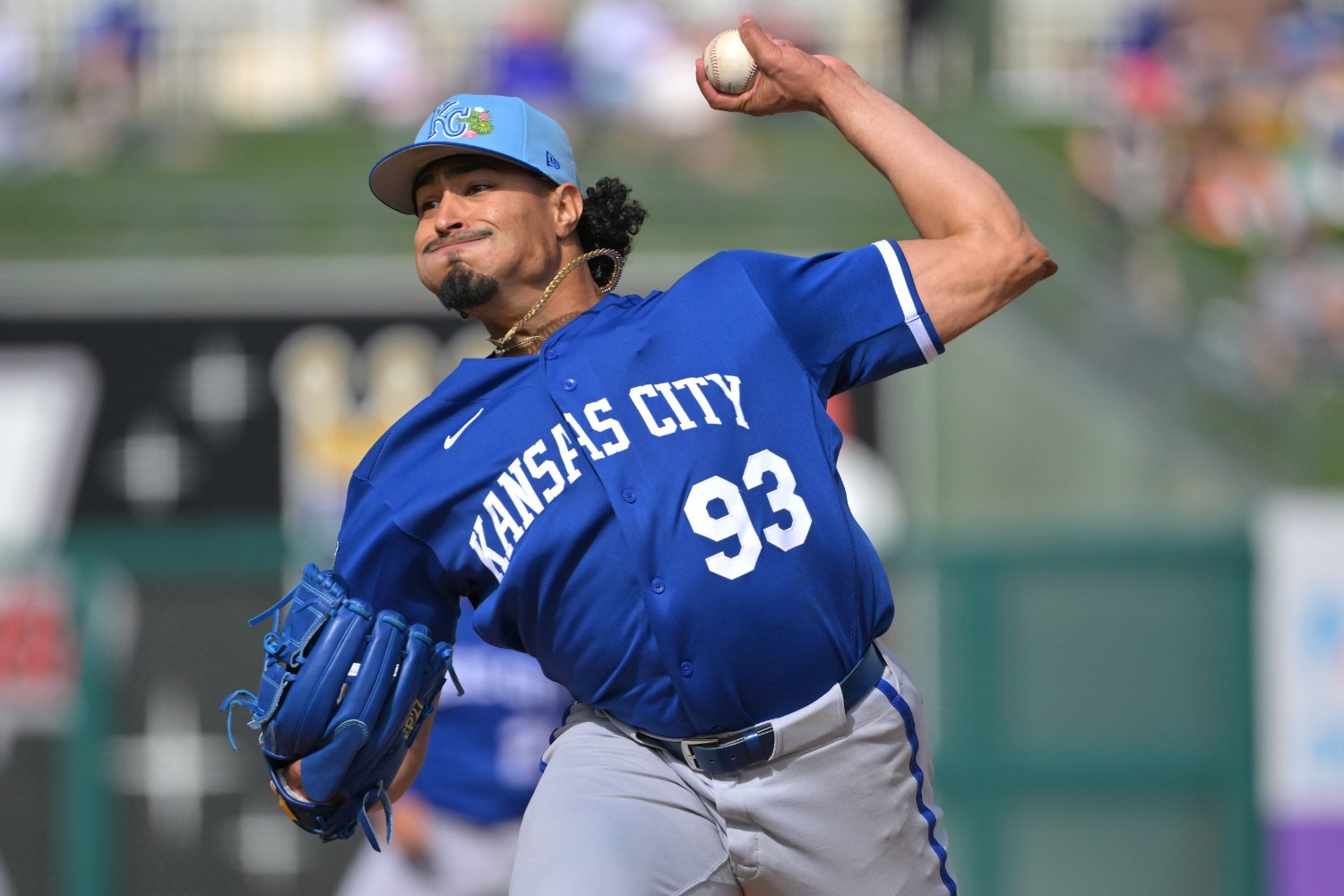 A big key for the Royals last year was the improvement in the bullpen from 2024 to 2025. While the bullpen improved after the Trade Deadline acquisition of Lucas Erceg, it was an inconsistent group in 2024, and the metrics proved it. Royals relievers ranked 20th in bullpen ERA (4.13), 28th in K/9 (8.06), 23rd in K/BB ratio (2.36), and 26th in SIERA (4.02). It's honestly amazing that the Royals won 86 games and made the playoffs with a bullpen that mediocre. In 2025, thanks to the acquisition of Carlos Estevez and the improvement of some other relievers, Kansas City's bullpen showed some growth in terms of results. They ranked 7th in bullpen ERA (3.63), 19th in K-BB ratio (2.46), and 21st in SIERA (3.99). However, the only blemish for this bullpen was the lack of strikeouts, as they actually ranked worse in K/9 with a 7.76 mark (which ranked 29th). Thus, Royals GM JJ Picollo made it a priority to acquire relievers who could get strikeouts and whiffs. Trades for Philadelphia's Matt Strahm and Milwaukee's Nick Mears confirmed that priority. That said, one intriguing Minor League signing this spring has been Helcris Olivarez, who pitched in the San Francisco Giants organization a season ago. In four outings and four IP, Olivarez has a 2.25 ERA, 1.50 WHIP, 3.87 FIP, and 3.00 K/BB ratio. The strikeouts haven't been great, as he has a 16.7% K% so far in Cactus League play. That said, he's limited the walks (5.6% BB%), something that has plagued him in the past in the Minor Leagues. For context, in 37 appearances in Double-A and Triple-A combined last year, he had a 24.6% BB% and 1.7% K-BB%. Safe to say, those kinds of numbers aren't going to cut it in the Majors. However, what has been different with Olivarez so far this spring? What kind of role could Olivarez have in the Royals' bullpen in 2026? What are some recent Royals bullpen success stories that are similar to Olivarez? Let's break down those questions using Fangraphs and TJ Stats data and applications. Olivarez's Four-Seamer and Curve Have Been Key This Spring The 25-year-old Dominican lefty hasn't generated a ton of strikeouts this spring, with only three strikeouts so far. That said, he's producing a decent chase and whiff, while minimizing hard contact, as illustrated by his reasonable xwOBACON. Those metrics can be seen via his TJ Stats summary of his performance this spring below. When it comes to TJ Stuff+, there's a lot to be encouraged about with Olivarez's profile. While his overall TJ Stuff+ is 100 and he has only one pitch with a TJ Stuff+ over 100 (his curve, which has a 106 mark), all four of his offerings have pitching grades over 50. That shows that he has a balanced profile, and he does have one elite pitch in his curveball, which has a pitching grade of 64 and a whiff rate of 66.7%. Olivarez hasn't generated an outstanding chase rate (28.6%), and his whiff rate has been below average (21.4%). That said, his four-seamer chase has been solid (31.6%), and he's been limiting hard contact on his fastball, with his four-seamer posting a .362 xwOBACON and his sinker posting a .107 xwOBACON. I believe a reason for the lower chase and whiff rates is due to his erratic control, as he has a 44.4% zone rate so far this spring. Below is Olivarez's pitch chart from yesterday's Cactus League game. Notice that it was feast or famine for him when it came to locating his pitches against the Rockies on Saturday. Once Olivarez is able to find the strike zone more this spring, the more effective his chase and whiff rates will be. His most thrown pitch this spring has been his four-seamer, and it's typically been a good pitch for him in terms of TJ Stuff+ and whiff profiles. Here's a look at his TJ Stats summary from last year in Triple-A Sacramento, and take a look at the data on the four-seamer from a season ago. The four-seamer not only averaged 97.3 MPH, but it also had a 99 TJ Stuff+, 52 grade, 36.5% whiff rate, and .248 xwOBACON. So, what can we say about that data on the fastball from last season? Yes, it is. Conversely, it had a 39.8% zone rate and 18.4% chase rate. Considering he threw the pitch 47.8% of the time, that erratic control of the four-seamer probably led to his 24.4% BB% in Sacramento. What's interesting about Olivarez's four-seamer is that it doesn't sport the characteristics of a normal four-seam fastball. It only had a 13.1 iVB and an 11.7 HB. Thus, it's more of a horizontal moving pitch with more armside movement than typical for a four-seamer. One can see that in the pitch below from his time in Double-A Portland (when he was in the Red Sox organization), which hovers on the line being a sinker (though I don't have the exact metrics of the pitch). Despite that unique profile, Olivarez located it up, which one would do with the typical four-seamer. Based on the TJ Stats heatmap data, the approach worked for Olivarez in Sacramento last season. He produced a 33.3% CSW, 21.7% whiff rate, and .230 xwOBACON against lefties and a 29.8% CSW, 41.1% whiff rate, and .258 xwOBACON against righties. Thus, his four-seamer was a better strike-generating pitch against lefties but a better swing-and-miss pitch against righties last year in Triple-A. Let's see how that heatmap data looks so far this spring. The location hasn't been quite as sharp for Olivarez, based on his heatmap. His four-seamer has been located more in the middle of the plate than it was a season ago, when it was located up and armside against both lefties and righties. Against lefties, whom he has a 55.6% four-seamer usage against, it's produced similar trends with a 26.7% CSW and 0.0% whiff, but .269 xwOBACON. Against righties, it's been even better when it comes to generating strikes (36.8% CSW) and whiffs (42.9%), but it's been hit a lot harder, as illustrated by a .487 xwOBACON. The four-seamer will be key for Olivarez this spring because it can effectively set up his curve, which may be his best put-away pitch. Here's a look at the TJ Stats heatmap data this spring on his primary breaking offering, especially against lefties. He's only thrown it 22.2% of the time against lefties (and 5.6% against righties). However, against lefties, it's been a stellar offering with a 33.3% CSW, 40% O-Swing (chase), and 66.7% whiff. He hasn't located it all that well either, with the curve being located more up and in than typical. Here's a look at his curveball heatmap data from 2025 with the Triple-A Rivercats. Olivarez located the curve primarily away and glove-side against lefties and righties last year. It was far more effective against righties with a 28% CSW, 57.1% whiff, and .120 xwOBACON. Command of the pitch is probably the reason for that difference, as his curve against righties was located more in the lower zone 7 portion of the strike zone, while against lefties, it was more up in zone 6. The curve breaking hard and in on hitters foot is always going to lead to more whiffs. It would be nice to see Olivarez get to commanding that curveball back in that area of the strikezone this spring in Cactus League play, but he would likely need his four-seam command to improve first so he can get in more ideal counts to utilize his effective curveball. What Kind of Role Can Olivarez Play in the Bullpen? The Royals lack lefty depth on the 40-man roster. The only lefties who could pitch out of the bullpen are Strahm, Daniel Lynch IV, and Bailey Falter. That said, Falter is more of a starter and only moved to the bullpen after struggling initially with the Royals last season. Lynch has looked solid this spring, with his stuff playing more up than it did a season ago, as illustrated by his TJ Stats summary in Cactus League play. Thus, Strahm and Lynch could probably hold things down in the bullpen from a lefty perspective. However, as for Falter? I'm not quite as sure, though the TJ Stuff+, his pitch extension, and xwOBACON have been fine so far in Spring Training, as illustrated below. It would be nice for the Royals to get one more lefty in the bullpen, especially with Angel Zerpa going to Milwaukee this offseason (in the Mears and Isaac Collins trade). Strahm is a workhorse, but he is another year older. Lynch IV has produced good numbers so far, but his 4.76 FIP was much higher than his 3.06 ERA last year. Thus, the former 34th overall pick of the 2018 MLB Draft could be due for regression in 2026. Olivarez is far from dependable, considering his track record. That said, he's a lefty with velocity and swing-and-miss stuff who could give the Royals the punch from the left side they desperately need in 2026, as long as he is able to harness the control a bit better. What Are Some Similar Situations to Olivarez? I don't think Olivarez will make the Opening Day roster. However, he still has a Minor League option, and he's still under-the-radar, so I don't think there will be a tremendous market for him to opt out (he likely wouldn't make another club's Opening Day roster either). However, while he will start the year in Triple-A Omaha, he has a chance to be a Royals reliever who started the year in the Minors but later became a key contributor to the Royals bullpen. Two examples of that archetype are Sam Long in 2024 and Taylor Clarke last year. Neither made the Royals' Opening Day roster that season. However, they ended up being key relievers for Kansas City when they got called up. Here's a look at what Long did in 2024. In 42.2 IP, Long posted a 3.16 ERA and 1.20 WHIP with a 15.3% K-BB%. He ended up being the Royals' most dependable left-handed reliever that season, with some key innings in the postseason. Like Olivarez, Long has control issues, as evidenced by his 45.7% zone rate. However, he generated strong chase (30.2%) and whiff rates (27.5%), and his four-seamer was his most effective pitch with a 55 grade. Long fell apart a bit in 2025, but the Royals would take a similar campaign from Olivarez in 2026. Now, let's take a look at Clarke, who returned to the Royals after being traded away after the 2023 season. Clarke didn't have a great four-seamer (97 TJ Stuff+ and 50 grade), but his slider was elite with a 108 TJ Stuff+ and 59 grade. The breaking offering that he threw 39.7% of the time also had a 50.9% zone rate, a 33.1% chase-and-whiff rate, and a .312 xwOBACON. As a result, in 55.1 IP, he posted a 3.25 ERA, 0.85 WHIP, 3.97 FIP, and 17% K-BB%. It may be unfair to compare Olivarez to either Long or Clarke, mainly because Olivarez's control issues are way worse than those of the two former Kansas City relievers. However, both are examples of pitchers who weren't taken seriously by fans in the offseason, had good Spring Training campaigns, started in the Minors, and parlayed that success into strong Major League campaigns. Success may look a little different for Olivarez in 2026. However, if the stuff continues and if he can continue to hone his command and control with each and every outing, both in Spring Training and in the Minor Leagues to begin the year, then it wouldn't be surprising to see Olivarez turn into some kind of dark-horse impact reliever for the Royals by mid-season. Hopefully, if that happens, he can have a longer, more successful tenure in Kansas City than Long or Clarke.
 -
Been doing these on Twitter and Bluesky. Figure I will also share these here for those who don't follow on either (though I will primarily share my Bluesky posts on the forums). Subscribe to TJ Stats if you haven't already. Great stuff, and the website has gone through a great revamp.
-
On Sunday, after the Royals' 3-1 win over the Milwaukee Brewers, manager Matt Quatraro announced that Luinder Avila will be joining Team Venezuela for the upcoming World Baseball Classic. Avila will be joining Team Venezuela along with Royals teammates Salvador Perez and Maikel Garcia, who were announced to the roster earlier in the offseason. In addition to those three, Bobby Witt Jr. and Michael Wacha will be joining Team USA; Vinnie Pasquantino and Jac Caglianone will be joining Team Italy; Seth Lugo will be starting for Team Puerto Rico; and Carlos Estevez will be pitching for Team Dominican Republic. Michael Coyle had a breakdown of all participants in the World Baseball Classic on February 5th here at Royals Keep. Avila ranks 13th on our Top 20 preseason Royals prospects list. He had a strong MLB debut, posting a 1.29 ERA and 0.93 WHIP in 13 appearances with the Royals. He also posted a 28.6% K% and had a 2.09 xERA in his first stint against MLB competition. In Royals camp, he's been in competition for not just a roster spot, but perhaps a spot in the Royals' rotation. Quatraro mentioned in a press conference in Spring Training that Avila had "frontline starter" potential. Prior to his call-up, the 24-year-old primarily pitched as a starter in the Minor Leagues, posting a 5.23 ERA and 1.33 WHIP in 53.1 IP with the Storm Chasers last season. However, he still posted a 28% K%, a 17.7% K-BB%, and a 4.38 FIP, indicating he was better in Omaha than his ERA suggested. This spring, Avila has been off to a strong start in Cactus League play. In 4.0 IP, he has a 2.25 ERA and 1.75 WHIP. His K% and K-BB% are a little low at 21.1% and 10.5%, respectively. That said, his TJ Stuff+, chase, and whiff metrics have still been strong, as seen below via his TJ Stats summary. Avila has a 100 overall TJ Stuff+ but has four pitches with marks of 100 or higher and grades of 54 or higher. His curveball has been his best pitch this spring on a TJ Stuff+ end, with a 59 grade, but it has only generated a 20% whiff and chase rate. On the flip side, his sinker is his worst pitch in terms of TJ Stuff+ (93 and 45 grade), but it's been his best offering in terms of generating chases (66.7%) and whiffs (53.8%). His slider and changeup have shown promise, but he's only thrown them one time each this spring. The Venezuelan righty will likely pitch out of the bullpen for Team Venezuela in the WBC. Carlos Hernandez was the last Royals pitcher to pitch for Team Venezuela in 2023 and had a solid showing. In 2.2 IP, he struck out five batters and allowed no runs, no walks, and only three hits. Hernandez's solid performance in the WBC helped him get off to a strong start in 2023, as he posted a 3.83 ERA, a 2.65 FIP, a 28.8% K%, and 22% K-BB% in 44.2 IP in the first half. His strong first half prompted the Royals to trade away established closer Scott Barlow to San Diego at the Trade Deadline. Unfortunately, Hernandez regressed sharply in the second half, posting a 7.82 ERA, 1.93 WHIP, 7.16 FIP, 21.1% K%, and 5.7% K-BB% in 25.1 IP. Let's hope that Avila not only gets valuable experience competing in the WBC but also has a solid performance that can be parlayed into another step forward in pitching development in 2026. Avila has a lot more upside than Hernandez, and he will be needed, especially with Stephen Kolek straining his oblique and likely starting the season on the 15-Day IL. The World Baseball Classic kicks off with pool play on Thursday, March 5th, and will conclude on March 17th. Venezuela is in Pool D with the Dominican Republic, Israel, Nicaragua, and the Netherlands. More information about the World Baseball Classic can be found on its website. View full rumor
-
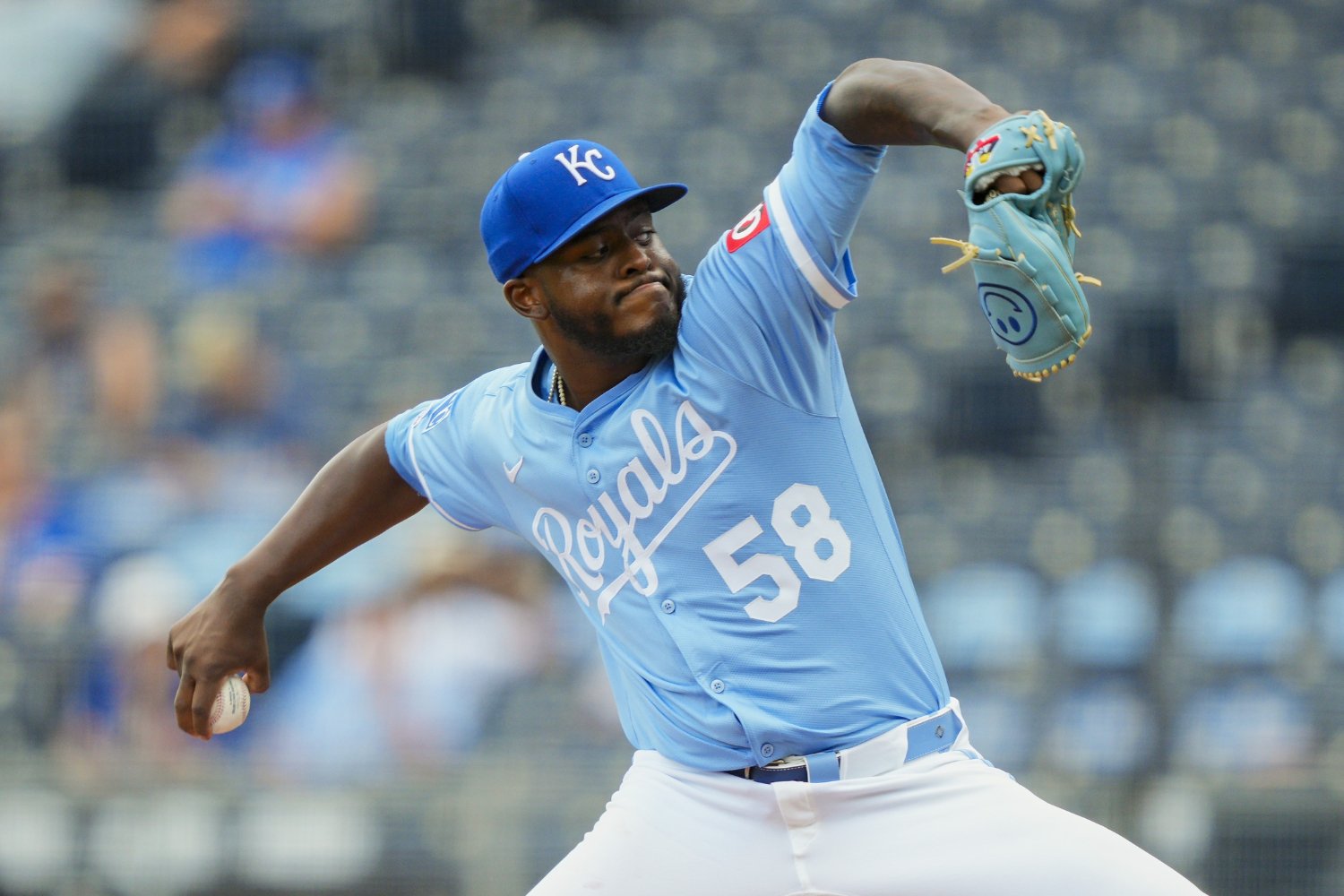 On Sunday, after the Royals' 3-1 win over the Milwaukee Brewers, manager Matt Quatraro announced that Luinder Avila will be joining Team Venezuela for the upcoming World Baseball Classic. Avila will be joining Team Venezuela along with Royals teammates Salvador Perez and Maikel Garcia, who were announced to the roster earlier in the offseason. In addition to those three, Bobby Witt Jr. and Michael Wacha will be joining Team USA; Vinnie Pasquantino and Jac Caglianone will be joining Team Italy; Seth Lugo will be starting for Team Puerto Rico; and Carlos Estevez will be pitching for Team Dominican Republic. Michael Coyle had a breakdown of all participants in the World Baseball Classic on February 5th here at Royals Keep. Avila ranks 13th on our Top 20 preseason Royals prospects list. He had a strong MLB debut, posting a 1.29 ERA and 0.93 WHIP in 13 appearances with the Royals. He also posted a 28.6% K% and had a 2.09 xERA in his first stint against MLB competition. In Royals camp, he's been in competition for not just a roster spot, but perhaps a spot in the Royals' rotation. Quatraro mentioned in a press conference in Spring Training that Avila had "frontline starter" potential. Prior to his call-up, the 24-year-old primarily pitched as a starter in the Minor Leagues, posting a 5.23 ERA and 1.33 WHIP in 53.1 IP with the Storm Chasers last season. However, he still posted a 28% K%, a 17.7% K-BB%, and a 4.38 FIP, indicating he was better in Omaha than his ERA suggested. This spring, Avila has been off to a strong start in Cactus League play. In 4.0 IP, he has a 2.25 ERA and 1.75 WHIP. His K% and K-BB% are a little low at 21.1% and 10.5%, respectively. That said, his TJ Stuff+, chase, and whiff metrics have still been strong, as seen below via his TJ Stats summary. Avila has a 100 overall TJ Stuff+ but has four pitches with marks of 100 or higher and grades of 54 or higher. His curveball has been his best pitch this spring on a TJ Stuff+ end, with a 59 grade, but it has only generated a 20% whiff and chase rate. On the flip side, his sinker is his worst pitch in terms of TJ Stuff+ (93 and 45 grade), but it's been his best offering in terms of generating chases (66.7%) and whiffs (53.8%). His slider and changeup have shown promise, but he's only thrown them one time each this spring. The Venezuelan righty will likely pitch out of the bullpen for Team Venezuela in the WBC. Carlos Hernandez was the last Royals pitcher to pitch for Team Venezuela in 2023 and had a solid showing. In 2.2 IP, he struck out five batters and allowed no runs, no walks, and only three hits. Hernandez's solid performance in the WBC helped him get off to a strong start in 2023, as he posted a 3.83 ERA, a 2.65 FIP, a 28.8% K%, and 22% K-BB% in 44.2 IP in the first half. His strong first half prompted the Royals to trade away established closer Scott Barlow to San Diego at the Trade Deadline. Unfortunately, Hernandez regressed sharply in the second half, posting a 7.82 ERA, 1.93 WHIP, 7.16 FIP, 21.1% K%, and 5.7% K-BB% in 25.1 IP. Let's hope that Avila not only gets valuable experience competing in the WBC but also has a solid performance that can be parlayed into another step forward in pitching development in 2026. Avila has a lot more upside than Hernandez, and he will be needed, especially with Stephen Kolek straining his oblique and likely starting the season on the 15-Day IL. The World Baseball Classic kicks off with pool play on Thursday, March 5th, and will conclude on March 17th. Venezuela is in Pool D with the Dominican Republic, Israel, Nicaragua, and the Netherlands. More information about the World Baseball Classic can be found on its website.
 -
Royals Agree to Deal With Starling Marte
Kevin O'Brien replied to Kevin O'Brien's topic in Kansas City Royals Talk
Agreed. I think it's ironic that many Royals fans are lamenting this move as if there's not a "spot" for Marte. Marte last year would've been a tremendous upgrade over the rotating OF group you mentioned, and he could've been the difference in the Royals making the postseason, honestly. As you said, not every player is going to play 162, and you need depth that can handle their own. Marte fits that mold, and at the very least, the talent level on the Royals' 26-man roster has raised a bit, regardless of the role that Marte will play in 2026. -
Image courtesy of Jordan Godfree-Imagn Images On Saturday afternoon, MLB.com's Mark Feinsand reported that the Kansas City Royals had agreed to a deal with outfielder Starling Marte, pending a physical. Yancen Pujols, via El Extra Base's Daniel Alvarez-Montes, reported early this morning that Marte and the Royals had progressed in talks and were close to signing a deal to bring him to Kansas City. The Royals have shown interest in Marte before. Last year, a possible deal at the Winter Meetings would've brought Marte to Kansas City in exchange for reliever Hunter Harvey. However, the deal couldn't be finalized. Marte was also a free agent this winter, and there were rumblings that he fit what the Royals were looking for in the outfield for 2026. Marte has a career 35.9 fWAR and is a two-time All-Star and Gold Glove award winner. He's been beset by injuries over the past few years, as he hasn't had more than 370 plate appearances in a season since 2022, his first season with the Mets. Last season, in 329 plate appearances, he slashed .270/.335/.410 with a .326 wOBA, 112 wRC+, and 0.7 fWAR. He also had nine home runs, 37 runs scored, 34 RBI, and seven stolen bases. In terms of his Statcast percentiles, he showed a decent 90th percentile exit velocity and ranked in the 52nd percentile in strikeout rate. However, he is definitely a player in the later stages of his career, as illustrated in his TJ Stats summary from 2025 below. Despite this declining skill set, it's likely that Marte will be a platoon bat who will rotate among all three outfield positions with Isaac Collins, Kyle Isbel, and Jac Caglianone. MLB.com Royals beat writer Anne Rogers reported that Marte, who is coming to Kansas City on a one-year deal, will be utilized mostly as a depth piece off the bench, but he could earn more playing time if he produces like he did last year or in 2024 (103 wRC+). It sounds like Marte will be receiving a Major League deal, which means that the Royals will likely DFA someone on the 40-man roster to make room. Outfielders Dairon Blanco and Drew Waters seem like prime candidates, especially Waters, who is out of Minor League options and posted a 66 wRC+ in 219 plate appearances last season. View full article
-
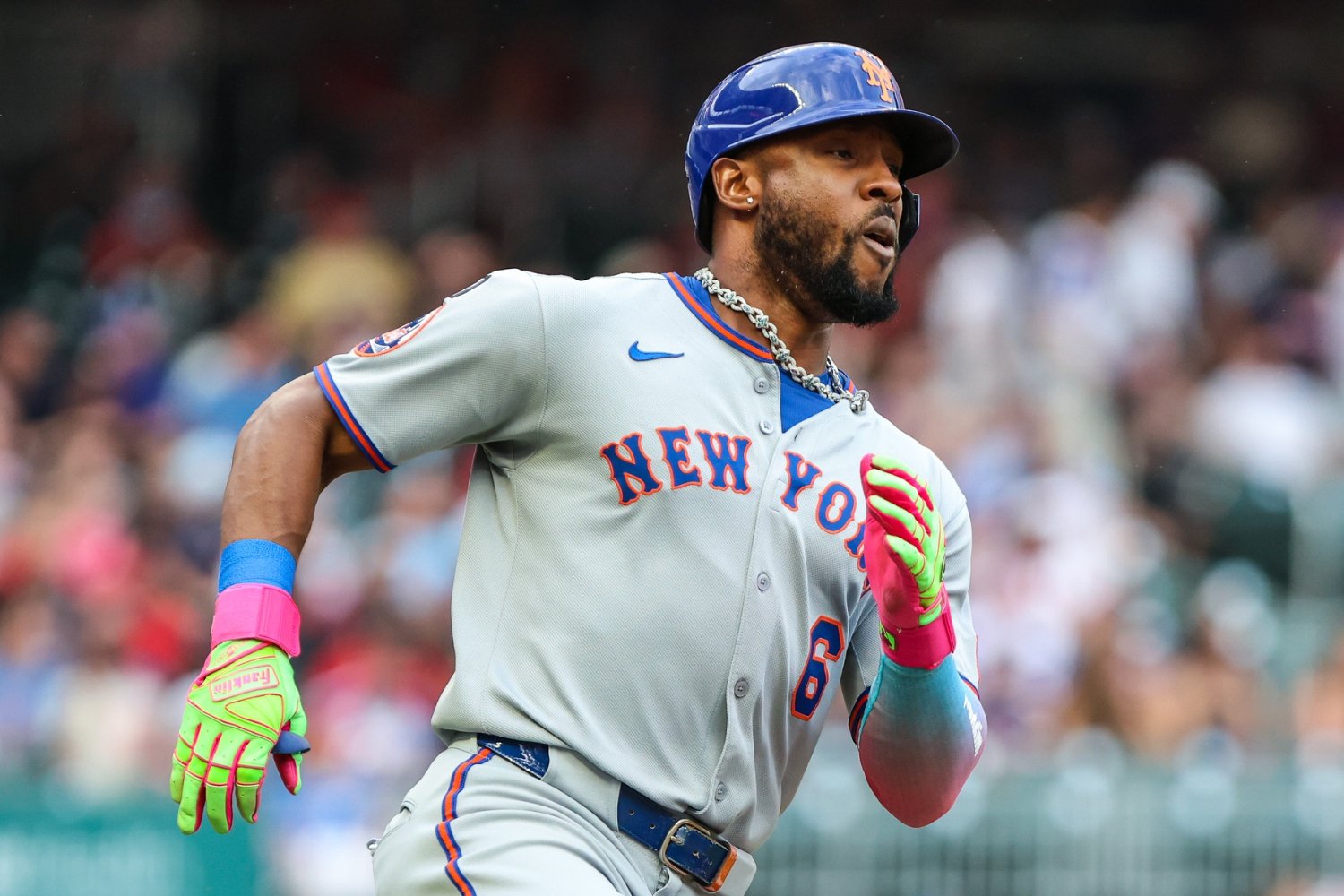 On Saturday afternoon, MLB.com's Mark Feinsand reported that the Kansas City Royals had agreed to a deal with outfielder Starling Marte, pending a physical. Yancen Pujols, via El Extra Base's Daniel Alvarez-Montes, reported early this morning that Marte and the Royals had progressed in talks and were close to signing a deal to bring him to Kansas City. The Royals have shown interest in Marte before. Last year, a possible deal at the Winter Meetings would've brought Marte to Kansas City in exchange for reliever Hunter Harvey. However, the deal couldn't be finalized. Marte was also a free agent this winter, and there were rumblings that he fit what the Royals were looking for in the outfield for 2026. Marte has a career 35.9 fWAR and is a two-time All-Star and Gold Glove award winner. He's been beset by injuries over the past few years, as he hasn't had more than 370 plate appearances in a season since 2022, his first season with the Mets. Last season, in 329 plate appearances, he slashed .270/.335/.410 with a .326 wOBA, 112 wRC+, and 0.7 fWAR. He also had nine home runs, 37 runs scored, 34 RBI, and seven stolen bases. In terms of his Statcast percentiles, he showed a decent 90th percentile exit velocity and ranked in the 52nd percentile in strikeout rate. However, he is definitely a player in the later stages of his career, as illustrated in his TJ Stats summary from 2025 below. Despite this declining skill set, it's likely that Marte will be a platoon bat who will rotate among all three outfield positions with Isaac Collins, Kyle Isbel, and Jac Caglianone. MLB.com Royals beat writer Anne Rogers reported that Marte, who is coming to Kansas City on a one-year deal, will be utilized mostly as a depth piece off the bench, but he could earn more playing time if he produces like he did last year or in 2024 (103 wRC+). It sounds like Marte will be receiving a Major League deal, which means that the Royals will likely DFA someone on the 40-man roster to make room. Outfielders Dairon Blanco and Drew Waters seem like prime candidates, especially Waters, who is out of Minor League options and posted a 66 wRC+ in 219 plate appearances last season.
 -
Image courtesy of Kamil Krzaczynski-Imagn Images The Royals are 3-4 right now after roughly one week of Cactus League play. They earned their third win of the year in a wild one on Friday afternoon against the Sacramento Athletics, winning 7-6 after trailing in the seventh inning. The Royals have seen some familiar hitters get off to strong starts in Spring Training. Bobby Witt Jr. leads the Royals in hits with six and hit his first home run of the spring today against the Athletics, a three-run blast. Jac Caglianone is also off to a strong start this spring after a rough rookie campaign. He's hitting .417 with a 1.212 OPS and has launched some tanks in Arizona. That included a double on Thursday against the Diamondbacks that had an exit velocity of 120.2 MPH. Lastly, Maikel Garcia and Michael Massey have gotten off to strong starts with five hits apiece. Garcia has an .814 OPS, and Massey has a 1.445 OPS. Garcia is trying to prove that his breakout in 2025 wasn't a fluke, while Massey is looking to show Royals fans that he can be a long-term solution in Kansas City as a utility player who can rotate between second base and left field. While the familiar position players are off to strong starts, there are some unfamiliar ones, specifically non-roster invitees, who are also doing well at the plate in Cactus League play. Thus, let's take a look at three NRI Royals hitters who are not just putting up strong performances but are also making their case for roster spots on Opening Day (which is one month away). Josh Rojas, 2B/3B Rojas played for the White Sox last year and had a brutal season, which explains why he was not given a Major League deal this offseason, even though he has a career 5.5 fWAR in 639 career Major League games. In 211 plate appearances with the White Sox, Rojas hit .180 with a .232 wOBA, a 44 wRC+, and -1.3 fWAR, according to Fangraphs. His fWAR was the worst mark of his career and his worst mark since 2020 with the Diamondbacks, when he posted a -0.3 fWAR in 17 games. His chances of making the roster initially seemed long, especially with utility bench options such as Nick Loftin and Tyler Tolbert also competing for roster spots this spring. However, Rojas has gotten off to a hot start at the plate, showing he may deserve a shot on the Opening Day roster. In 10 at-bats, the 31-year-old utility infielder has four hits, two home runs, and six RBI. His latest home run came on February 24th against the Cincinnati Reds. The former 26th-round draft pick has long been known for his glove over his bat. His defense at second has traditionally been better than his defense at third. He has a +10 career OAA at the keystone, but a -8 career OAA at the hot corner. That said, the Royals seem set at third base with Garcia. They are less solidified with Massey and Jonathan India, who both struggled in 2025. Furthermore, given Massey's injury history, Rojas could be a player who seamlessly fills in for him, though he doesn't exactly have Massey's defensive versatility. The University of Hawaii product has only 729 innings in the outfield. On a positive note, he has a +1 OAA there, so if the bat continues, the Royals may be prompted to give Rojas more time in the outfield to give him more versatility off the bench. Kevin Newman, 2B/SS The Royals acquired Newman early in the offseason, and he seemed like an intriguing pickup who could give Kansas City not only positional flexibility but a veteran presence. In fact, his acquisition could be a reason why the Royals opted not to bring back Adam Frazier for the 2026 season. In 10 at-bats this spring, the 32-year-old infielder has three hits and is hitting .300 with an .864 OPS. He has one walk and two strikeouts, and he has hit two doubles, showing that he has the batted-ball profile to take advantage of Kauffman Stadium's spacious grounds. Against Arizona pitcher Kade Strowd, Newman laced a double down the line and showed excellent speed to get to second base standing up. Newman had an underwhelming 2025 season with the Angels, posting a .202 average, 27 wRC+, and -0.7 fWAR in 116 plate appearances. However, he played with the Diamondbacks in 2024 and fared much better over a larger sample. In 111 games and 311 plate appearances that season, he hit .278 with an 89 wRC+ and 1.4 fWAR. He also hit three home runs, scored 41 runs, stole eight bases, and provided solid defense, as evidenced by his +7 OAA at shortstop and second base combined. Loftin has gotten off to a slow start this spring. He is currently hitting .167 with a .481 OPS in 12 at-bats. While he did have a two-run double today, if the former Baylor product continues to perform poorly at the plate, the Royals may opt for Newman over Loftin for the right-handed utility role off the bench to start the 2026 season. Connor Kaiser, 2B When the Royals signed him to a Minor League deal, Kaiser struck me as more of an everyday player for the Omaha Storm Chasers than a serious candidate to make the Major League Opening Day roster. That said, the former Blue Valley West High School product is showing that he may be a call-up at some point in 2026, even if he begins the year in Omaha. In eight at-bats, the 29-year-old second baseman has three hits, including two doubles. He is hitting .375 with a 1.000 OPS, and he has one RBI to boot. It's a small sample, and Kaiser has mostly done this while coming off the bench (meaning he isn't facing top-flight pitching). Nonetheless, he's producing in the limited at-bats that he's getting. Kaiser will likely receive a lot more soon when Witt and Garcia leave camp to report for the World Baseball Classic. The Vanderbility product doesn't have an extensive track record in Major League. He has 23 career MLB plate appearances and has a career .091 average, -29 wrC+, and -0.2 fWAR. He also strikes out a bit too much, as he has a 30.4% career K rate in the Majors and had a 27.5% K rate with Reno, Arizona's Triple-A club, last season. Still, when he gets a hold of the ball, Kaiser can find the gaps, much like Newman, as illustrated in this hit below with the Diamondbacks last season (his first career MLB hit). With some modifications from the Royals' hitting development team, it's possible that Kaiser could morph into a Cam Devanney of sorts, who broke out last season in Triple-A Omaha. While Devanney didn't contribute at all to the Major League roster, he was utilized as capital in a trade to Pittsburgh for Frazier at the All-Star Break. Maybe Frazier can be acquired again by the Royals midseason, with Kaiser as the trade asset this time around. View full article
-
Three Non-Roster Invitee Hitters Making Their Case in Royals Camp
Kevin O'Brien posted an article in Royals
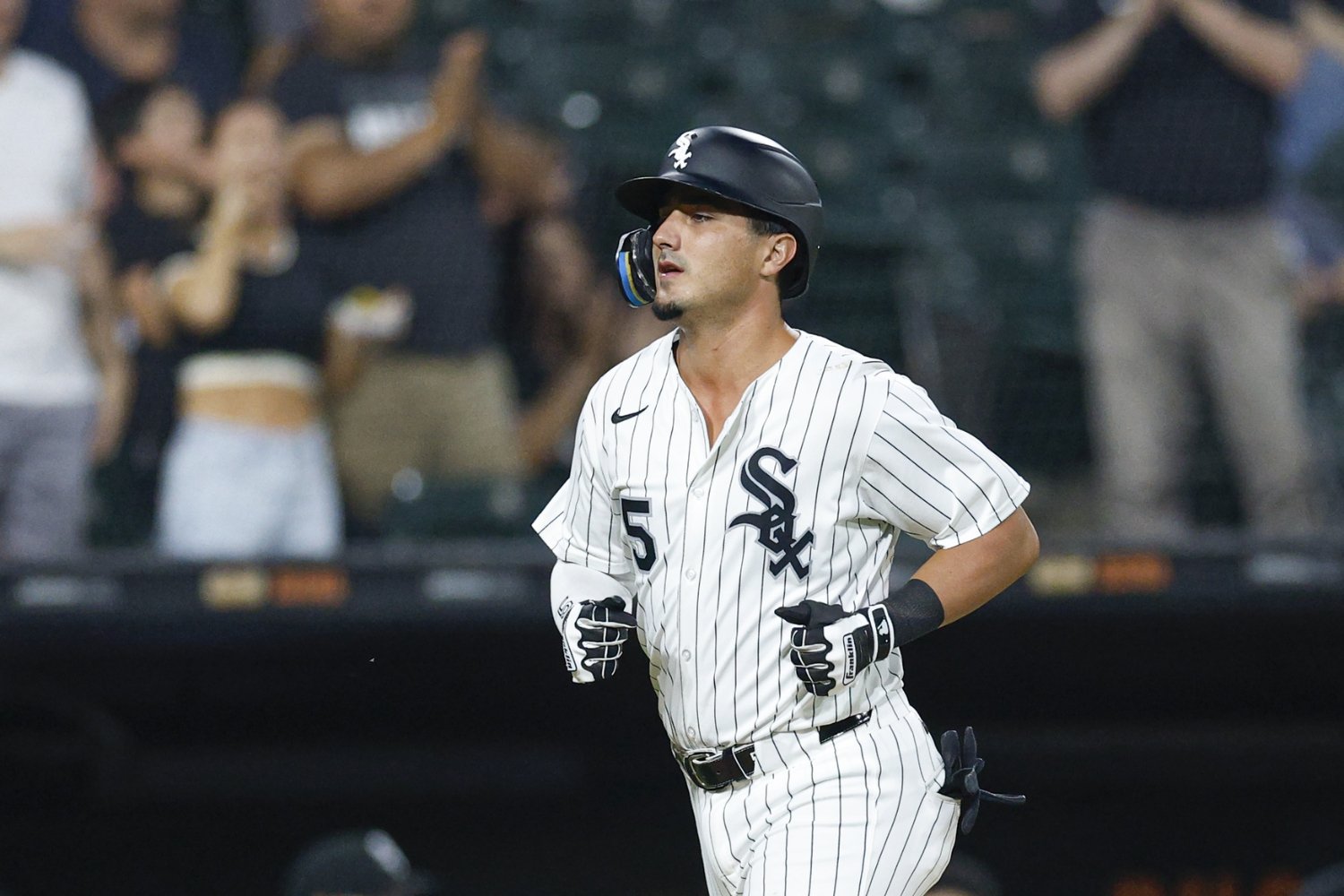 The Royals are 3-4 right now after roughly one week of Cactus League play. They earned their third win of the year in a wild one on Friday afternoon against the Sacramento Athletics, winning 7-6 after trailing in the seventh inning. The Royals have seen some familiar hitters get off to strong starts in Spring Training. Bobby Witt Jr. leads the Royals in hits with six and hit his first home run of the spring today against the Athletics, a three-run blast. Jac Caglianone is also off to a strong start this spring after a rough rookie campaign. He's hitting .417 with a 1.212 OPS and has launched some tanks in Arizona. That included a double on Thursday against the Diamondbacks that had an exit velocity of 120.2 MPH. Lastly, Maikel Garcia and Michael Massey have gotten off to strong starts with five hits apiece. Garcia has an .814 OPS, and Massey has a 1.445 OPS. Garcia is trying to prove that his breakout in 2025 wasn't a fluke, while Massey is looking to show Royals fans that he can be a long-term solution in Kansas City as a utility player who can rotate between second base and left field. While the familiar position players are off to strong starts, there are some unfamiliar ones, specifically non-roster invitees, who are also doing well at the plate in Cactus League play. Thus, let's take a look at three NRI Royals hitters who are not just putting up strong performances but are also making their case for roster spots on Opening Day (which is one month away). Josh Rojas, 2B/3B Rojas played for the White Sox last year and had a brutal season, which explains why he was not given a Major League deal this offseason, even though he has a career 5.5 fWAR in 639 career Major League games. In 211 plate appearances with the White Sox, Rojas hit .180 with a .232 wOBA, a 44 wRC+, and -1.3 fWAR, according to Fangraphs. His fWAR was the worst mark of his career and his worst mark since 2020 with the Diamondbacks, when he posted a -0.3 fWAR in 17 games. His chances of making the roster initially seemed long, especially with utility bench options such as Nick Loftin and Tyler Tolbert also competing for roster spots this spring. However, Rojas has gotten off to a hot start at the plate, showing he may deserve a shot on the Opening Day roster. In 10 at-bats, the 31-year-old utility infielder has four hits, two home runs, and six RBI. His latest home run came on February 24th against the Cincinnati Reds. The former 26th-round draft pick has long been known for his glove over his bat. His defense at second has traditionally been better than his defense at third. He has a +10 career OAA at the keystone, but a -8 career OAA at the hot corner. That said, the Royals seem set at third base with Garcia. They are less solidified with Massey and Jonathan India, who both struggled in 2025. Furthermore, given Massey's injury history, Rojas could be a player who seamlessly fills in for him, though he doesn't exactly have Massey's defensive versatility. The University of Hawaii product has only 729 innings in the outfield. On a positive note, he has a +1 OAA there, so if the bat continues, the Royals may be prompted to give Rojas more time in the outfield to give him more versatility off the bench. Kevin Newman, 2B/SS The Royals acquired Newman early in the offseason, and he seemed like an intriguing pickup who could give Kansas City not only positional flexibility but a veteran presence. In fact, his acquisition could be a reason why the Royals opted not to bring back Adam Frazier for the 2026 season. In 10 at-bats this spring, the 32-year-old infielder has three hits and is hitting .300 with an .864 OPS. He has one walk and two strikeouts, and he has hit two doubles, showing that he has the batted-ball profile to take advantage of Kauffman Stadium's spacious grounds. Against Arizona pitcher Kade Strowd, Newman laced a double down the line and showed excellent speed to get to second base standing up. Newman had an underwhelming 2025 season with the Angels, posting a .202 average, 27 wRC+, and -0.7 fWAR in 116 plate appearances. However, he played with the Diamondbacks in 2024 and fared much better over a larger sample. In 111 games and 311 plate appearances that season, he hit .278 with an 89 wRC+ and 1.4 fWAR. He also hit three home runs, scored 41 runs, stole eight bases, and provided solid defense, as evidenced by his +7 OAA at shortstop and second base combined. Loftin has gotten off to a slow start this spring. He is currently hitting .167 with a .481 OPS in 12 at-bats. While he did have a two-run double today, if the former Baylor product continues to perform poorly at the plate, the Royals may opt for Newman over Loftin for the right-handed utility role off the bench to start the 2026 season. Connor Kaiser, 2B When the Royals signed him to a Minor League deal, Kaiser struck me as more of an everyday player for the Omaha Storm Chasers than a serious candidate to make the Major League Opening Day roster. That said, the former Blue Valley West High School product is showing that he may be a call-up at some point in 2026, even if he begins the year in Omaha. In eight at-bats, the 29-year-old second baseman has three hits, including two doubles. He is hitting .375 with a 1.000 OPS, and he has one RBI to boot. It's a small sample, and Kaiser has mostly done this while coming off the bench (meaning he isn't facing top-flight pitching). Nonetheless, he's producing in the limited at-bats that he's getting. Kaiser will likely receive a lot more soon when Witt and Garcia leave camp to report for the World Baseball Classic. The Vanderbility product doesn't have an extensive track record in Major League. He has 23 career MLB plate appearances and has a career .091 average, -29 wrC+, and -0.2 fWAR. He also strikes out a bit too much, as he has a 30.4% career K rate in the Majors and had a 27.5% K rate with Reno, Arizona's Triple-A club, last season. Still, when he gets a hold of the ball, Kaiser can find the gaps, much like Newman, as illustrated in this hit below with the Diamondbacks last season (his first career MLB hit). With some modifications from the Royals' hitting development team, it's possible that Kaiser could morph into a Cam Devanney of sorts, who broke out last season in Triple-A Omaha. While Devanney didn't contribute at all to the Major League roster, he was utilized as capital in a trade to Pittsburgh for Frazier at the All-Star Break. Maybe Frazier can be acquired again by the Royals midseason, with Kaiser as the trade asset this time around.
 -
Image courtesy of Jay Biggerstaff-Imagn Images Kansas City Royals closer Carlos Estevez made his 2026 Cactus League debut on Tuesday, February 24th, against the Reds in Goodyear. Safe to say, it didn't go swimmingly. In one inning of work, Estevez allowed two runs on two hits, back-to-back home runs by Reds sluggers Elly De La Cruz and Eugenio Suarez. He did minimize the damage after those two home runs, retiring Spencer Steer, Will Benson, and Tyler Stephenson in order. However, the 33-year-old Royals reliever allowed four hard-hit balls and an average exit velocity of 99 MPH on batted balls in his lone Spring Training outing thus far. To make matters worse, MLB.com Royals beat writer Anne Rogers pointed out that Estevez saw a massive drop in his velocity from a season ago (though she said he also showed a similar drop last season). Of course, Royals fans are solely focusing on every little thing players do right now in Arizona, both good and bad. Hence, some are panicking, thinking that Estevez may be falling off a cliff in 2026 after making the All-Star team and leading Major League Baseball in saves a season ago. Are fans valid in their feelings that the Royals should be concerned about Estevez's ability to repeat his sensational 2025 campaign? Or is that just an example of Estevez getting warmed up and treating Spring Training in a similar way to how a veteran offensive lineman treats NFL Summer Camp? Here are three takeaways from Estevez's first outing of Spring Training and why Royals fans should keep their heads cool for now. Estevez May Have Been Working On A Particular Pitch (i.e., his changeup) When looking at his TJ Stats pitch plot data, his TJ Stuff+ doesn't look great. All three of his pitches registered TJ Stuff+ marks below 95. That is not an encouraging sign, especially considering his limited repertoire. His four-seamer, which he threw only once, received the highest grade, 42. Conversely, his two most thrown pitches, the changeup (55% usage) and slider (41% usage), registered grades of 30 and 32, respectively. Those aren't good trends, especially considering what Estevez's stuff looked like last season, according to TJ Stats pitch plot data. Estevez only threw the changeup 16% of the time last year, and it was a below-average pitch, according to the data. His main offspeed offering sported a 96 TJ Stuff+ and 49 grade, with limited spin at 1,616 RPM. Still, his TJ Stuff+ was 13 points lower on Tuesday than his overall mark in 2025. That said, it's entirely plausible that Estevez was trying something new with the changeup in this Spring Training outing, and the TJ Stuff+ metrics were a casualty. Here are some key differences in his changeup against the Reds and what it looked like a season ago. Last season, his changeup had an iVB of 9.8. On Tuesday, it had an iVB of 11. Thus, it may be that Estevez was trying to get more vertical movement on the pitch, and the quality was inconsistent as he toyed with this difference. A sign of that experimentation could be found in his changeup trends, as shown in both his pitch movement plot and velocity linear chart. The former, which can be seen in the Spring Training plot above, showed three pitches that are WAY off from the previous group, illustrating "gross mistake" pitches (i.e., super-waste ones). The sheer difference in movement profile from the main group of changeup pitches demonstrates that he tried something different, and it didn't work out (or he couldn't quite get a grip and lost command of it). In the latter, the changeup shows major dips at a few points in the velocity chart, as shown below. Those illustrate to baseball fans that Estevez messed up with his control against Cincinnati while trying something different on his changeup. Estevez had three changeups that hovered around 80 MPH or slightly below. That is a far cry from the rest of his changeup pitches, which were around the upper 80's. The Dominican-born pitcher, who will be pitching for the Dominican Republic in the upcoming WBC, is a veteran who doesn't need to earn his spot in Spring Training. Thus, Estevez trying to tweak his mix mid-game is something a pitcher of his status can afford to do, even if it produces lackluster results. He's not going to lose his closer job after one rough Cactus League game. Estevez May Be a Slow Starter The right-hander may just be a slow starter, whether it's in Spring Training or the start of the season. Therefore, this may be something Royals fans just have to get used to with him, or at least pay attention to, in his appearances in Arizona. Since 2021, Estevez has posted ERA marks in the double digits twice: 2021 with the Rockies (12.38 ERA) and 2023 with the Angels (10.57 ERA). While that looks bad, it's Spring Training, and the sample sizes are so small. One bad outing can sink a player's Cactus League campaign. Vice versa, a good Spring Training outing can correct itself in March/April with more innings and against better competition. This is what happened to Estevez last year in his first year in Kansas City. After posting a 1.80 ERA in five IP in the Cactus League, he struggled out of the gate, recovering from a minor back injury. He had a 2.77 ERA in 13 IP in April, but his WHIP was slightly higher than expected at 1.23, and he had eight walks to only 11 strikeouts. He struggled to get strikeouts, and his lackluster fastball velocity in the first two months (April and May) was likely a reason. Here's what his four-seam velocity looked like by month last season, and notice how in July, he looked like his best self, velocity-wise. Obviously, there's a desire for more with Estevez, especially with him signed in free agency last season and making slightly over $11 million this season in the last year of the two-year deal he signed prior to the 2025 MLB season. However, given his size and age, this may just be a sign that things are taking longer for Estevez to get ready for the upcoming season. A positive difference in this Spring Training, compared to a year ago, is that Estevez is healthy. A healthy Spring Training could help him avoid a slow start in the regular season, especially in April, as was the case in Estevez's first season in Kansas City. Could Normal Regression Be Happening? Estevez has become a fan favorite, especially for his Dragon Ball Z-inspired celebration after each and every save. It's becoming a popular trend for Royals fans to follow (and Royals broadcasters to revel in) after a Kansas City victory. However, while Estevez impressed last season with a 2.45 ERA, his FIP was 3.67, xERA 3.69, and xFIP 4.95. Furthermore, his strikeout rate dropped from 23.6% in 2024 to 20.1% in 2025, and his K-BB% declined from 17.9% to 11.9% over the same period. Hence, it's not a surprise that Estevez had only a 1.1 fWAR last year, which was the same amount he produced in 2024 with the Angels and Phillies, but in 11 fewer innings. The TJ Stats summary from last year also illustrates a closer with good stuff, but struggles to generate chase and whiffs on a regular basis. Estevez had a TJ Stuff+ of 103 overall, with pitch grades of 57 (slider) and 60 (four-seamer). That said, his chase was only 23%, his whiff was only 19%, and his xwOBACON was .386. All of those were below-average marks for Estevez last year, with his whiff rate rating especially low. ATC is projecting 32 saves in 65 IP for Estevez in 2026, according to Fangraphs. That also includes a 4.15 ERA, 1.27 WHIP, a 21.4% K rate, and 13.1% K-BB%. There are some improvements from last season expected for Estevez in those projections, especially in terms of K-BB% (his mark last season was his lowest mark in a single season since 2017, his second year in the Majors). Conversely, every other category in ATC's projection of him is a regression, suggesting that Estevez is unlikely to be the 42-save, sub-3.00 ERA reliever he was a year ago. The struggles this Spring Training may show that some regression is due to Estevez in this upcoming year. Nonetheless, that doesn't mean that Royals fans should automatically give up, especially after one bad outing. Even with a slightly down season, Estevez could still be a 3 to 3.50 ERA pitcher and collect 30+ saves in 2026. That's how good the stuff is (even if the chase and swing-and-miss aren't as good). This bad performance from Estevez isn't something for the Royals to freak out about just yet. Instead, it should be eye-opening and a sign that he may regress and look more mortal (i.e., less lucky) in 2026. However, he isn't going to fall off a cliff statistically for the Royals. Rather, he will just need to receive more help from other pitchers in the bullpen. With newcomers Matt Strahm, Alex Lange, and Nick Mears, as well as returners Lucas Erceg, John Schreiber, and Daniel Lynch IV, the Royals have the help Estevez may need more often than a year ago. View full article
-
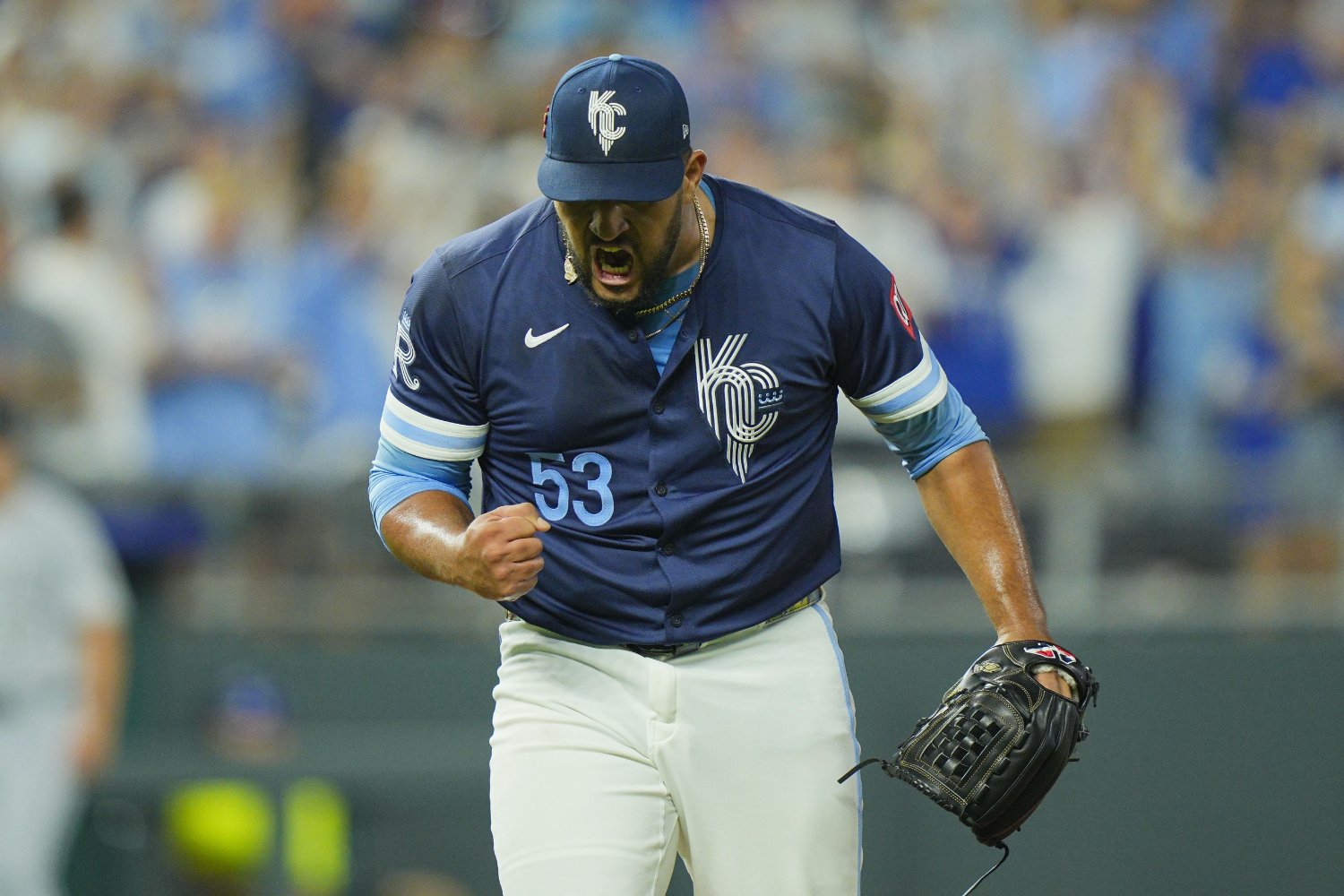 Kansas City Royals closer Carlos Estevez made his 2026 Cactus League debut on Tuesday, February 24th, against the Reds in Goodyear. Safe to say, it didn't go swimmingly. In one inning of work, Estevez allowed two runs on two hits, back-to-back home runs by Reds sluggers Elly De La Cruz and Eugenio Suarez. He did minimize the damage after those two home runs, retiring Spencer Steer, Will Benson, and Tyler Stephenson in order. However, the 33-year-old Royals reliever allowed four hard-hit balls and an average exit velocity of 99 MPH on batted balls in his lone Spring Training outing thus far. To make matters worse, MLB.com Royals beat writer Anne Rogers pointed out that Estevez saw a massive drop in his velocity from a season ago (though she said he also showed a similar drop last season). Of course, Royals fans are solely focusing on every little thing players do right now in Arizona, both good and bad. Hence, some are panicking, thinking that Estevez may be falling off a cliff in 2026 after making the All-Star team and leading Major League Baseball in saves a season ago. Are fans valid in their feelings that the Royals should be concerned about Estevez's ability to repeat his sensational 2025 campaign? Or is that just an example of Estevez getting warmed up and treating Spring Training in a similar way to how a veteran offensive lineman treats NFL Summer Camp? Here are three takeaways from Estevez's first outing of Spring Training and why Royals fans should keep their heads cool for now. Estevez May Have Been Working On A Particular Pitch (i.e., his changeup) When looking at his TJ Stats pitch plot data, his TJ Stuff+ doesn't look great. All three of his pitches registered TJ Stuff+ marks below 95. That is not an encouraging sign, especially considering his limited repertoire. His four-seamer, which he threw only once, received the highest grade, 42. Conversely, his two most thrown pitches, the changeup (55% usage) and slider (41% usage), registered grades of 30 and 32, respectively. Those aren't good trends, especially considering what Estevez's stuff looked like last season, according to TJ Stats pitch plot data. Estevez only threw the changeup 16% of the time last year, and it was a below-average pitch, according to the data. His main offspeed offering sported a 96 TJ Stuff+ and 49 grade, with limited spin at 1,616 RPM. Still, his TJ Stuff+ was 13 points lower on Tuesday than his overall mark in 2025. That said, it's entirely plausible that Estevez was trying something new with the changeup in this Spring Training outing, and the TJ Stuff+ metrics were a casualty. Here are some key differences in his changeup against the Reds and what it looked like a season ago. Last season, his changeup had an iVB of 9.8. On Tuesday, it had an iVB of 11. Thus, it may be that Estevez was trying to get more vertical movement on the pitch, and the quality was inconsistent as he toyed with this difference. A sign of that experimentation could be found in his changeup trends, as shown in both his pitch movement plot and velocity linear chart. The former, which can be seen in the Spring Training plot above, showed three pitches that are WAY off from the previous group, illustrating "gross mistake" pitches (i.e., super-waste ones). The sheer difference in movement profile from the main group of changeup pitches demonstrates that he tried something different, and it didn't work out (or he couldn't quite get a grip and lost command of it). In the latter, the changeup shows major dips at a few points in the velocity chart, as shown below. Those illustrate to baseball fans that Estevez messed up with his control against Cincinnati while trying something different on his changeup. Estevez had three changeups that hovered around 80 MPH or slightly below. That is a far cry from the rest of his changeup pitches, which were around the upper 80's. The Dominican-born pitcher, who will be pitching for the Dominican Republic in the upcoming WBC, is a veteran who doesn't need to earn his spot in Spring Training. Thus, Estevez trying to tweak his mix mid-game is something a pitcher of his status can afford to do, even if it produces lackluster results. He's not going to lose his closer job after one rough Cactus League game. Estevez May Be a Slow Starter The right-hander may just be a slow starter, whether it's in Spring Training or the start of the season. Therefore, this may be something Royals fans just have to get used to with him, or at least pay attention to, in his appearances in Arizona. Since 2021, Estevez has posted ERA marks in the double digits twice: 2021 with the Rockies (12.38 ERA) and 2023 with the Angels (10.57 ERA). While that looks bad, it's Spring Training, and the sample sizes are so small. One bad outing can sink a player's Cactus League campaign. Vice versa, a good Spring Training outing can correct itself in March/April with more innings and against better competition. This is what happened to Estevez last year in his first year in Kansas City. After posting a 1.80 ERA in five IP in the Cactus League, he struggled out of the gate, recovering from a minor back injury. He had a 2.77 ERA in 13 IP in April, but his WHIP was slightly higher than expected at 1.23, and he had eight walks to only 11 strikeouts. He struggled to get strikeouts, and his lackluster fastball velocity in the first two months (April and May) was likely a reason. Here's what his four-seam velocity looked like by month last season, and notice how in July, he looked like his best self, velocity-wise. Obviously, there's a desire for more with Estevez, especially with him signed in free agency last season and making slightly over $11 million this season in the last year of the two-year deal he signed prior to the 2025 MLB season. However, given his size and age, this may just be a sign that things are taking longer for Estevez to get ready for the upcoming season. A positive difference in this Spring Training, compared to a year ago, is that Estevez is healthy. A healthy Spring Training could help him avoid a slow start in the regular season, especially in April, as was the case in Estevez's first season in Kansas City. Could Normal Regression Be Happening? Estevez has become a fan favorite, especially for his Dragon Ball Z-inspired celebration after each and every save. It's becoming a popular trend for Royals fans to follow (and Royals broadcasters to revel in) after a Kansas City victory. However, while Estevez impressed last season with a 2.45 ERA, his FIP was 3.67, xERA 3.69, and xFIP 4.95. Furthermore, his strikeout rate dropped from 23.6% in 2024 to 20.1% in 2025, and his K-BB% declined from 17.9% to 11.9% over the same period. Hence, it's not a surprise that Estevez had only a 1.1 fWAR last year, which was the same amount he produced in 2024 with the Angels and Phillies, but in 11 fewer innings. The TJ Stats summary from last year also illustrates a closer with good stuff, but struggles to generate chase and whiffs on a regular basis. Estevez had a TJ Stuff+ of 103 overall, with pitch grades of 57 (slider) and 60 (four-seamer). That said, his chase was only 23%, his whiff was only 19%, and his xwOBACON was .386. All of those were below-average marks for Estevez last year, with his whiff rate rating especially low. ATC is projecting 32 saves in 65 IP for Estevez in 2026, according to Fangraphs. That also includes a 4.15 ERA, 1.27 WHIP, a 21.4% K rate, and 13.1% K-BB%. There are some improvements from last season expected for Estevez in those projections, especially in terms of K-BB% (his mark last season was his lowest mark in a single season since 2017, his second year in the Majors). Conversely, every other category in ATC's projection of him is a regression, suggesting that Estevez is unlikely to be the 42-save, sub-3.00 ERA reliever he was a year ago. The struggles this Spring Training may show that some regression is due to Estevez in this upcoming year. Nonetheless, that doesn't mean that Royals fans should automatically give up, especially after one bad outing. Even with a slightly down season, Estevez could still be a 3 to 3.50 ERA pitcher and collect 30+ saves in 2026. That's how good the stuff is (even if the chase and swing-and-miss aren't as good). This bad performance from Estevez isn't something for the Royals to freak out about just yet. Instead, it should be eye-opening and a sign that he may regress and look more mortal (i.e., less lucky) in 2026. However, he isn't going to fall off a cliff statistically for the Royals. Rather, he will just need to receive more help from other pitchers in the bullpen. With newcomers Matt Strahm, Alex Lange, and Nick Mears, as well as returners Lucas Erceg, John Schreiber, and Daniel Lynch IV, the Royals have the help Estevez may need more often than a year ago.
 -
Agreed. I don't think a lot of KC sports fans realize how lucky we are, especially since we are so used to Patrick Mahomes. Having a Top-3 players in baseball in a market like KC is pretty rare, especially in baseball, where star players are more likely to play in bigger markets than the NFL.
-
Image courtesy of Jay Biggerstaff-Imagn Images On Tuesday, the Kansas City Royals announced on social media that Bobby Witt Jr. received the Lou Gehrig Memorial Award for the 2025 season. He becomes the third Royals player in franchise history to earn the award, joining Hall of Famer George Brett and current captain Salvador Perez. For those unfamiliar with the award, it is defined as follows, according to the press release found on MLB.com. Witt earned the award through his various charitable contributions to the Kansas City community, as highlighted in the article. His most prominent work was raising funds and awareness for research and support in the fight against ALS. That includes hosting camps and clinics that raised $45,000 to financially support those suffering from ALS, including Sarah Nauser, a local Kansas Citian who has developed a close relationship with Witt and the Royals organization over the years. In the press release, Perez highlighted Witt's work in the fight against ALS, as well as the leadership he demonstrates in the clubhouse and the community. Salvy pointed out that Witt deserves to be the next Royals captain after he retires (though no date has been set on that yet). In addition to his work in the fight against ALS, Witt was also involved in increasing youth participation in baseball through MLB's Play Ball initiative, serving as the first-ever Play Ball Ambassador. Furthermore, Witt volunteered as a Royals Literacy League Classroom champion to improve literacy rates in elementary schools across the Kansas City Metro. All these different causes contributed to him earning this prestigious award in the MLB community. What Witt Means to the Royals and Kansas City In the press release, Royals President of Baseball Operations JJ Picollo commented on Witt's honor and how the Royals superstar embodied the spirit of Gehrig with this award, and in his work in the Kansas City community. Hopes were high when Witt was drafted No. 2 overall in the 2019 MLB Draft. While still a high schooler, many Royals fans envisioned Witt when he was selected as someone who could become the kind of franchise player the organization hadn't really had since Brett retired after the 1993 season (which included Brett hitting a walk-off home run in his last game). There have been players post-Brett who have been anointed as the heir apparent to lead the Royals franchise. That includes highly-drafted players like Eric Hosmer, Mike Moustakas, Alex Gordon, Carlos Beltran, and even Johnny Damon, with the latter starring in a commercial with Brett that almost hinted at Damon being the next "face" of the Royals franchise. However, while all those players had their moments and highs, they have never touched Brett's aura. Witt isn't quite there just yet, but he's closing the gap quite quickly. In just four seasons, Witt has collected 105 home runs, 403 runs, 373 RBI, and 148 stolen bases. In 2,722 career plate appearances, he has a .290 average, .357 wOBA, 129 wRC+, and 26.7 fWAR. Since 2010, Witt has accumulated the most fWAR of any Royals player, surpassing Gordon this past year, who accumulated 26.2 fWAR since 2010, according to Fangraphs. The dynamic Royals shortstop has also earned hardware during his four-year tenure. In addition to the Gehrig award, he's also a two-time All-Star, Silver Slugger, Gold Glove winner, and a one-time Platinum Glove winner and American League Batting champion. He's finished in the Top-5 in AL MVP voting twice, including second in 2024 (behind the Yankees' Aaron Judge). Lastly, he's been on Team USA for the World Baseball Classic twice and should be a key part of their lineup in this year's edition. (It's amazing how he was buried by Team USA manager Mark DeRosa in the last WBC for Tim Anderson, who's pretty much out of baseball now.) Amazingly, Witt has also earned all these honors under the age of 26. What's even more incredible is that Witt isn't satisfied with his career just yet. He believes he has even more room to grow, as discussed in a recent interview with MLB Network. All of Witt's on-field honors, combined with the Gehrig award, show how important and special Witt is to the Royals community and in Kansas City sports history. Because the Royals are a small-market franchise in a game where big markets rule, it seemed likely that Witt's tenure with the Royals would be brief. That was the case with former "stars" before Witt like Damon, Beltran, and Hosmer (at least Hosmer helped the Royals to two pennants and a title). After all, Witt's dad played for the Texas Rangers, a big-market franchise in his home state. Many pessimistic Royals fans assumed Witt would eventually return to Texas once he became a free agent. Heck, there was even a point where some from that Royals fanbase thought it would be beneficial to trade Witt for a super prospect package, similar to the one the Nationals got from San Diego in exchange for Juan Soto. And yet, the Royals not only held onto him, but also inked him prior to the 2024 season to an 11-year, $288.778 million deal that would guarantee him to be in Kansas City until at least 2030. Since signing that contract, Witt has not only achieved monumental individual success but has also led the Royals to two winning seasons and a return to the postseason. Remember, prior to 2024, the last Kansas City team to win a World Series was the 2015 team. Witt winning on the field would be enough for Royals fans. And yet, he has done more than that. He's been active in the community. He's a hit with kids like Roy Hobbs in "The Natural" (the movie, not the book, which is more depressing). He's been a major supporter and advocate in the fight against a disease like ALS. Witt doesn't have to do these things. He could be a superstar who could carry himself in a bigger city or market, hang out with all kinds of celebrities, and make more money in endorsements for more national brands (or Kalshi; hopefully Witt never goes down this route like some athletes). However, that's not Witt. There's something genuine about Witt. Something wholesome and unique that fans don't often see in many baseball players, especially those paid vast sums of money per year. Witt has something special that makes him the exact right fit for the Royals franchise, which has been in the doldrums for decades. This fanbase and city not only needed winning baseball after years of brutal play in the wake of former owner Ewing Kauffman's death and Brett's retirement. They needed a hopeful face. Maybe not a savior, but something close to that. Witt has been everything and more to Kansas City in his four seasons with the Royals. And the best part? There is more to come, both on the field and off. The Gehrig award is just the beginning for Witt's legacy with the Royals, as crazy as that sounds. View full article
-
Bobby Witt Jr. Adds to His Royals Legacy Both On and Off The Field
Kevin O'Brien posted an article in Royals
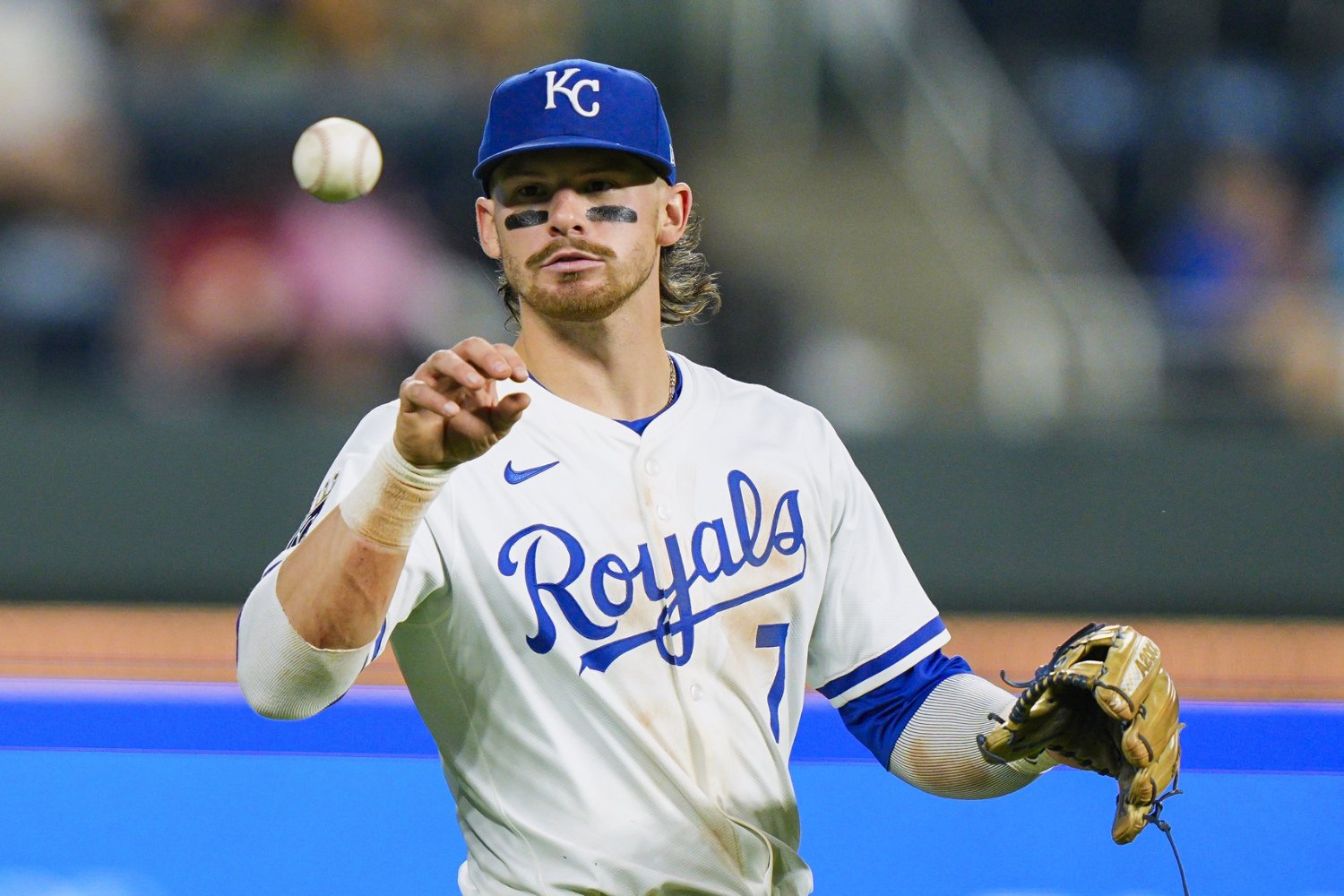 On Tuesday, the Kansas City Royals announced on social media that Bobby Witt Jr. received the Lou Gehrig Memorial Award for the 2025 season. He becomes the third Royals player in franchise history to earn the award, joining Hall of Famer George Brett and current captain Salvador Perez. For those unfamiliar with the award, it is defined as follows, according to the press release found on MLB.com. Witt earned the award through his various charitable contributions to the Kansas City community, as highlighted in the article. His most prominent work was raising funds and awareness for research and support in the fight against ALS. That includes hosting camps and clinics that raised $45,000 to financially support those suffering from ALS, including Sarah Nauser, a local Kansas Citian who has developed a close relationship with Witt and the Royals organization over the years. In the press release, Perez highlighted Witt's work in the fight against ALS, as well as the leadership he demonstrates in the clubhouse and the community. Salvy pointed out that Witt deserves to be the next Royals captain after he retires (though no date has been set on that yet). In addition to his work in the fight against ALS, Witt was also involved in increasing youth participation in baseball through MLB's Play Ball initiative, serving as the first-ever Play Ball Ambassador. Furthermore, Witt volunteered as a Royals Literacy League Classroom champion to improve literacy rates in elementary schools across the Kansas City Metro. All these different causes contributed to him earning this prestigious award in the MLB community. What Witt Means to the Royals and Kansas City In the press release, Royals President of Baseball Operations JJ Picollo commented on Witt's honor and how the Royals superstar embodied the spirit of Gehrig with this award, and in his work in the Kansas City community. Hopes were high when Witt was drafted No. 2 overall in the 2019 MLB Draft. While still a high schooler, many Royals fans envisioned Witt when he was selected as someone who could become the kind of franchise player the organization hadn't really had since Brett retired after the 1993 season (which included Brett hitting a walk-off home run in his last game). There have been players post-Brett who have been anointed as the heir apparent to lead the Royals franchise. That includes highly-drafted players like Eric Hosmer, Mike Moustakas, Alex Gordon, Carlos Beltran, and even Johnny Damon, with the latter starring in a commercial with Brett that almost hinted at Damon being the next "face" of the Royals franchise. However, while all those players had their moments and highs, they have never touched Brett's aura. Witt isn't quite there just yet, but he's closing the gap quite quickly. In just four seasons, Witt has collected 105 home runs, 403 runs, 373 RBI, and 148 stolen bases. In 2,722 career plate appearances, he has a .290 average, .357 wOBA, 129 wRC+, and 26.7 fWAR. Since 2010, Witt has accumulated the most fWAR of any Royals player, surpassing Gordon this past year, who accumulated 26.2 fWAR since 2010, according to Fangraphs. The dynamic Royals shortstop has also earned hardware during his four-year tenure. In addition to the Gehrig award, he's also a two-time All-Star, Silver Slugger, Gold Glove winner, and a one-time Platinum Glove winner and American League Batting champion. He's finished in the Top-5 in AL MVP voting twice, including second in 2024 (behind the Yankees' Aaron Judge). Lastly, he's been on Team USA for the World Baseball Classic twice and should be a key part of their lineup in this year's edition. (It's amazing how he was buried by Team USA manager Mark DeRosa in the last WBC for Tim Anderson, who's pretty much out of baseball now.) Amazingly, Witt has also earned all these honors under the age of 26. What's even more incredible is that Witt isn't satisfied with his career just yet. He believes he has even more room to grow, as discussed in a recent interview with MLB Network. All of Witt's on-field honors, combined with the Gehrig award, show how important and special Witt is to the Royals community and in Kansas City sports history. Because the Royals are a small-market franchise in a game where big markets rule, it seemed likely that Witt's tenure with the Royals would be brief. That was the case with former "stars" before Witt like Damon, Beltran, and Hosmer (at least Hosmer helped the Royals to two pennants and a title). After all, Witt's dad played for the Texas Rangers, a big-market franchise in his home state. Many pessimistic Royals fans assumed Witt would eventually return to Texas once he became a free agent. Heck, there was even a point where some from that Royals fanbase thought it would be beneficial to trade Witt for a super prospect package, similar to the one the Nationals got from San Diego in exchange for Juan Soto. And yet, the Royals not only held onto him, but also inked him prior to the 2024 season to an 11-year, $288.778 million deal that would guarantee him to be in Kansas City until at least 2030. Since signing that contract, Witt has not only achieved monumental individual success but has also led the Royals to two winning seasons and a return to the postseason. Remember, prior to 2024, the last Kansas City team to win a World Series was the 2015 team. Witt winning on the field would be enough for Royals fans. And yet, he has done more than that. He's been active in the community. He's a hit with kids like Roy Hobbs in "The Natural" (the movie, not the book, which is more depressing). He's been a major supporter and advocate in the fight against a disease like ALS. Witt doesn't have to do these things. He could be a superstar who could carry himself in a bigger city or market, hang out with all kinds of celebrities, and make more money in endorsements for more national brands (or Kalshi; hopefully Witt never goes down this route like some athletes). However, that's not Witt. There's something genuine about Witt. Something wholesome and unique that fans don't often see in many baseball players, especially those paid vast sums of money per year. Witt has something special that makes him the exact right fit for the Royals franchise, which has been in the doldrums for decades. This fanbase and city not only needed winning baseball after years of brutal play in the wake of former owner Ewing Kauffman's death and Brett's retirement. They needed a hopeful face. Maybe not a savior, but something close to that. Witt has been everything and more to Kansas City in his four seasons with the Royals. And the best part? There is more to come, both on the field and off. The Gehrig award is just the beginning for Witt's legacy with the Royals, as crazy as that sounds.
 -
Image courtesy of Rick Osentoski-Imagn Images Much has been made about Seth Lugo and his outlook for the 2026 season. For the Royals to have a chance at an AL Central Division title and return to the postseason, Kansas City will need a Lugo closer to his 2024 form than to his 2025 version. In 2024, he went 16-9 with a 3.00 ERA, 3.25 FIP, 1.09 WHIP, 3.77 K/BB ratio, and 4.7 fWAR in 206.2 IP. That performance helped him not only earn the Bruce Rice Pitcher of the Year award (which goes to the Royals' best pitcher), but it also garnered him AL Cy Young runner-up honors to Detroit's Tarik Skubal. Thus, after 2024, it seemed like Kansas City had a top-of-the-rotation arm that could complement Cole Ragans for at least a few more seasons. Unfortunately, Lugo took a step back in 2025, much to the Royals' and Kansas City fanbase's chagrin. Due to various injuries, he only pitched 145.1 innings, and the numbers regressed in that small sample as well. He posted a 4.15 ERA, 5.09 FIP, 1.29 WHIP, 2.27 K/BB ratio, and 0.5 fWAR. Even though the Royals gave him an extension near the end of the season (keeping him in Kansas City until at least 2027), many fans wondered at the end of the 2025 season if Lugo had peaked in 2024 and would be on the decline for the remainder of his career. At 36, he is at an age when such career regression is common. The 34th-round pick in the 2011 MLB Draft out of Centenary College of Louisiana made his Spring Training debut this season and held his own in two innings of work. He threw 27 pitches and struck out one while allowing two hits, zero runs, and zero walks. Lugo was also efficient with his pitch mix, posting intriguing stuff and strike metrics, according to his TJ Stats summary below. His overall TJ Stuff+ was just 97, and he only had three pitches with a TJ Stuff+ over 100 and one with a 55 grade (his curveball). He was also a bit inconsistent when it came to finding the strike zone, as illustrated by his 44.4% zone rate. However, his chase rate was 40%, his whiff rate was 28.6%, and his xwOBACON was .327. That's not bad for a first Spring Training start, especially for a veteran who's just trying to ramp up and stretch himself out in preparation for Opening Day. The results and overall profile of Lugo don't matter too much, especially considering this is just one Cactus League outing. However, his curveball was an interesting offering, even if it was only thrown two times against the Cubs. It's an intriguing pitch to watch this spring, as it regressed a bit in 2025 from 2024, and one could argue that its effectiveness decline partially explains Lugo's struggles a season ago. Let's take a look at the changes in Lugo's curve, why that's important, and what kind of takeaways Royals fans could have on the pitch from Lugo's 2026 Cactus League debut. Lugo's Curve Saw a Decline in Velocity and Pitch Quality On Monday, Nick Pollack of Pitcher List released his Kansas City Royals SP Breakdown. Pollack breaks down all the rotations of every MLB team before Opening Day, and his SP Breakdown series is one of the best annual deep dives out there for fantasy baseball diehards. Below is a link to Pollack's latest piece, focusing on the Royals' starting pitchers for 2026. As expected, Pollack broke down Lugo and his outlook for 2026. The Pitcher List founder focused on Lugo's curveball and how it changed in 2024, which contributed to his decline in success last season. Curious by Pollack's comments, I did a TJ Stats summary comparison of Lugo from 2024 to 2025, and below is what that data set looked like. Lugo saw declines across many metrics last season. His overall TJ Stuff+ went from 99 to 98, and that seemed to contribute to his regression in all his overall categories via TJ Stats. His chase rate increased from 29.3% in 2024 to 23.8% in 2025. His whiff rate went from 22.4% to 20.5%. Lastly, his went xwOBACON went from .363 to .427. The only category where he saw improvement was zone rate, which rose from 48% to 51.1%. That said, while he threw more pitches in the strike zone in 2025, it also made him more hittable. His expected batting average against went from .240 in 2024 to .256 in 2025. While many of Lugo's pitches regressed from 2024 to 2025, the curveball trend stood out the most. Here's what the breakdown of the pitch was in both 2024 and 2025, via TJ Stats. 2024: 16.2% usage, 79.8 MPH, -14.5 iVB, -14.6 HB, 3,283 spin, 109 TJ Stuff+, 68 grade, 41.9% zone, 41.1% chase, 33.6% whiff, and .367 xwOBACON. 2025: 18.2% usage, 78.9 MPH, -13.8 iVB, -14.4 HV, 3,237 spin, 106 TJ Stuff+, 64 grade, 47.5% zone, 32.5% chase, 25.9% whiff, and .442 xwOBACON. Lugo threw the pitch two percent more in 2025 than in 2024. However, nearly everything worsened, except the zone rate. That said, for a pitch that generated so much chase and whiff in 2024, throwing it more in the zone was actually counterintuitive and led to worse results, especially in whiff rate and xwOBACON. The key difference seemed to be the decline in velocity. Not only was it 0.9 MPH slower in 2025 than in 2024, but it was also his slowest curveball MPH since 2020, as seen in the chart below via Baseball Savant. In addition to a decline in velocity, Lugo's curve also experienced a decline in spin rate last season. His 3,237 spin was 46 RPM lower than his 2024 spin. Furthermore, like velocity, his curveball spin had the lowest RPM since 2020, as seen in the chart below via Savant. A decline in spin and velocity often leads to a regression in pitch quality, and that was the case with Lugo's curve last season. His TJ Stuff+ declined by three, and his curveball grade declined by four from 2024 to 2025. Granted, some of it may have been due to injury. A finger injury at the beginning of the year and later a back issue seemed to not only force him to pitch fewer innings but also produce fewer quality outings on the mound. It's likely that those two issues also affected his velocity, spin, and the overall quality of his curveball last season, based on the data. What Did the Heatmap Data Look Like From 2024 and 2025? In order to understand the decline in Lugo's curveball effectiveness, it seemed essential to explore the heatmap data on Lugo's curve from 2024 to 2025. Seeing where the pitch was located and the results against left-handed and right-handed batters could give a glimpse of what went wrong for Lugo last year with his primary breaking pitch. Let's explore what his curveball heatmap looked like from last season. As one can see above, Lugo threw the pitch way too much in the zone, against both lefties and righties. He produced decent CSW rates, with a 32.2% mark against lefties and 33.7% against righties. Furthermore, his whiff rates were solid as well: 25.5% against lefties, 27.3% against righties. However, when opposing hitters made contact, they did damage. He allowed a .462 xwOBACON against lefties with his curve and a .374 mark against righties. Here's an example of Lugo leaving up his curveball in the zone against right-handed hitter Marcell Ozuna. He absolutely punishes it for a home run at Kauffman Stadium in late July. TUE3TVlfWGw0TUFRPT1fQUFaVlUxMVdWQU1BRHdjQ1ZnQUhBZ0ZTQUFNRkJsa0FWd1FNVWdSV0FBQUdDQUlB.mp4 Now, let's take a glance at his curveball heatmap data from 2024, via TJ Stats. The curveball against lefties is pretty much located in the same area as 2025. However, the results were much better: the CSW was 4.3% better, the whiff rate was 7.5% higher, and the xwOBACON was 79 points lower. The better pitch velocity and spin likely helped in 2024. That said, the curveball results were dramatically better against righties in 2024 than in 2025. While his CSW was 2.1% lower than in 2025, his whiff rate was 10.2% higher, and his O-Swing% was 14.7% higher as well. He didn't get as many called strikes with the curve against righties, but he generated WAY more whiffs and chase. Furthermore, he located the pitch much differently against righties in 2024 than in 2025. In 2024, he commanded the pitch more low and away, which explains not just the better chase and whiff rates, but also the better xwOBACON (.263). Below is an example of Lugo getting San Francisco's Tyler Fitzgerald to strike out on a curveball located low and away, right in the heart of the heatmap. S3d2QWpfWGw0TUFRPT1fQUFjREFRRU1BMUFBV1ZFSFhnQUFVd01EQUFNRFdsQUFBbGNCVmdaWEExVlhBMWRU.mp4 A key for Lugo will be locating the pitch more effectively against righties in 2026. He doesn't throw the curve much against righties, only throwing the breaking offering 9.1% in 2025 and 4.0% in 2024. However, while limited, location matters. If he's going to use it under 10% against right-handed hitters again in 2026, he'll need to do a better job of commanding it low and away, like in 2024, not high and in the middle, like in 2025. What to Watch From Lugo's Curve This Spring Velocity and spin will be the key to success for Lugo and his curveball in 2026. Even when he didn't have the best velocity on his curveball in 2024, it was a much sharper offering than the loopier one he threw last season. In the clip compilation below, the 2024 version against Andres Gimenez is a much steeper dropping pitch than the 2025 one against Miami's Kyle Stowers. This is despite the 2024 curveball being 0.5 MPH slower. Getting that spin and vertical break again on the curve for Lugo will be key this spring. Thankfully, it seems like he's making progress on at least some of his breaking offerings in Spring Training. MLB.com Royals writer Anne Rogers noted that Lugo added two MPH to his slider in his first outing, thanks to some grip changes made this offseason. In addition to four whiffs, Lugo produced a 60% zone and 50% chase with the slider. And yet, the slider had a 101 TJ Stuff+ and a 45 grade today. That is slightly worse than the 102 TJ Stuff+ and 55 grade on the curve from today's outing. Yes, he threw the slider five times and the curve twice. However, if he's being that intentional with his grip and mindset on the slider, it's likely he's adopting the same approach with his curve, which is a more crucial pitch to his repertoire. If a similar trend with his curve happens in subsequent outings this spring, whether in Arizona or the World Baseball Classic (he will be pitching for Puerto Rico), then the 36-year-old righty may be on his way to recapturing some of the magic of his 2024 campaign for this upcoming season. View full article
-
 Much has been made about Seth Lugo and his outlook for the 2026 season. For the Royals to have a chance at an AL Central Division title and return to the postseason, Kansas City will need a Lugo closer to his 2024 form than to his 2025 version. In 2024, he went 16-9 with a 3.00 ERA, 3.25 FIP, 1.09 WHIP, 3.77 K/BB ratio, and 4.7 fWAR in 206.2 IP. That performance helped him not only earn the Bruce Rice Pitcher of the Year award (which goes to the Royals' best pitcher), but it also garnered him AL Cy Young runner-up honors to Detroit's Tarik Skubal. Thus, after 2024, it seemed like Kansas City had a top-of-the-rotation arm that could complement Cole Ragans for at least a few more seasons. Unfortunately, Lugo took a step back in 2025, much to the Royals' and Kansas City fanbase's chagrin. Due to various injuries, he only pitched 145.1 innings, and the numbers regressed in that small sample as well. He posted a 4.15 ERA, 5.09 FIP, 1.29 WHIP, 2.27 K/BB ratio, and 0.5 fWAR. Even though the Royals gave him an extension near the end of the season (keeping him in Kansas City until at least 2027), many fans wondered at the end of the 2025 season if Lugo had peaked in 2024 and would be on the decline for the remainder of his career. At 36, he is at an age when such career regression is common. The 34th-round pick in the 2011 MLB Draft out of Centenary College of Louisiana made his Spring Training debut this season and held his own in two innings of work. He threw 27 pitches and struck out one while allowing two hits, zero runs, and zero walks. Lugo was also efficient with his pitch mix, posting intriguing stuff and strike metrics, according to his TJ Stats summary below. His overall TJ Stuff+ was just 97, and he only had three pitches with a TJ Stuff+ over 100 and one with a 55 grade (his curveball). He was also a bit inconsistent when it came to finding the strike zone, as illustrated by his 44.4% zone rate. However, his chase rate was 40%, his whiff rate was 28.6%, and his xwOBACON was .327. That's not bad for a first Spring Training start, especially for a veteran who's just trying to ramp up and stretch himself out in preparation for Opening Day. The results and overall profile of Lugo don't matter too much, especially considering this is just one Cactus League outing. However, his curveball was an interesting offering, even if it was only thrown two times against the Cubs. It's an intriguing pitch to watch this spring, as it regressed a bit in 2025 from 2024, and one could argue that its effectiveness decline partially explains Lugo's struggles a season ago. Let's take a look at the changes in Lugo's curve, why that's important, and what kind of takeaways Royals fans could have on the pitch from Lugo's 2026 Cactus League debut. Lugo's Curve Saw a Decline in Velocity and Pitch Quality On Monday, Nick Pollack of Pitcher List released his Kansas City Royals SP Breakdown. Pollack breaks down all the rotations of every MLB team before Opening Day, and his SP Breakdown series is one of the best annual deep dives out there for fantasy baseball diehards. Below is a link to Pollack's latest piece, focusing on the Royals' starting pitchers for 2026. As expected, Pollack broke down Lugo and his outlook for 2026. The Pitcher List founder focused on Lugo's curveball and how it changed in 2024, which contributed to his decline in success last season. Curious by Pollack's comments, I did a TJ Stats summary comparison of Lugo from 2024 to 2025, and below is what that data set looked like. Lugo saw declines across many metrics last season. His overall TJ Stuff+ went from 99 to 98, and that seemed to contribute to his regression in all his overall categories via TJ Stats. His chase rate increased from 29.3% in 2024 to 23.8% in 2025. His whiff rate went from 22.4% to 20.5%. Lastly, his went xwOBACON went from .363 to .427. The only category where he saw improvement was zone rate, which rose from 48% to 51.1%. That said, while he threw more pitches in the strike zone in 2025, it also made him more hittable. His expected batting average against went from .240 in 2024 to .256 in 2025. While many of Lugo's pitches regressed from 2024 to 2025, the curveball trend stood out the most. Here's what the breakdown of the pitch was in both 2024 and 2025, via TJ Stats. 2024: 16.2% usage, 79.8 MPH, -14.5 iVB, -14.6 HB, 3,283 spin, 109 TJ Stuff+, 68 grade, 41.9% zone, 41.1% chase, 33.6% whiff, and .367 xwOBACON. 2025: 18.2% usage, 78.9 MPH, -13.8 iVB, -14.4 HV, 3,237 spin, 106 TJ Stuff+, 64 grade, 47.5% zone, 32.5% chase, 25.9% whiff, and .442 xwOBACON. Lugo threw the pitch two percent more in 2025 than in 2024. However, nearly everything worsened, except the zone rate. That said, for a pitch that generated so much chase and whiff in 2024, throwing it more in the zone was actually counterintuitive and led to worse results, especially in whiff rate and xwOBACON. The key difference seemed to be the decline in velocity. Not only was it 0.9 MPH slower in 2025 than in 2024, but it was also his slowest curveball MPH since 2020, as seen in the chart below via Baseball Savant. In addition to a decline in velocity, Lugo's curve also experienced a decline in spin rate last season. His 3,237 spin was 46 RPM lower than his 2024 spin. Furthermore, like velocity, his curveball spin had the lowest RPM since 2020, as seen in the chart below via Savant. A decline in spin and velocity often leads to a regression in pitch quality, and that was the case with Lugo's curve last season. His TJ Stuff+ declined by three, and his curveball grade declined by four from 2024 to 2025. Granted, some of it may have been due to injury. A finger injury at the beginning of the year and later a back issue seemed to not only force him to pitch fewer innings but also produce fewer quality outings on the mound. It's likely that those two issues also affected his velocity, spin, and the overall quality of his curveball last season, based on the data. What Did the Heatmap Data Look Like From 2024 and 2025? In order to understand the decline in Lugo's curveball effectiveness, it seemed essential to explore the heatmap data on Lugo's curve from 2024 to 2025. Seeing where the pitch was located and the results against left-handed and right-handed batters could give a glimpse of what went wrong for Lugo last year with his primary breaking pitch. Let's explore what his curveball heatmap looked like from last season. As one can see above, Lugo threw the pitch way too much in the zone, against both lefties and righties. He produced decent CSW rates, with a 32.2% mark against lefties and 33.7% against righties. Furthermore, his whiff rates were solid as well: 25.5% against lefties, 27.3% against righties. However, when opposing hitters made contact, they did damage. He allowed a .462 xwOBACON against lefties with his curve and a .374 mark against righties. Here's an example of Lugo leaving up his curveball in the zone against right-handed hitter Marcell Ozuna. He absolutely punishes it for a home run at Kauffman Stadium in late July. TUE3TVlfWGw0TUFRPT1fQUFaVlUxMVdWQU1BRHdjQ1ZnQUhBZ0ZTQUFNRkJsa0FWd1FNVWdSV0FBQUdDQUlB.mp4 Now, let's take a glance at his curveball heatmap data from 2024, via TJ Stats. The curveball against lefties is pretty much located in the same area as 2025. However, the results were much better: the CSW was 4.3% better, the whiff rate was 7.5% higher, and the xwOBACON was 79 points lower. The better pitch velocity and spin likely helped in 2024. That said, the curveball results were dramatically better against righties in 2024 than in 2025. While his CSW was 2.1% lower than in 2025, his whiff rate was 10.2% higher, and his O-Swing% was 14.7% higher as well. He didn't get as many called strikes with the curve against righties, but he generated WAY more whiffs and chase. Furthermore, he located the pitch much differently against righties in 2024 than in 2025. In 2024, he commanded the pitch more low and away, which explains not just the better chase and whiff rates, but also the better xwOBACON (.263). Below is an example of Lugo getting San Francisco's Tyler Fitzgerald to strike out on a curveball located low and away, right in the heart of the heatmap. S3d2QWpfWGw0TUFRPT1fQUFjREFRRU1BMUFBV1ZFSFhnQUFVd01EQUFNRFdsQUFBbGNCVmdaWEExVlhBMWRU.mp4 A key for Lugo will be locating the pitch more effectively against righties in 2026. He doesn't throw the curve much against righties, only throwing the breaking offering 9.1% in 2025 and 4.0% in 2024. However, while limited, location matters. If he's going to use it under 10% against right-handed hitters again in 2026, he'll need to do a better job of commanding it low and away, like in 2024, not high and in the middle, like in 2025. What to Watch From Lugo's Curve This Spring Velocity and spin will be the key to success for Lugo and his curveball in 2026. Even when he didn't have the best velocity on his curveball in 2024, it was a much sharper offering than the loopier one he threw last season. In the clip compilation below, the 2024 version against Andres Gimenez is a much steeper dropping pitch than the 2025 one against Miami's Kyle Stowers. This is despite the 2024 curveball being 0.5 MPH slower. Getting that spin and vertical break again on the curve for Lugo will be key this spring. Thankfully, it seems like he's making progress on at least some of his breaking offerings in Spring Training. MLB.com Royals writer Anne Rogers noted that Lugo added two MPH to his slider in his first outing, thanks to some grip changes made this offseason. In addition to four whiffs, Lugo produced a 60% zone and 50% chase with the slider. And yet, the slider had a 101 TJ Stuff+ and a 45 grade today. That is slightly worse than the 102 TJ Stuff+ and 55 grade on the curve from today's outing. Yes, he threw the slider five times and the curve twice. However, if he's being that intentional with his grip and mindset on the slider, it's likely he's adopting the same approach with his curve, which is a more crucial pitch to his repertoire. If a similar trend with his curve happens in subsequent outings this spring, whether in Arizona or the World Baseball Classic (he will be pitching for Puerto Rico), then the 36-year-old righty may be on his way to recapturing some of the magic of his 2024 campaign for this upcoming season.
 -
Image courtesy of Peter Aiken-Imagn Images One player who should be coming into Royals Spring Training with a lot of motivation is outfielder Dairon Blanco. After playing in 157 games in 2023 and 2024 combined, he only played in nine games with the Royals last season. Part of that was due to an Achilles injury, which seemed to sap him of his one premium tool (his speed). However, it seemed like manager Matt Quatraro and the Royals preferred Tyler Tolbert in the role that Blanco served in during Quatraro's first two seasons as Royals manager. Tolbert is back with the Royals and seems like a favorite to make the Royals' Opening Day roster, according to Roster Resource projections. Not only was Tolbert a demon on the basepaths last year (21 stolen bases on 23 attempts), but the 2019 13th-round pick can also play the infield, something Blanco cannot do. That said, Royals fans shouldn't sleep on Blanco completely this Spring Training, especially after he has collected two hits in his first two games in Cactus League play (which includes a single and a double). While he doesn't have the defensive versatility of Tolbert, Blanco could be an interesting weapon for the Royals again if he's 100 percent healthy again. What Blanco Brings to the Royals From 2023 to 2024, Blanco served as Kansas City's primary baserunner off the bench. It was for good reason: he was adept on the basepaths, especially when it came to stolen bases. Even though he only had 270 plate appearances from 2023 to 2024, Blanco stole 55 bases for the Royals. Over that two-year period, only Bobby Witt Jr. (80) and Maikel Garcia (60) had more stolen bases than Blanco, according to Fangraphs. Furthermore, when it came to Statcast's baserunning "runner runs" metric, Blanco fared quite well. For those unfamiliar with Statcast's baserunning metrics, below is an outline of what they are and how to read them. From 2023 to 2024, much like the stolen base totals, only Witt and Garcia outperformed Blanco in terms of baserunning run value via Statcast. That is shown in the table below. Blanco created 7.7 total "runner runs" from 2023 to 2024, with 1.5 of those runs coming on extra bases taken on base hits and 6.2 coming from stolen bases. In fact, his 6.2 stolen base runs total was the highest of Royals players over that two-year span. His mark was 1.1 runs better than Garcia's and 2.4 runs higher than Witt's. While Blanco's strengths were primarily on the basepaths, he held his own at the plate as a bench outfielder who would get occasional playing time. In 138 plate appearances in 2023, he posted a .333 wOBA and 102 wRC+ with three home runs and a 1.2 fWAR. In 132 plate appearances in 2024, he regressed a bit, sporting a .306 wOBA, 96 wRC, and 0.5 fWAR. He also saw some regression defensively, as his outfield FRV went from +5 in 2023 to -1 in 2024. That said, when things were clicking, Blanco could get hot at the plate and collect hits and runs in bunches. That was the case on August 17th in 2024, when he had 7 RBI while using a "crayon" bat for Player's Weekend. Blanco's profile wasn't perfect by any means. His xwOBA underperformed his wOBA in 2023 and 2024 with .302 and .284 marks, respectively. Additionally, even during his respectable 2024 season, the Statcast percentiles were questionable, especially in the exit velocity, hard-hit, and LA sweet-spot percentage categories. Below is a look at his TJ Stats Statcast summary profile from that season. Still, when healthy, Blanco was a nice fourth outfielder who may not be able to play regularly, but gave the Royals some nice stretches at the plate from time to time. That ability from Blanco was a nice benefit of his profile, in addition to his strong baserunning. What Happened Last Year With Blanco? Blanco suffered an Achilles injury on March 31st last season and didn't get reinstated until mid-May. When he returned, his sprint speed went from 30.3 FT/S (feet per second) in 2024 to 29.6 FT/S in 2025. Furthermore, Tolbert emerged as a reasonable option off the bench in Blanco's absence. In 57 plate appearances, the former UAB product posted a .305 wOBA, 92 wRC+, and 0.3 fWAR. When it came to baserunning metrics via Statcast, Tolbert ranked among the best Royals when it came to total runner runs. However, the numbers weren't as impressive as Blanco's marks from 2023 to 2024, as seen in the 2025 table below. Last season, Tolbert was third in total runner runs with a 1.0 mark. He was 6.4 runner runs behind Witt and 0.3 runner runs behind Adam Frazier. Surprisingly, Garcia took a step back in the baserunning category last season. He had a -0.1 total runner runs mark thanks to -1.5 stolen base runner runs. As for Blanco, despite the small sample in 2025 (nine games), he still produced 0.2 total runner runs with 0.1 runs in both the extra base and stolen base categories. It's too small a sample to take anything major away from, but it still shows that Blanco's baserunning was still a positive for the Royals last year, despite his injury. Unfortunately, things didn't go great for Blanco in Omaha last season, where he primarily played. In 295 plate appearances, he hit eight home runs, stole 32 bases (on 35 attempts), posted a .334 wOBA, and 92 wRC+. Much like 2024 with the Royals, the Statcast percentiles weren't all that impressive either, as illustrated in his TJ Stats Statcast summary from a season ago. He pulled the ball better in Triple-A, as his Pull% ranked in the 68th percentile with the Storm Chasers (39.9%). Everything else, however? He only ranked in the 50th percentile or higher in two other categories (Z-Swing% and K%). That's a bit disappointing for a player who was primarily on the Major League squad in 2023 and 2024. Tolbert's Statcast percentiles last year with the Royals weren't much more impressive than Blanco's in 2024, especially in the exit velocity, barrel, and hard-hit categories. However, the 28-year-old utility player excelled in launch angle, which gives him a bit more upside, especially in Kauffman Stadium's spacious yard. It's hard to justify Blanco over Tolbert for now, especially since Tolbert stayed healthy and thrived in the "Blanco" role last season (Tolbert's stolen bases alone justify his roster spot). However, if Blanco can get his hitting approach back in check and recapture that 2024 sprint speed, then he could make a case for an Opening Day roster spot, especially if Tolbert doesn't look sharp in Cactus League play. What Needs to Happen This Spring for Blanco? It's been a bit of a mixed start for Blanco so far in Cactus League play. While he has two hits, he also made a defensive blunder in his first outing against the Padres, misplaying a ball in the sun, and got thrown out on a stolen base attempt (also against the Padres). Considering that those are two areas that Quatraro wants to clean up in 2026, those kinds of mistakes aren't encouraging, even if it's still early in Spring Training. Also, in Sunday's game against the Brewers, Blanco was hit in the head by a pitch and had to leave the game. His status going forward is uncertain. While it was promising to see Blanco leave under his own power, getting hit in the head can have devastating effects. Royals fans saw how Jonathan India wasn't the same after getting hit in the head by then Cleveland Guardians closer Emmanuel Clase during Opening Day weekend at Kauffman Stadium. Every game counts for Blanco this Spring Training, especially if he wants to be on the roster on Opening Day in Atlanta. For Blanco to make the team over Tolbert, he will have to show that his speed is back and that he can hit the ball harder and with more authority than Tolbert. Blanco saw a dramatic drop in xwOBA midway through the 2024 season after promising gains in 2023 and the start of 2024, which can be seen in the rolling chart data below, via Savant. Should Blanco get back to those more positive trends, it's plausible to think Quatraro could see him as a nice outfielder option off the bench who can fill in when needed. If he can do those two things, he could perhaps justify himself not just as the designated punch runner, but one who could play the corner outfield positions when they face a left-handed starter. The outfield is a bit deeper than it was last year, so the bar is a little bit higher for Blanco in terms of proving he can belong, especially on the offensive end. The Cuban outfielder isn't exactly young at 32 (he will be 33 in late April). However, he still remains a stellar athlete and may be the most explosive player on the 40-man roster beyond Witt. While the odds are against him making the Opening Day roster (especially with this latest hit-by-pitch incident), seeing Blanco return to his 2023 and 2024 form would be a nice (and much-needed) success story for the Royals, not just this spring, but in 2026 overall. View full article
-
 One player who should be coming into Royals Spring Training with a lot of motivation is outfielder Dairon Blanco. After playing in 157 games in 2023 and 2024 combined, he only played in nine games with the Royals last season. Part of that was due to an Achilles injury, which seemed to sap him of his one premium tool (his speed). However, it seemed like manager Matt Quatraro and the Royals preferred Tyler Tolbert in the role that Blanco served in during Quatraro's first two seasons as Royals manager. Tolbert is back with the Royals and seems like a favorite to make the Royals' Opening Day roster, according to Roster Resource projections. Not only was Tolbert a demon on the basepaths last year (21 stolen bases on 23 attempts), but the 2019 13th-round pick can also play the infield, something Blanco cannot do. That said, Royals fans shouldn't sleep on Blanco completely this Spring Training, especially after he has collected two hits in his first two games in Cactus League play (which includes a single and a double). While he doesn't have the defensive versatility of Tolbert, Blanco could be an interesting weapon for the Royals again if he's 100 percent healthy again. What Blanco Brings to the Royals From 2023 to 2024, Blanco served as Kansas City's primary baserunner off the bench. It was for good reason: he was adept on the basepaths, especially when it came to stolen bases. Even though he only had 270 plate appearances from 2023 to 2024, Blanco stole 55 bases for the Royals. Over that two-year period, only Bobby Witt Jr. (80) and Maikel Garcia (60) had more stolen bases than Blanco, according to Fangraphs. Furthermore, when it came to Statcast's baserunning "runner runs" metric, Blanco fared quite well. For those unfamiliar with Statcast's baserunning metrics, below is an outline of what they are and how to read them. From 2023 to 2024, much like the stolen base totals, only Witt and Garcia outperformed Blanco in terms of baserunning run value via Statcast. That is shown in the table below. Blanco created 7.7 total "runner runs" from 2023 to 2024, with 1.5 of those runs coming on extra bases taken on base hits and 6.2 coming from stolen bases. In fact, his 6.2 stolen base runs total was the highest of Royals players over that two-year span. His mark was 1.1 runs better than Garcia's and 2.4 runs higher than Witt's. While Blanco's strengths were primarily on the basepaths, he held his own at the plate as a bench outfielder who would get occasional playing time. In 138 plate appearances in 2023, he posted a .333 wOBA and 102 wRC+ with three home runs and a 1.2 fWAR. In 132 plate appearances in 2024, he regressed a bit, sporting a .306 wOBA, 96 wRC, and 0.5 fWAR. He also saw some regression defensively, as his outfield FRV went from +5 in 2023 to -1 in 2024. That said, when things were clicking, Blanco could get hot at the plate and collect hits and runs in bunches. That was the case on August 17th in 2024, when he had 7 RBI while using a "crayon" bat for Player's Weekend. Blanco's profile wasn't perfect by any means. His xwOBA underperformed his wOBA in 2023 and 2024 with .302 and .284 marks, respectively. Additionally, even during his respectable 2024 season, the Statcast percentiles were questionable, especially in the exit velocity, hard-hit, and LA sweet-spot percentage categories. Below is a look at his TJ Stats Statcast summary profile from that season. Still, when healthy, Blanco was a nice fourth outfielder who may not be able to play regularly, but gave the Royals some nice stretches at the plate from time to time. That ability from Blanco was a nice benefit of his profile, in addition to his strong baserunning. What Happened Last Year With Blanco? Blanco suffered an Achilles injury on March 31st last season and didn't get reinstated until mid-May. When he returned, his sprint speed went from 30.3 FT/S (feet per second) in 2024 to 29.6 FT/S in 2025. Furthermore, Tolbert emerged as a reasonable option off the bench in Blanco's absence. In 57 plate appearances, the former UAB product posted a .305 wOBA, 92 wRC+, and 0.3 fWAR. When it came to baserunning metrics via Statcast, Tolbert ranked among the best Royals when it came to total runner runs. However, the numbers weren't as impressive as Blanco's marks from 2023 to 2024, as seen in the 2025 table below. Last season, Tolbert was third in total runner runs with a 1.0 mark. He was 6.4 runner runs behind Witt and 0.3 runner runs behind Adam Frazier. Surprisingly, Garcia took a step back in the baserunning category last season. He had a -0.1 total runner runs mark thanks to -1.5 stolen base runner runs. As for Blanco, despite the small sample in 2025 (nine games), he still produced 0.2 total runner runs with 0.1 runs in both the extra base and stolen base categories. It's too small a sample to take anything major away from, but it still shows that Blanco's baserunning was still a positive for the Royals last year, despite his injury. Unfortunately, things didn't go great for Blanco in Omaha last season, where he primarily played. In 295 plate appearances, he hit eight home runs, stole 32 bases (on 35 attempts), posted a .334 wOBA, and 92 wRC+. Much like 2024 with the Royals, the Statcast percentiles weren't all that impressive either, as illustrated in his TJ Stats Statcast summary from a season ago. He pulled the ball better in Triple-A, as his Pull% ranked in the 68th percentile with the Storm Chasers (39.9%). Everything else, however? He only ranked in the 50th percentile or higher in two other categories (Z-Swing% and K%). That's a bit disappointing for a player who was primarily on the Major League squad in 2023 and 2024. Tolbert's Statcast percentiles last year with the Royals weren't much more impressive than Blanco's in 2024, especially in the exit velocity, barrel, and hard-hit categories. However, the 28-year-old utility player excelled in launch angle, which gives him a bit more upside, especially in Kauffman Stadium's spacious yard. It's hard to justify Blanco over Tolbert for now, especially since Tolbert stayed healthy and thrived in the "Blanco" role last season (Tolbert's stolen bases alone justify his roster spot). However, if Blanco can get his hitting approach back in check and recapture that 2024 sprint speed, then he could make a case for an Opening Day roster spot, especially if Tolbert doesn't look sharp in Cactus League play. What Needs to Happen This Spring for Blanco? It's been a bit of a mixed start for Blanco so far in Cactus League play. While he has two hits, he also made a defensive blunder in his first outing against the Padres, misplaying a ball in the sun, and got thrown out on a stolen base attempt (also against the Padres). Considering that those are two areas that Quatraro wants to clean up in 2026, those kinds of mistakes aren't encouraging, even if it's still early in Spring Training. Also, in Sunday's game against the Brewers, Blanco was hit in the head by a pitch and had to leave the game. His status going forward is uncertain. While it was promising to see Blanco leave under his own power, getting hit in the head can have devastating effects. Royals fans saw how Jonathan India wasn't the same after getting hit in the head by then Cleveland Guardians closer Emmanuel Clase during Opening Day weekend at Kauffman Stadium. Every game counts for Blanco this Spring Training, especially if he wants to be on the roster on Opening Day in Atlanta. For Blanco to make the team over Tolbert, he will have to show that his speed is back and that he can hit the ball harder and with more authority than Tolbert. Blanco saw a dramatic drop in xwOBA midway through the 2024 season after promising gains in 2023 and the start of 2024, which can be seen in the rolling chart data below, via Savant. Should Blanco get back to those more positive trends, it's plausible to think Quatraro could see him as a nice outfielder option off the bench who can fill in when needed. If he can do those two things, he could perhaps justify himself not just as the designated punch runner, but one who could play the corner outfield positions when they face a left-handed starter. The outfield is a bit deeper than it was last year, so the bar is a little bit higher for Blanco in terms of proving he can belong, especially on the offensive end. The Cuban outfielder isn't exactly young at 32 (he will be 33 in late April). However, he still remains a stellar athlete and may be the most explosive player on the 40-man roster beyond Witt. While the odds are against him making the Opening Day roster (especially with this latest hit-by-pitch incident), seeing Blanco return to his 2023 and 2024 form would be a nice (and much-needed) success story for the Royals, not just this spring, but in 2026 overall.
 -
Image courtesy of Jayne Kamin-Oncea-Imagn Images The Royals are 1-1 so far in the Cactus League in 2026. After winning their Spring Training opener against the Texas Rangers, Kansas City had a much rougher day on Saturday, losing 10-3 to the Padres. One pitcher that stood out in the Royals' first couple of games was Stephen Kolek, who started Kansas City's Cactus League opener on Friday. In two innings of work, he allowed one run on three hits and one walk while striking out two. He threw a total of 36 pitches in his first Spring Training start of the season. When it came to his advanced metrics, Kolek did a decent job of finding the zone, but struggled when it came to generating chases and whiffs. And yet, his TJ Stuff+ metrics were decent overall, especially considering it was his first Spring Training start and his diverse pitch mix. Below is a look at what his outing looked like via his TJ Stats summary from Friday's outing. Kolek posted a 102 overall TJ Stuff+ with four of his pitches sporting TJ Stuff+ marks over 100 (his sinker, changeup, sweeper, and slider). His sinker and changeup graded 68 and 75, respectively. However, that didn't translate much into his other metrics, as his 16.7% chase rate, 7.1% whiff rate, and .387 xwOBACON were mediocre marks, to put it nicely. Still, stuff is what one wants to see from early Spring Training starts, especially as pitchers get ramped back up after a long offseason. Kolek showing solid TJ Stuff+ marks demonstrates that he's ready to go, and could put up better numbers in Cactus League play once his command irons out over more outings. Nonetheless, one has to wonder where Kolek fits on this Royals pitching staff for 2026. The 28-year-old had a solid debut for Kansas City in 2026, posting a 1.93 ERA, 2.71 FIP, and 0.9 fWAR in 33 IP after coming over from San Diego at the Trade Deadline. That said, he has a lot of competition for a spot on the pitching staff, especially with the rotation that consists of Cole Ragans, Michael Wacha, Seth Lugo, Kris Bubic, and Noah Cameron. In addition to that projected five, Kolek also will be competing with Ryan Bergert (who started today), Mason Black, Ben Kudrna, Luinder Avila, and Mitch Spence. Despite all that competition, Kolek has a chance to break with the club at the conclusion of Spring Training. Here are three pitch-related trends to pay attention to with Kolek this spring, as they could determine his chance to make Kansas City's Opening Day roster. Kolek's Four-Seamer vs. Sinker Kolek's primary two pitches are his four-seamer and sinker. He threw the pitches 26% and 24% of the time, respectively, last season. When it came to the metrics on those pitches, this is how they fared, according to his season-long TJ Stats summary. Kolek's sinker rated as a better offering than his four-seamer a season ago. The sinker had a 99 TJ Stuff+ and 58 grade, and produced a 58.5% zone rate, 31.4% chase, and a .308 xwOBACON. Conversely, the four-seamer had only a 92 TJ Stuff+ and 41 grade, and produced a 52.5% zone rate, 17.1% chase rate, and .446 xwOBACON, all worse marks in those categories than the sinker. That said, the four-seamer had a slightly better whiff rate (15.4%) than the sinker (13.1%). Below is the heatmap data of the four-seamer, which also includes split results, in addition to heatmaps against hitters from each side of the plate. Kolek threw the four-seamer more against lefties and tended to locate the pitch up and away. While the four-seamer CSW numbers against lefties (26%) were similar to those against righties (26.7%) and the chase rate was slightly better (17.4% to 16.4% O-Swing%), he also had a lower whiff rate (13.1% to 22.2%) and a higher xwOBACON (.452 to .428). Thus, one has to wonder if that four-seamer usage gap (15.8%) will close a bit in 2026. Now, let's take a look at the TJ Stats heatmap data with the sinker below. The sinker was less of a whiff-inducing pitch than the four-seamer overall. Furthermore, it produced a 26.9% CSW against lefties and a 26.4% mark against righties. Those rates are not all that different from his four-seamer. However, his sinker was a much better chase-inducing offering, producing a 34.1% O-Swing% against righties and 23.9% mark against lefties. Thus, it's not surprising that his xwOBACON was .274 against righties, as hitters had a hard time squaring up against a pitch they chased nearly 35% of the time. His xwOBACON was less stellar against lefties at .422. However, he also threw the sinker 30% less against lefties (11.2% against lefties; 41.2% against righties). It appears that his sinker is his go-to fastball offering against righties, and his four-seamer is his go-to against lefties. However, I wonder whether closing that gap a bit and mixing more sinkers against righties could be beneficial in the long term. Granted, the sinker is a more horizontal offering, which makes it less of a whiff-inducing pitch compared to the more vertical four-seamer. That said, it's intriguing how Kolek locates both pitches and how they can work effectively when commanded effectively, as seen in the clip compilation below. How Kolek's sinker and four-seamer usage fare this spring should be watched closely by Royals fans. If changes in this mix lead to better results (especially in chase and whiff), he could find himself stealing a rotation or bullpen spot by Opening Day. Mixing the Changeup In Effectively Kolek's changeup was one of the most impressive pitches, stuff-wise, in his 2026 Spring Training debut. It sported a 75 grade and 113 TJ Stuff+. However, it had a zone rate of 16.7%, a chase rate of 20%, and a 0% whiff rate. In 2025, the pitch had a 102 TJ Stuff+, a 60 grade, and a .270 xwOBACON. However, the zone (29.1%), chase (31.7%), and whiff (24.7%) rates were all a bit meager. It would also be nicer to see that chase rate up, especially if the zone is going to remain low. Here's the heatmap data on his changeup, and how it was thrown against lefties and righties last season. His changeup was primarily thrown against lefties, as it had an 18.3% usage against lefty hitters compared to a 2.8% usage against righties. Regardless, it was primarily a pitch designated to generate chase, as it was thrown in the chase zone 35.8% of the time and waste zone 13.6% against lefties. While it didn't produce a ton of CSW (19.3%) against lefties, hitters didn't do much against Kolek's offspeed offering either, as evidenced by the .225 xwOBACON. Below is a clip of his changeup located in that chase zone, effectively against left-handed Twins hitter James Outman. Kolek forces Outman to not only chase but also whiff badly. Kolek's changeup is a unique weapon, even if it doesn't generate many called or swinging strikes. It would be nice to see him utilize this offering more with the sinker, especially since they sport similar movement. The changeup's 6.1 MPH difference from the sinker could lead to more whiffs on the offspeed pitch this spring and in 2026. Which Breaking Offering is More Effective? Kolek sports a slider (16.6% usage) and a sweeper (6.8% usage) as his primary breaking pitches. The slider has produced better results, especially in terms of xwOBACON (.378 to sweeper's .461) and chase (32.6% to sweeper's 20.7%). That said, the sweeper had slightly better stuff, with a 103 TJ Stuff+ (the slider had a 102). Here's a look at the slider's heatmap data via TJ Stats. The encouraging characteristic with Kolek's slider is that he generates strong chase against lefties (29.3%) and righties (36.2%). While the pitch is a better whiff-inducing offering against righties (23%), the whiff rate isn't that bad against lefties, as it is only 3.3% lower. When Kolek is able to locate the slider knee high and into lefties, he can produce effective whiffs like this one below against Freddie Freeman. That said, the sweeper is an intriguing pitch, and I think it could be a more worthwhile offering, especially against righties. Below is a look at his sweeper heatmap data via TJ Stats. He only threw the sweeper 9.2% against righties last year. However, it induced a 27.8% O-Swing% and a .265 xwOBACON. That xwOBACON was 93 points better than his slider's xwOBACON against righties. The sweeper is a much "loopier" breaking offering, averaging 82.5 MPH last year, 1.9 MPH slower than his slider. That said, the sweeper shape and velocity may make it a nice change of pace, especially when paired with the sinker and four-seamer. Below is an example of Kolek pulling the strings on Angels catcher (and former Royal) Sebastian Rivero last year on a sweeper. Rivero whiffs because he's sitting on a four-seamer or sinker. I don't think Kolek needs to add a traditional curveball to his pitch mix. He has a slider, a harder cutter, and a sweeper in addition to the sweeper. However, utilizing his sweeper more could help make his breaking offerings more effective in 2026. The sweeper is the kind of pitch that can really get right-handed hitters swinging out of their shoes badly, as Rivero demonstrated in the clip above. Kolek threw the sweeper 13.9% of the time in his first Catcus League start, which is 7.1% more than his sweeper usage in 2025. Thus, pitching coaches Brian Sweeney and Mike McFerran may also believe that Kolek should be throwing his sweeper more in 2026 and are getting that process started with Kolek in Arizona. View full article
-
What Can Stephen Kolek Do To Make the Royals' Opening Day Roster?
Kevin O'Brien posted an article in Royals
 The Royals are 1-1 so far in the Cactus League in 2026. After winning their Spring Training opener against the Texas Rangers, Kansas City had a much rougher day on Saturday, losing 10-3 to the Padres. One pitcher that stood out in the Royals' first couple of games was Stephen Kolek, who started Kansas City's Cactus League opener on Friday. In two innings of work, he allowed one run on three hits and one walk while striking out two. He threw a total of 36 pitches in his first Spring Training start of the season. When it came to his advanced metrics, Kolek did a decent job of finding the zone, but struggled when it came to generating chases and whiffs. And yet, his TJ Stuff+ metrics were decent overall, especially considering it was his first Spring Training start and his diverse pitch mix. Below is a look at what his outing looked like via his TJ Stats summary from Friday's outing. Kolek posted a 102 overall TJ Stuff+ with four of his pitches sporting TJ Stuff+ marks over 100 (his sinker, changeup, sweeper, and slider). His sinker and changeup graded 68 and 75, respectively. However, that didn't translate much into his other metrics, as his 16.7% chase rate, 7.1% whiff rate, and .387 xwOBACON were mediocre marks, to put it nicely. Still, stuff is what one wants to see from early Spring Training starts, especially as pitchers get ramped back up after a long offseason. Kolek showing solid TJ Stuff+ marks demonstrates that he's ready to go, and could put up better numbers in Cactus League play once his command irons out over more outings. Nonetheless, one has to wonder where Kolek fits on this Royals pitching staff for 2026. The 28-year-old had a solid debut for Kansas City in 2026, posting a 1.93 ERA, 2.71 FIP, and 0.9 fWAR in 33 IP after coming over from San Diego at the Trade Deadline. That said, he has a lot of competition for a spot on the pitching staff, especially with the rotation that consists of Cole Ragans, Michael Wacha, Seth Lugo, Kris Bubic, and Noah Cameron. In addition to that projected five, Kolek also will be competing with Ryan Bergert (who started today), Mason Black, Ben Kudrna, Luinder Avila, and Mitch Spence. Despite all that competition, Kolek has a chance to break with the club at the conclusion of Spring Training. Here are three pitch-related trends to pay attention to with Kolek this spring, as they could determine his chance to make Kansas City's Opening Day roster. Kolek's Four-Seamer vs. Sinker Kolek's primary two pitches are his four-seamer and sinker. He threw the pitches 26% and 24% of the time, respectively, last season. When it came to the metrics on those pitches, this is how they fared, according to his season-long TJ Stats summary. Kolek's sinker rated as a better offering than his four-seamer a season ago. The sinker had a 99 TJ Stuff+ and 58 grade, and produced a 58.5% zone rate, 31.4% chase, and a .308 xwOBACON. Conversely, the four-seamer had only a 92 TJ Stuff+ and 41 grade, and produced a 52.5% zone rate, 17.1% chase rate, and .446 xwOBACON, all worse marks in those categories than the sinker. That said, the four-seamer had a slightly better whiff rate (15.4%) than the sinker (13.1%). Below is the heatmap data of the four-seamer, which also includes split results, in addition to heatmaps against hitters from each side of the plate. Kolek threw the four-seamer more against lefties and tended to locate the pitch up and away. While the four-seamer CSW numbers against lefties (26%) were similar to those against righties (26.7%) and the chase rate was slightly better (17.4% to 16.4% O-Swing%), he also had a lower whiff rate (13.1% to 22.2%) and a higher xwOBACON (.452 to .428). Thus, one has to wonder if that four-seamer usage gap (15.8%) will close a bit in 2026. Now, let's take a look at the TJ Stats heatmap data with the sinker below. The sinker was less of a whiff-inducing pitch than the four-seamer overall. Furthermore, it produced a 26.9% CSW against lefties and a 26.4% mark against righties. Those rates are not all that different from his four-seamer. However, his sinker was a much better chase-inducing offering, producing a 34.1% O-Swing% against righties and 23.9% mark against lefties. Thus, it's not surprising that his xwOBACON was .274 against righties, as hitters had a hard time squaring up against a pitch they chased nearly 35% of the time. His xwOBACON was less stellar against lefties at .422. However, he also threw the sinker 30% less against lefties (11.2% against lefties; 41.2% against righties). It appears that his sinker is his go-to fastball offering against righties, and his four-seamer is his go-to against lefties. However, I wonder whether closing that gap a bit and mixing more sinkers against righties could be beneficial in the long term. Granted, the sinker is a more horizontal offering, which makes it less of a whiff-inducing pitch compared to the more vertical four-seamer. That said, it's intriguing how Kolek locates both pitches and how they can work effectively when commanded effectively, as seen in the clip compilation below. How Kolek's sinker and four-seamer usage fare this spring should be watched closely by Royals fans. If changes in this mix lead to better results (especially in chase and whiff), he could find himself stealing a rotation or bullpen spot by Opening Day. Mixing the Changeup In Effectively Kolek's changeup was one of the most impressive pitches, stuff-wise, in his 2026 Spring Training debut. It sported a 75 grade and 113 TJ Stuff+. However, it had a zone rate of 16.7%, a chase rate of 20%, and a 0% whiff rate. In 2025, the pitch had a 102 TJ Stuff+, a 60 grade, and a .270 xwOBACON. However, the zone (29.1%), chase (31.7%), and whiff (24.7%) rates were all a bit meager. It would also be nicer to see that chase rate up, especially if the zone is going to remain low. Here's the heatmap data on his changeup, and how it was thrown against lefties and righties last season. His changeup was primarily thrown against lefties, as it had an 18.3% usage against lefty hitters compared to a 2.8% usage against righties. Regardless, it was primarily a pitch designated to generate chase, as it was thrown in the chase zone 35.8% of the time and waste zone 13.6% against lefties. While it didn't produce a ton of CSW (19.3%) against lefties, hitters didn't do much against Kolek's offspeed offering either, as evidenced by the .225 xwOBACON. Below is a clip of his changeup located in that chase zone, effectively against left-handed Twins hitter James Outman. Kolek forces Outman to not only chase but also whiff badly. Kolek's changeup is a unique weapon, even if it doesn't generate many called or swinging strikes. It would be nice to see him utilize this offering more with the sinker, especially since they sport similar movement. The changeup's 6.1 MPH difference from the sinker could lead to more whiffs on the offspeed pitch this spring and in 2026. Which Breaking Offering is More Effective? Kolek sports a slider (16.6% usage) and a sweeper (6.8% usage) as his primary breaking pitches. The slider has produced better results, especially in terms of xwOBACON (.378 to sweeper's .461) and chase (32.6% to sweeper's 20.7%). That said, the sweeper had slightly better stuff, with a 103 TJ Stuff+ (the slider had a 102). Here's a look at the slider's heatmap data via TJ Stats. The encouraging characteristic with Kolek's slider is that he generates strong chase against lefties (29.3%) and righties (36.2%). While the pitch is a better whiff-inducing offering against righties (23%), the whiff rate isn't that bad against lefties, as it is only 3.3% lower. When Kolek is able to locate the slider knee high and into lefties, he can produce effective whiffs like this one below against Freddie Freeman. That said, the sweeper is an intriguing pitch, and I think it could be a more worthwhile offering, especially against righties. Below is a look at his sweeper heatmap data via TJ Stats. He only threw the sweeper 9.2% against righties last year. However, it induced a 27.8% O-Swing% and a .265 xwOBACON. That xwOBACON was 93 points better than his slider's xwOBACON against righties. The sweeper is a much "loopier" breaking offering, averaging 82.5 MPH last year, 1.9 MPH slower than his slider. That said, the sweeper shape and velocity may make it a nice change of pace, especially when paired with the sinker and four-seamer. Below is an example of Kolek pulling the strings on Angels catcher (and former Royal) Sebastian Rivero last year on a sweeper. Rivero whiffs because he's sitting on a four-seamer or sinker. I don't think Kolek needs to add a traditional curveball to his pitch mix. He has a slider, a harder cutter, and a sweeper in addition to the sweeper. However, utilizing his sweeper more could help make his breaking offerings more effective in 2026. The sweeper is the kind of pitch that can really get right-handed hitters swinging out of their shoes badly, as Rivero demonstrated in the clip above. Kolek threw the sweeper 13.9% of the time in his first Catcus League start, which is 7.1% more than his sweeper usage in 2025. Thus, pitching coaches Brian Sweeney and Mike McFerran may also believe that Kolek should be throwing his sweeper more in 2026 and are getting that process started with Kolek in Arizona.
 -
 On Friday, the Royals acquired free-agent catcher Elias Diaz, signing the 35-year-old to a Minor League deal. He is not expected until next week, according to the announcement on the Royals' social media account. Diaz made the All-Star team with the Rockies in 2023. That season, he hit 14 home runs and collected 72 RBI, but only posted an 82 wRC+ and -0.1 fWAR. Last year, he played 106 games with the Padres and had nine home runs, 29 RBI, a 74 wRC+, and a 0.4 fWAR in 283 plate appearances. In terms of Statcast, Diaz didn't excel in any particular areas, though he is aggressive on pitches in the strike zone, as illustrated in his Statcast summary below. Since debuting with the Pirates in 2015, he has played 830 career games and had 2,800 plate appearances at the Major League level. In that time span, he has 71 home runs and 326 RBI, but a career 78 wRC+ and 0.3 fWAR. At this point in his career, he may be a Major League backup catcher, at best. The Royals seem set at catcher with Salvador Perez and Carter Jensen on the big league roster. Perez showed he is ready for the upcoming season in Kansas City's first Spring Training game of the year, hitting a 441-foot home run on Friday against the Rangers' Nathan Eovaldi. However, the Royals may need some catching depth this spring, as they have been down a couple of catchers. Jorge Alfaro has not been able to report yet due to visa issues. Luke Maile hasn't reported due to personal reasons. Thus, Diaz likely was acquired due to the issues with those two catchers, who both were signed on Minor League deals in the offseason. Diaz will likely start the year in Triple-A Omaha, though he may opt out of his deal if he doesn't make the Opening Day roster. It is unlikely Diaz will have a shot at making the active roster unless an injury happens to Perez or Jensen in Spring Training.
 -
On Friday, the Royals acquired free-agent catcher Elias Diaz, signing the 35-year-old to a Minor League deal. He is not expected until next week, according to the announcement on the Royals' social media account. Diaz made the All-Star team with the Rockies in 2023. That season, he hit 14 home runs and collected 72 RBI, but only posted an 82 wRC+ and -0.1 fWAR. Last year, he played 106 games with the Padres and had nine home runs, 29 RBI, a 74 wRC+, and a 0.4 fWAR in 283 plate appearances. In terms of Statcast, Diaz didn't excel in any particular areas, though he is aggressive on pitches in the strike zone, as illustrated in his Statcast summary below. Since debuting with the Pirates in 2015, he has played 830 career games and had 2,800 plate appearances at the Major League level. In that time span, he has 71 home runs and 326 RBI, but a career 78 wRC+ and 0.3 fWAR. At this point in his career, he may be a Major League backup catcher, at best. The Royals seem set at catcher with Salvador Perez and Carter Jensen on the big league roster. Perez showed he is ready for the upcoming season in Kansas City's first Spring Training game of the year, hitting a 441-foot home run on Friday against the Rangers' Nathan Eovaldi. However, the Royals may need some catching depth this spring, as they have been down a couple of catchers. Jorge Alfaro has not been able to report yet due to visa issues. Luke Maile hasn't reported due to personal reasons. Thus, Diaz likely was acquired due to the issues with those two catchers, who both were signed on Minor League deals in the offseason. Diaz will likely start the year in Triple-A Omaha, though he may opt out of his deal if he doesn't make the Opening Day roster. It is unlikely Diaz will have a shot at making the active roster unless an injury happens to Perez or Jensen in Spring Training. View full rumor
-
Fermin is not listed in this sample. That said, Jensen was a carbon copy in terms of arm strength (84.6 MPH) and exchange (0.63 seconds). Maile wasn't much in those categories, though his arm strength (83.3 MPH) and exchange (0.69 seconds) were a little lower than the Royals' top prospect. When it comes to pure throwing skills, Jensen has the tools to handle MLB base stealers. His 1.87 pop time was 0.06 seconds better than Perez's and even 0.03 points better than Fermin's last year. Granted, the sample for Jensen was much smaller, but the Park Hill product's solid poptime metrics are probably a prime reason why the Royals felt comfortable parting ways with Fermin at last year's Trade Deadline. Salvy and the Royals' Catchers Kept Base Stealers at Bay Having great poptime is one thing. Transitioning those skills into actual outs is another challenge. Thus, it's important to see how many of the Royals' catchers' throws turned into outs last season, and how many runs that saved the Kansas City pitching staff. Caught Stealing Above Average (CSAA) is one of the key metrics used to determine a catcher's effectiveness at preventing stolen bases. Here is the definition of CSAA, some nuances about the metric, and Catcher Stealing runs, which is a product of CSAA. Let's take a look below at how Fermin and Perez ranked among MLB catchers last year in terms of CSAA. Perez and Fermin were even more impressive in CSAA. Salvy ranked 8th in baseball with a +4 CSAA, and Fermin ranked 19th with a +2 CSAA. Furthermore, Perez ranked third in CS rate (40%) and sixth in CSAA per throw (0.14). As for Freddy, he ranked 23rd in CS rate (25%) and 14th in CSAA per throw (0.06). Those are solid marks and explain why Royals catchers were held in so high regard defensively last season. Now, let's take a look at how Maile and Jensen fared in those metrics as well (and how they compared to Fermin and Perez). As expected, Jensen looked good in his caught stealing metrics, especially in CSAA per throw, which was 0.15. That was 0.01 better than Salvy and 0.17 points better than Fermin. Maile, on the other hand, didn't fare well when it came to throwing out runners last year. He not only had a -1 CS run and CSAA, but his -0.24 CAA per throw was the worst mark of the four Royals catchers from last season. Because of the production of these four Royals catchers, Kansas City ranked 11th in total CSAA last season, according to Baseball Savant. They also ranked 4th in CS% (29%) and 6th in CAA per throw (0.05). With the return of Perez and Jensen, Kansas City should be a scary team again in 2026 for opposing baserunners. Final Thoughts On the Royals' Catcher Metrics When it comes to Kansas City catchers' defensive data, the following takeaways could be made. The blocking is a problem. Perez and Jensen fared pretty poorly in this category last year, and they likely are making improvement a priority in 2026, especially in Spring Training. It would help if they had better consistency in the pitching staff, as I do believe the shuffling of so many starting pitchers didn't make things easier for Salvy, Fermin, Maile, and Jensen. The framing was surprising, and the improvement over the past three years under bench coach Paul Hoover is not talked about enough. The Royals were arguably the WORST team in baseball when it came to framing and getting extra strikes. Now? They're middle of the pack. That's tremendous growth and should only help the pitching staff in 2026, though the ABS challenge installation this year could minimize the impact of catcher framing (not as much as some may think). The Royals' throwing as a catching group is elite. That said, while Fermin and Jensen contributed positively in this area, most of the focus should be diverted to Salvy. His throwing metrics should be a big reason why Perez deserves a Hall of Fame case in Cooperstown. It's one thing to be an excellent-hitting catcher. However, to do that and still have elite poptime and caught stealing numbers at 35 years old is incredible and not talked about enough. Heck, just watch this throw out of Cleveland's Jose Ramirez, one of the league's better base stealers, on March 29th this season and tell me that he's not a Hall of Fame catcher. The Royals catchers may not get the defensive love that teams like the Giants, Orioles, Mets, Phillies, or Guardians receive. That said, Kansas City has been much better behind the dish than some experts give them credit for. The encouraging framing and throwing metrics outweigh the brutal blocking numbers. Furthermore, they should be even better in 2026, especially with Salvy showing such solid throwing ability and Jensen perhaps being a younger, maybe slightly better version of Perez at catching runners on the basepaths (we just need to see a bigger sample at the Major League level). View full article

