


Royals Video
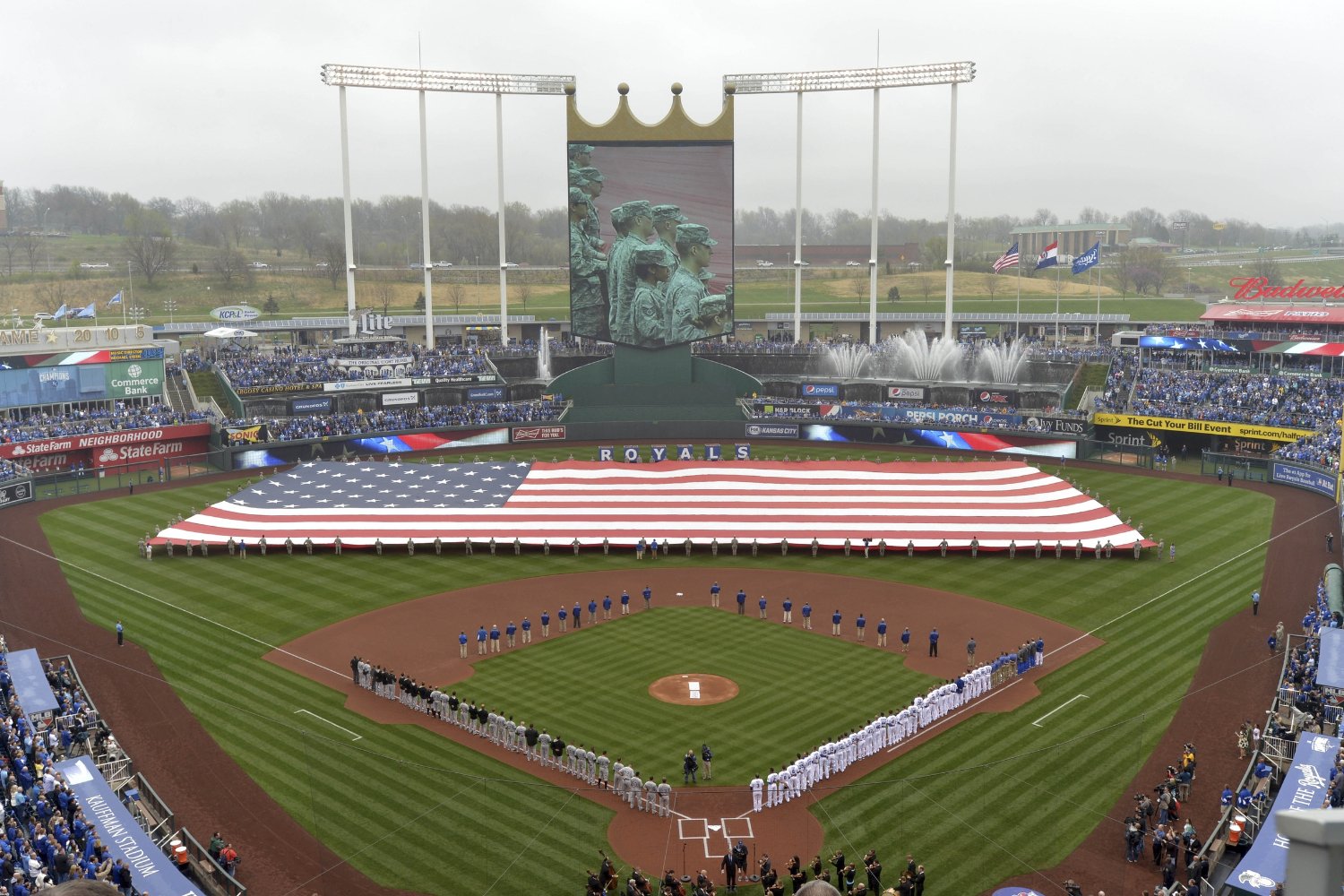
On Tuesday morning, reports circulated that the Royals would be moving the fences in at Kauffman Stadium to generate more home runs and, thus, more offense. Jeff Passan was the first to break news on the report.
Later in the morning, the Kansas City Royals confirmed the report and held a press conference in the afternoon featuring GM JJ Picollo and Vice President of Research and Development Dr. Daniel Mack. A replay of the press conference is available on the Kansas City Royals' YouTube channel, embedded below.
The Royals' decision is a bit of a surprise, especially since owner John Sherman has said the Royals will move out of Kauffman Stadium when its lease expires in 2031. Furthermore, Kauffman actually profiles as a hitter's park based on Statcast Park Factors. The 101 Park Factor over the past three years is the sixth-highest in baseball, according to Baseball Savant.
That said, Kauffman has been a dead zone for home runs, especially recently. The 85 Home Run factor is tied for the third-lowest mark in baseball from 2023 to 2025 (they are tied with Cleveland's Progressive Field). Only Pittsburgh's PNC Park (76) and San Francisco's Oracle Park (82) have a lower HR factor than Kauffman Stadium. However, the Royals' home park is quite spacious, which has led to higher Double (113) and Triple (183) factors, both Top-5 marks in the league. That explains the high overall Park Factor since 2023.
Hence, let's see the exact changes to Kauffman, which hitters will benefit the most, and what drawbacks could come with the new dimensions?
Creating a More Neutral (Not "Hitter Friendly") Ballpark is the Goal
Anne Rogers, the Royals beat writer for MLB.com, went into the changes to the dimensions in her latest article. She talked about the walls being moved in and lowered in height, as illustrated in the segment below.
QuoteThe left- and right-field walls will be moved in nine to 10 feet, starting close to the foul poles and then tapering toward center field, where 410 feet will remain the distance from home plate. The wall height is going from 10 feet to 8 1/2 feet in most places. There will be more seats available, about 150 in left field and about 80 new drink-rail seats in right.
According to a team-provided diagram, the left- and right-field corners are being pulled in nine feet, from 356 and 353 feet, respectively, to 347 and 344 feet. The previous distances of 373 in both left and right fields will be nine feet closer, at 364 feet. Left-center and right-center fields will be moved in 10 feet, from 389 feet to 379 feet.
As illustrated in her piece, the Royals will have better opportunities to hit home runs, which have dogged Royals hitters for years. The Royals actually made similar changes to Kauffman's dimensions in the 90s, moving the fences in by 10 feet. However, in 2004, the Kansas City Royals ownership decided to move it back to its original dimensions, where it's been Death Valley for home runs since. Before 2019, no Royals hitter had hit more than 40 home runs in a single season (two have hit that 40+ mark: Jorge Soler and Salvador Perez, who both hit 48 in 2019 and 2021).
In addition to encouraging more runs, the new dimensions will also add additional seating. Based on the changes, Kauffman will gain 230 additional seats, providing an economic benefit to ownership.
In Picollo and Mack's press conference, they both remarked that the park will remain spacious, with outfield defense prioritized. Picollo mentioned that Kyle Isbel and his glove would still be immensely valuable in center field, thus showing that the Royals won't be changing their identity anytime soon. The Royals GM said the goal of this change was not to create an "offensive" ballpark, but to make it more neutral for Royals hitters.
Quote“Our goal here isn’t to have an offensive ballpark,” Picollo said. “It’s to have a very fair ballpark. We don’t want it to turn into a bandbox and every ball up in the air turns into a home run. We just want hitters to be rewarded when they hit the ball well, particularly in the gaps.”
Mack mentioned that a lot of time and research went into confirming these changes and determining whether they would be in the Royals' best interests. That included research not just into the effect of the walls, both in terms of height and distance, but also how the weather would impact the new dimensions of Kauffman.
Quote
“These sorts of conversations about the park have been pervasive my entire time with the Royals,” said Mack, who is entering his 14th season with Kansas City. “I think it’s informed the philosophy of how we’ve tried to build this team. It was a fact, almost, that what the stadium is and what the club is have to be intermeshed with one another.
“Alan and I started breaking it down. What’s the effect of the walls? What’s the effect of the altitude? What’s the effect of the temperature and wind? Trying to figure out how to take all those effects into account and balance them.”
Much like Picollo echoed, Mack confirmed that they wanted to change the dimensions to make things fairer for hitters, not to punish pitchers. The Royals understand that deeper dimensions have been beneficial to pitchers, especially those who can induce weak or moderately hit fly balls. They didn't want the Royals' pitchers to lose that advantage or ability due to these new ballpark changes.
Quote“The idea was to find a way to improve [the run value per fly ball] without improving it to a point that it hurts our pitching staff,” Mack said. “Do it in a way that helps our players. When they play at Kauffman, they don’t have to play one specific way, and then when they go to another ballpark, even if it’s way on the other extreme, all of a sudden, they’re thinking about, ‘Do I have to do something different offensively there in order to be successful versus what I do at Kauffman?’ Trying to find that fairness and consistency across the board.”
Mack's "not having to play a specific way" comment is interesting. The Royals led the league in Infield Fly Ball percentage last year with an 11.9% mark. Interestingly, the data doesn't show that the Royals as a team hit more "pop-ups" at Kauffman Stadium compared to on the road. Here are their home/road splits for IFFB% and HR/FB%.
- Home: 9.4% IFFB% (16th); 8.0% HR/FB% (29th)
- Away: 14.2% IFFB% (1st); 9.5% HR/FB% (29th)
The Royals had a 4.8% higher IFFB% on the road than at home and sported a 1.5% lower HR/FB rate at Kauffman. That big spike in IFFB% could signify that the Royals were trying to hit more flyballs and thus, home runs, away from the K, but that approach was counterintuitive. The Royals are hoping that focusing on the same approach at home and away will narrow the gap in home/away IFFB%, leading not only to better HR/FB% production but also to more runs overall (they ranked 26th in runs scored last year).
Which Hitters Will Benefit the Most?
As expected with these dimension changes, Royals fans and the fantasy baseball community came out in full force with their theories of which Royals hitters will benefit the most in 2026.
Eric Cross of Rotoballer pointed out the core four Kansas City hitters: Bobby Witt Jr., Maikel Garcia, Vinnie Pasquantino, and Salvador Perez. In his tweet, he shared their spray charts and implied that they could be due for some positive regression in home runs with the ballpark changes.
When looking at the spray chart last year and fitting into next year's dimensions, things look optimistic for the Royals' four primary hitters. It's easy to see that Witt, Pasquantino, Perez, and Garcia could get an extra five to seven home runs with a similar spray chart next season, at a minimum. Thus, it isn't out of the question to think that Garcia could hit 20+ HRs, Witt collect 30+ HRs, and Perez and Pasquantino touch the 40-HR mark.
That kind of 20 to 30-HR increase from their four most important hitters will have a tremendous boost on the Royals' offense, which not only struggled with home runs last year (they ranked 26th) but run consistency. Furthermore, the new dimensions could also channel the power of budding hitters like Jac Caglianone.
Caglianone struggled as a rookie last season. The former Florida Gator and 2024 Royals first-round pick posted a 46 wRC+ and hit seven home runs in 232 plate appearances. However, when looking at his spray chart modified to Target Field (which mirrors the new Kauffman Stadium changes), he would have hit double-digit home runs, which would have helped his overall production a season ago.

A home park that is friendlier to Caglianone could help him build confidence and be that much-needed 20+ HR hitter that the Royals need in the middle of the lineup. After all, his .318 xwOBA was much better than his .239 actual wOBA, which means that there is potential for positive regression for Caglianone in 2026, even without the changes to Kauffman Stadium. However, with the new ballpark dimensions, the soon-to-be 23-year-old outfielder could surpass his 18-HR Steamer projection by a considerable margin.
It's one thing for Witt, Perez, Pasquantino, and Garcia to see a boost in their home run numbers. They have proven to be productive hitters in the past, even if the home runs haven't been consistent. That said, seeing a breakout from Caglianone or someone else due to the new dimensions is a benefit more than worth the price of the ballpark changes.
How Will This Affect the Pitching Staff?
The Royals' pitching staff was an interesting one in terms of their batted-ball profile. They allowed the sixth-lowest HR/FB% in baseball with a 10.7% mark, and they ranked 17th in FB% allowed with a 38.3% mark. A key to their success was their ability to induce infield fly balls, as they ranked 9th with a 10.5% IFFB%.
When looking at the Royals pitchers individually, the table below shows their batted-ball profiles, organized by IFFB%.

When it comes to which pitchers to worry about with the new dimensions, the ones with high FB% and IFFB% rates are worth watching. Carlos Estevez (15.5% IFFB%), Michael Wacha (14%), Cole Ragans (12.3%), and Kris Bubic (12.3%) are the ones most likely to be affected by the fences being moved in. Their flyballs could be home runs with the new dimensions.
For context, let's look at the spray chart for Estevez, with it modified to Target Field dimensions (much like Caglianone).

Estevez not only had the highest IFFB% of returning pitchers, but also the highest flyball percentage at 51.6%. And yet, his HR/FB rate was only 5.2%, the fourth-lowest of Royals pitchers with 10 or more IP last year. With the new dimensions, he could be due for a sharp regression. That explains why Kansas City has been aggressive in terms of adding relievers who can generate chase, whiffs, and strikeouts like Alex Lange, Nick Mears, and Matt Strahm.
Pitchers who induce higher groundball rates could be more protected from the new ballpark dimensions in 2026 and beyond. That includes Stephen Kolek (53.5%), Lucas Erceg (52.8%), Luinder Avila (50%), and even Bubic (47.2%). I think those three pitchers could be due for strong seasons, especially Erceg, who plateaued a bit in 2025 after a sensational 2024 debut with the Royals.
.png.74704f7e81d365e6076212bd8ddce9f5.png)
Thus, Royals fans should feel more confident in pitchers with this groundball-inducing profile, as well as those who can generate whiffs and strikeouts. Having those three qualities will be more important than ever with the new dimensions, even if the K will still be slightly pitcher-friendly. If the Royals acquire any more relievers this offseason, it shouldn't be surprising if they profile well in those three areas mentioned above.





Recommended Comments
There are no comments to display.
Create an account or sign in to comment
You need to be a member in order to leave a comment
Create an account
Sign up for a new account in our community. It's easy!
Register a new accountSign in
Already have an account? Sign in here.
Sign In Now