


Royals Video
You are 23 years old. You are living your childhood dream, playing for the major league team in your home state, roughly an hour from your hometown. You made the Opening Day roster, even, going from Single-A ball to the majors in one offseason. And then, your body betrays you. Not exactly a physical ailment–that is understandable, just a part of sports. No, this is worse. Because it’s a little-known, barely-understood (even by doctors) neurological disorder. It’s been with you your whole life. And now, with the world at your fingertips, it is destroying your dream.
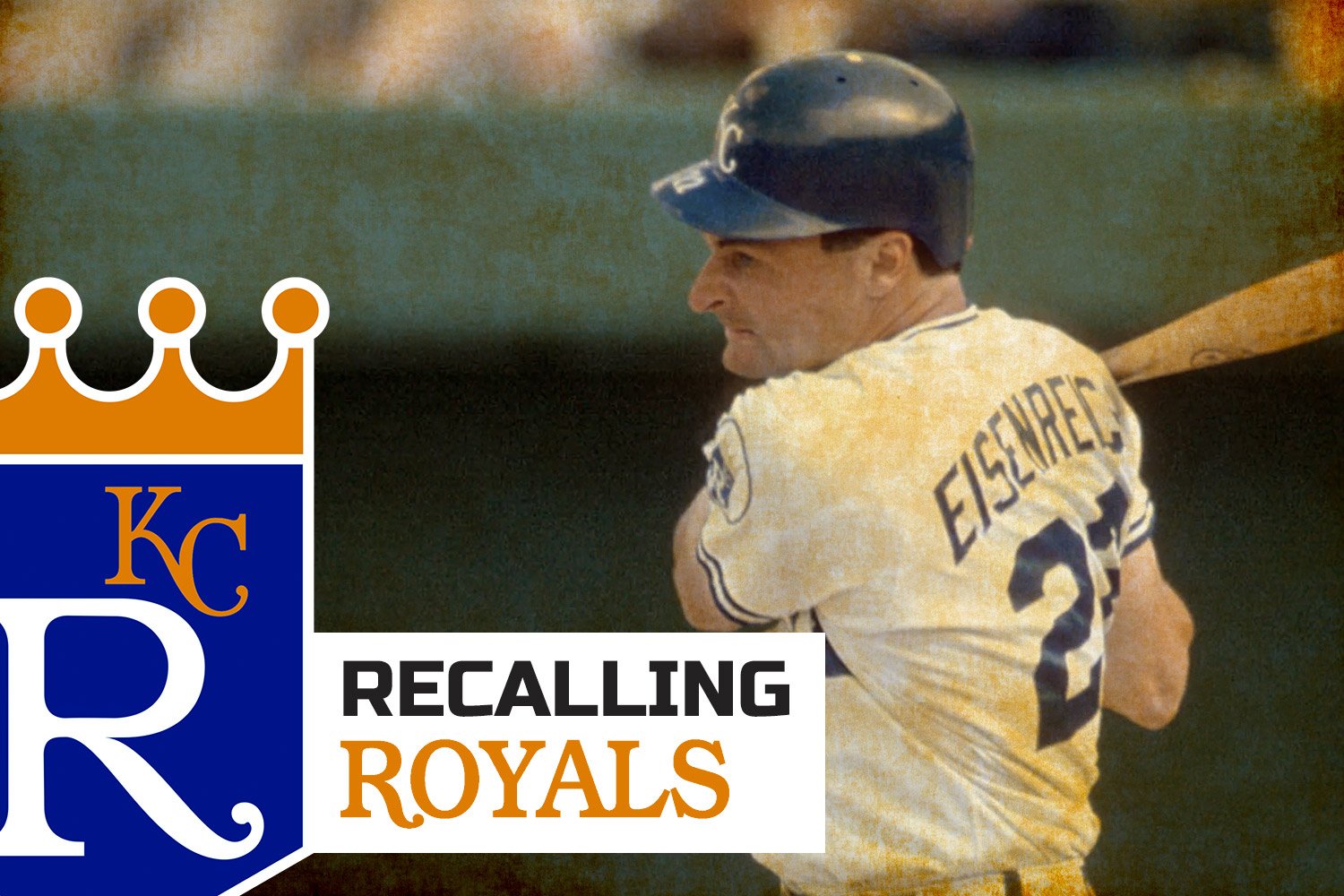
The disorder is Tourette Syndrome. The player is Jim Eisenreich. And the story is inspiring.
James Michael Eisenreich was born on April 18, 1959, in St. Cloud, Minnesota. Born and raised there, in fact, he attended St. Cloud Tech High School and St. Cloud State University before the Minnesota Twins selected him in the 16th round of the 1980 June amateur draft.
Eisenreich signed quickly and played in 67 games for the Elizabethton (Tennessee) Twins in the rookie-level Appalachian League. He did well, hitting .298/.386/.411, and was bumped up to single-A Wisconsin Rapids for a handful of games at the end of the season. In 1981, he returned to Wisconsin Rapids and was sensational, hitting .311/.407/.507 in 585 plate appearances. With the Twins undergoing a youth movement, they extended a non-roster invite to Eisenreich for spring training in 1982. They probably figured they’d get him some experience with the big leaguers. Instead, they got their Opening Day center fielder.
Things went well for the first month of the season. The Twins weren’t great, but Eisenreich was hitting around .300 and had smacked a couple of home runs. But then, his lifelong affliction came to the forefront. During a three-game home series against Milwaukee, Eisenreich was removed early from each game, as he was hyperventilating. And then things got worse.
The Twins were in Boston. Eisenreich was in center field. And when the tics began, the fans, who by now had read about the rookie’s issues in the newspapers, noticed. The taunts and jeers were too much, and Eisenreich left the game in the fourth inning. The next night, the same thing, except he was removed in the third game. The night after that, he told manager Billy Gardner he didn’t want to play.
The team doctors tried different medications. Hypnosis was suggested. He went on the injured list for a few weeks as various remedies were tried. Finally, he found a medication that worked, but it made him tired, and he was not playing as well as he could. When he reduced the dosage, the symptoms returned. Ultimately, he played in 34 games, hitting .303/.378/.424 in 111 plate appearances.
Eisenreich reported to spring training in 1983 ready to play, but after a couple of interviews early, he did not want to talk about his condition.
“No one seemed able to help me. My attitude became, ‘If you can’t play Major League Baseball, so be it.’ That was tough to admit. Playing in the majors was my lifetime ambition. But I had to face reality, that maybe it wasn’t for me.”
--Eisenreich, quoted by Bob Fowler, The Orlando Sentinel, February 22, 1983
But, despite a strong spring training, his struggles returned. After just two regular-season games, he decided to walk away from baseball, with plans to go back to college. The Twins, who had been supportive and understanding throughout, placed him on the disabled list, hoping they could change his mind. They were unsuccessful, at least until the offseason. He returned for spring training in 1984, but things went almost exactly as they did the year before. Good spring training, then the problems returned, and after 12 games, he wanted to walk away again. The Twins, who were now displeased that Eisenreich had changed medications on his own, finally reached a settlement with the player that placed him on the retired list.
His career to this point might have been a sad footnote in baseball history. He returned to St. Cloud, getting his baseball fix in softball and semi-pro leagues, where he was, as you might expect, a star. Even better, he figured out the routine that would keep his symptoms at bay. One of his college teammates, Bob Hegman, was by now working in the Royals’ front office and recommended the team take a chance. Shortly after the 1986 season ended, the Royals claimed him for the waiver price of $1.
Eisenreich began the 1987 season at double-A Memphis, where he proved he could still hit, posting a video-game-like .382/.469/.705 line in 324 plate appearances. The Royals, trying to hang in the division race with a mediocre offense, called him up in mid-June. He had only appeared in a few games when he got his storybook moment, delivering a pinch-hit double in the ninth for a walkoff win over Minnesota.
Because he had suffered an elbow injury in spring training, Eisenreich did not play any outfield in 1987, serving as a DH and pinch-hitter and finishing the year with a .238/.278/.467 line. With the elbow injury and the inability to play outfield, it was tough to find regular playing time, but the important thing was that Eisenreich had proven he could last in the majors.
Eisenreich made the Opening Day roster in 1988, but struggled mightily for three months before the Royals optioned him to Triple-A Omaha. He seemed to regain his batting stroke there, hitting .289/.327/.472, and hit .271/.295/.356 when he came back to the majors for 27 games.
That might have been the turning point for his career. He enjoyed his finest season to date in 1989, hitting .293/.341/.448 and playing regularly, a total of 134 games. For the next three seasons, he would be a solid bat in the Royals’ lineup and a good glove in the outfield.
The Royals let Eisenreich depart as a free agent following the 1992 season, but his career still had quite a bit of time left. He signed with Philadelphia and was their starting right fielder as they made a surprising run to the World Series. Eisenreich hit a three-run home run in Game 2, staking the Phillies to a 5-0 lead in a game they eventually won 6-4, but Toronto would win the Series on Joe Carter’s walkoff home run in Game 6.
Eisenreich stayed in Philadelphia through 1996, then signed with the Florida Marlins before the 1997 season. He was now a backup outfielder and first baseman, but his timing was great again as the Marlins reached the World Series. This time, Eisenreich was on the winning side. Although he had only 11 plate appearances in the Series, he posted a .500 batting average, a home run, and 3 RBI. He was on second base when Edgar Renteria’s single scored the winning run and ended the Series in Game 7.
Of course, the Marlins followed that title with a fire sale during the 1998 season, and in mid-May, Eisenreich was traded to the Los Angeles Dodgers in the deal that made Mike Piazza a Marlin for about five minutes. A free agent after the season ended, Eisenreich discussed a return to the Royals, but the team, still in financial limbo after Ewing Kauffman’s death and under the control of a temporary ownership group, decided they couldn’t afford him. Like many former Royals, Eisenreich had maintained a home in the Kansas City area, so he stayed in the area. He and his wife had started a foundation for youth with Tourette syndrome in 1996, so that his family became his focus.
For his career, Eisenreich finished with 1,160 hits and a .290/ 341/.404 batting line. It was a solid career that could easily have been derailed by his affliction, but he was able to overcome that.
Do you approve of the job the Royals front office is doing?

Follow Royals Keep For Kansas City Royals News & Analysis



-
 1
1


Recommended Comments
There are no comments to display.
Create an account or sign in to comment
You need to be a member in order to leave a comment
Create an account
Sign up for a new account in our community. It's easy!
Register a new accountSign in
Already have an account? Sign in here.
Sign In Now