


Royals Video
When the tying or go-ahead run is standing on second, the Royals' staff has a knack for falling apart in ways that cold, hard numbers, like the 50 homers they've surrendered with runners on base, the most in the majors, barely begin to capture. They've allowed 46.6% of their total runs via the long ball, the second-highest rate in baseball and well above the league-average mark of 39.8%. They've also given up 13 three-run homers, tied for third-most. The trend followed them to Washington in their last series, where six of the fifteen runs they coughed up came on just two swings; both three-run shots.
The Strikeout Trap
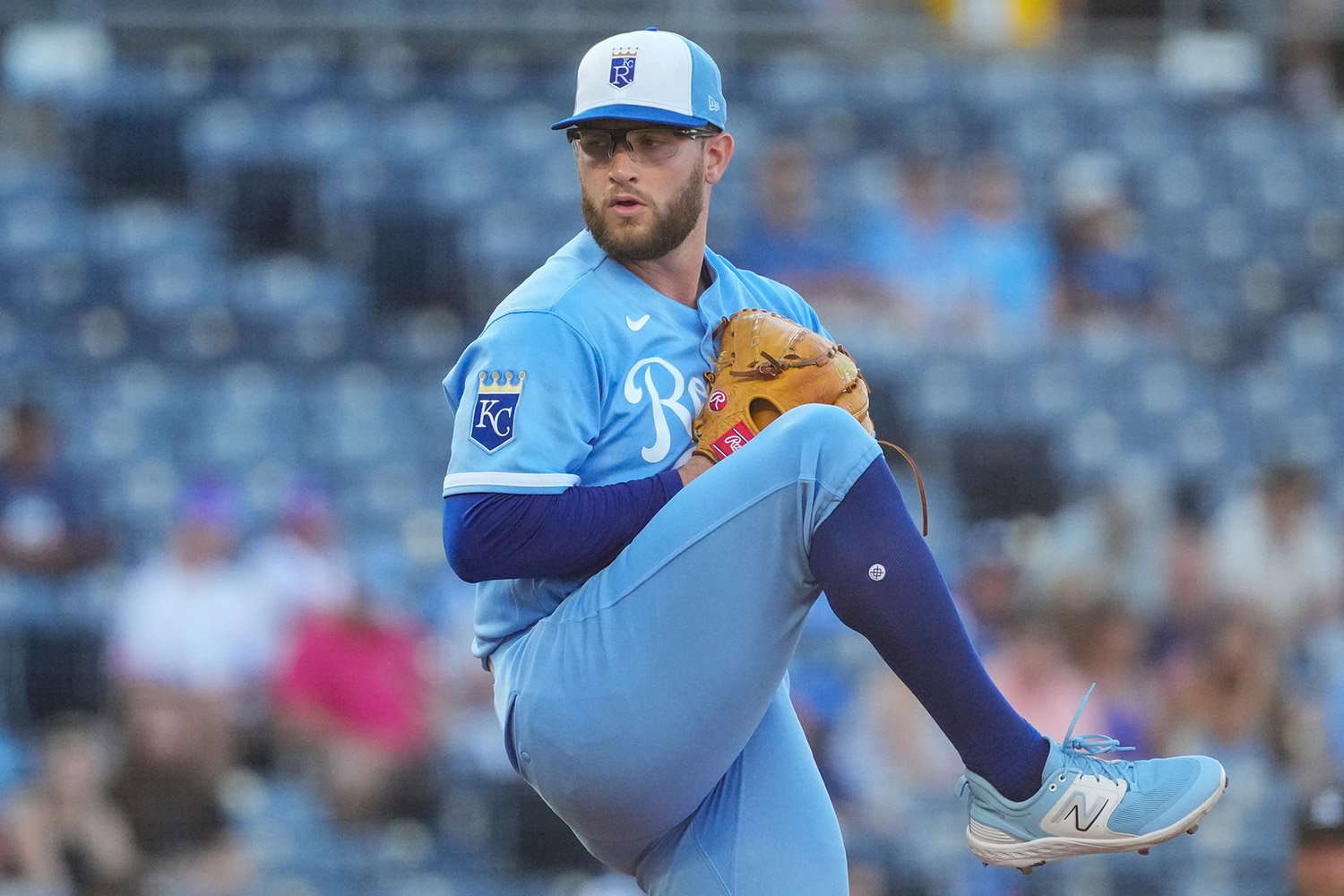
Noah Cameron has been, on paper, one of the more intriguing arms in the system. His slider generates whiffs, and his 18.6% strikeout rate in pressure-packed plate appearances is nothing to dismiss. But when Cameron misses, he misses in the worst possible locations. Across 70 high-leverage trips to the plate, he's allowed five homers, paired with a 15.7% barrel rate and a .552 expected slugging percentage.

His heat map tells the whole story: a .696 xwOBA in the upper-middle third, and .452 on the inner half up. When he elevates his fastball or leaves it drifting into the hitter's wheelhouse, the punishment is immediate. Cameron hasn't lost his stuff—his sweeping slider is still nasty—but his arsenal, and particularly a fastball that lacks true vertical ride, is poorly suited for the high-leverage moments he's being thrown into.
Michael Wacha sits on the opposite end of the spectrum. He doesn't beat himself with free passes (3.8% walk rate in high-leverage spots), but his fastball averages just 88.4 mph, and hitters know it's coming. His HardHit% in those same clutch situations sits at 45.2%, and the five homers he's allowed with the game on the line are no fluke.

Wacha's heat map flashes danger zones at .720 on the low-outside corner and a staggering .779 in the lower-middle. Throwing strikes without the ability to miss bats or induce weak contact is a death sentence in today's game, and right now Wacha is turning too many at-bats into damage opportunities. The silver lining? His changeup and curveball remain legitimate weapons—and he'll need to lean on them heavily to reverse this trend.
| Pitcher | Situation | PA | HR | K% | BB% | Barrel/BBE% | HardHit% | xSLG | xwOBA |
|---|---|---|---|---|---|---|---|---|---|
| Noah Cameron | Go-Ahead/Tie | 70 | 5 | 18.6% | 8.6% | 15.7% | 39.2% | .552 | .394 |
| Michael Wacha | Go-Ahead/Tie | 80 | 5 | 18.8% | 3.8% | 9.7% | 45.2% | .540 | .370 |
| Seth Lugo | Go-Ahead/Tie | 65 | 2 | 18.5% | 7.7% | 16.7% | 47.9% | .618 | .400 |
| Lucas Erceg | Go-Ahead/Tie | 54 | 0 | 14.8% | 13.0% | 0.0% | 31.6% | .331 | .333 |
| Kris Bubic | Go-Ahead/Tie | 56 | 2 | 25.0% | 7.1% | 10.5% | 44.7% | .483 | .345 |
| Daniel Lynch IV | Go-Ahead/Tie | 38 | 2 | 26.3% | 10.5% | 12.5% | 37.5% | .438 | .318 |
Seth Lugo is the most fascinating case study of the bunch. He's allowed only two homers across 65 high-leverage plate appearances, yet his .618 xSLG leads the team, and his HardHit% checks in at 47.9%. Lugo is surviving, make no mistake—but he is absolutely not dominating.

His heat map is genuinely concerning: a .921 xwOBA up and away and .571 in the upper-middle. Hitters are squaring him up all over the zone, but Kansas City's elite defense has masked a surprising amount of loud contact. Lugo is navigating treacherous waters, and his expected slugging suggests those loud contact events are going to start finding grass and bleachers sooner rather than later.
Lucas Erceg offers the stark contrast. He has allowed zero home runs in 54 high-leverage appearances. His barrel rate sits at an immaculate 0.0%, his HardHit% at 31.6%, and his .331 xSLG is the lowest on the entire staff.

His heat map is ice-cold across almost every quadrant. That sinker, with its extreme horizontal run, generates weak grounders on command. Erceg isn't trying to punch anyone out; he's trying to keep the ball inside the yard, and so far, he's executing that mission flawlessly.
Daniel Lynch IV: The Name No One Mentions
Lynch has surrendered just two homers in 38 high-leverage plate appearances, striking out 26.3% of hitters while posting a .318 xwOBA—the second-lowest mark among the group.

His heat map is the coldest of them all. He has a lone hot spot in the upper-middle (1.860 xwOBA), but everything else is deep blue: .265 up and away, .160 low and away, .097 low and in. Lynch leans on his changeup and slider to keep hitters off-balance and guessing. In a season where the pitching staff has been a perpetual headache, Lynch has quietly morphed into a reliable, go-to weapon.
The Path Forward
Cole Ragans is on the injured list. So is Kris Bubic. Carlos Estévez, who was supposed to anchor the bullpen, has been sidelined since April. Ragans, before his shutdown, was the most intriguing rollercoaster of them all: a dazzling 34.4% strikeout rate in high-leverage spots, undermined by a shaky 12.5% walk rate. His control issues turned every outing into a crapshoot. Bubic's absence (2 HR allowed in 56 PA, .483 xSLG) has left a void that neither Cameron nor Wacha has been able to fill with any consistency.
The Royals need their arms to find the command that has so far eluded them when the game hangs in the balance. Erceg and Lynch have proven it's possible. Cameron and Wacha are due for adjustments. Lugo is walking a tightrope, and his heat map suggests the reckoning could be closer than his traditional ERA indicates.
But this isn't just a pitching problem. The offense hasn't held up its end of the bargain, either. When the staff has coughed up runs in critical spots, the bats have largely gone silent. Kansas City has scored just 33.9% of its runs via the home run, ranking 26th in the big leagues. Worse, their homers have been overwhelmingly solo affairs—nine of their last ten have come with the bases empty. To win close, low-scoring affairs, you need more than just consistent pitching and defense; you need timely thunder.
When Ragans, Bubic, and Estévez eventually return, the front office will have a chance to recalibrate the hierarchy. But the lesson of this season is already crystal clear: the talent is plainly there. What's missing is dependability when the game is hanging in the balance. If this staff can finally find its rhythm in pressure-packed situations—and if the lineup starts connecting with ducks on the pond—those narrow losses will start flipping into gritty wins.
For now, though, the Royals are still searching for that elusive consistency. When they find it, one-run games will finally start tilting in their favor.





Recommended Comments
There are no comments to display.
Create an account or sign in to comment
You need to be a member in order to leave a comment
Create an account
Sign up for a new account in our community. It's easy!
Register a new accountSign in
Already have an account? Sign in here.
Sign In Now