


Royals Video
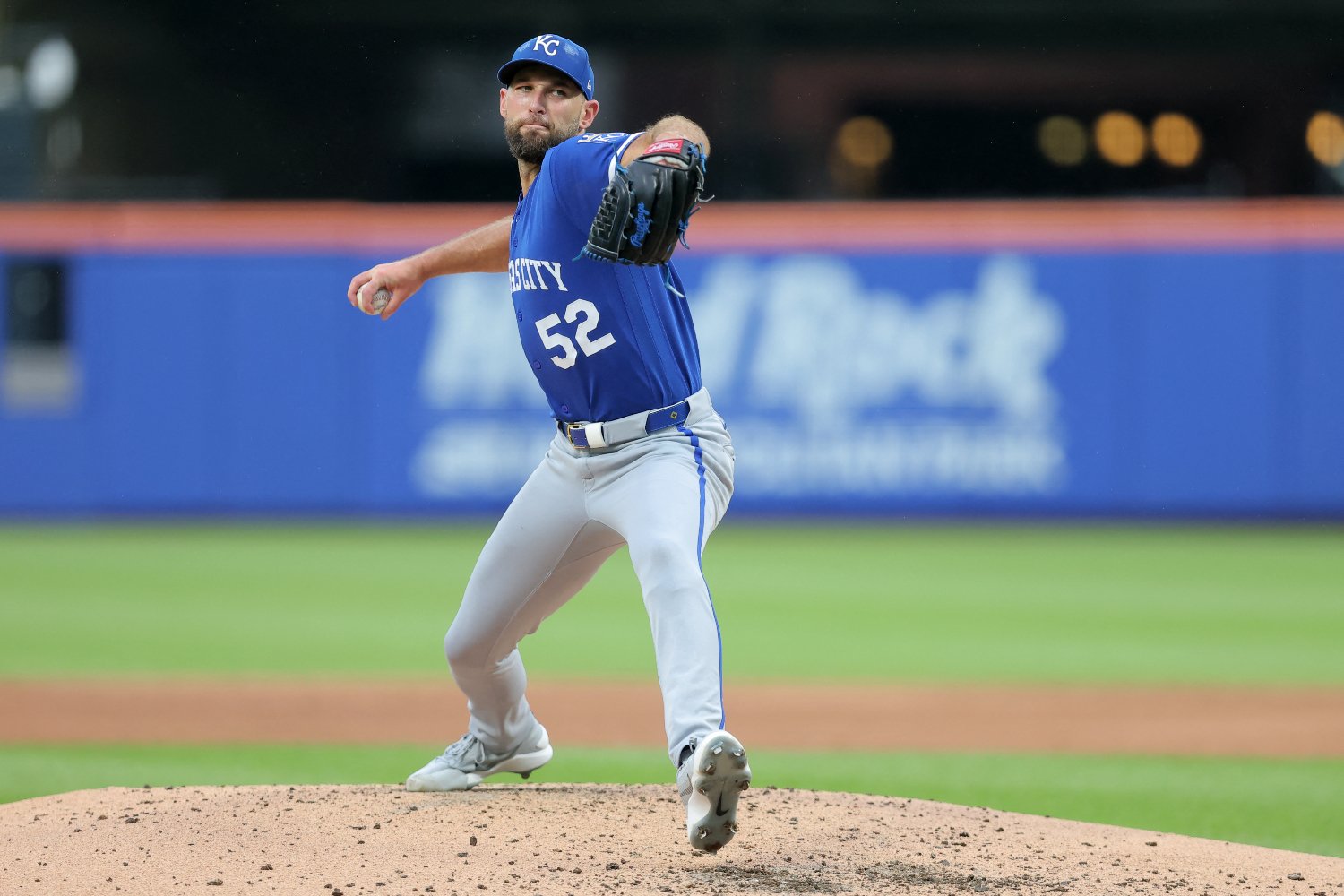
Before Thursday's rubber game against the New York Mets, Ken Rosenthal of The Athletic reported that the Royals were unlikely to trade starting pitchers Michael Wacha and Seth Lugo by the August 3rd Trade Deadline.
Rosenthal reported that they would not trade either starting pitcher barring a "massive" return. With a 4.56 ERA and $21.5 million due next year, it is unlikely that Kansas City would trade Lugo at the Trade Deadline. Not only would the return be meager, but the Royals would have to eat some of Lugo's contract to make a deal enticing for an opposing ballclub. For a team with a limited payroll, that isn't exactly a recipe for success.
Wacha, on the other hand, is a tougher dilemma for the Royals.
While he has had two difficult outings recently, the 35-year-old starter has been Kansas City's most dependable pitcher and one of baseball's most durable.
In 119.1 IP, Wacha has produced a 3.77 ERA, 1.19 WHIP, 4.05 FIP, and 12.7% K-BB%. He ranks in the top three in innings pitched this year, and his 12 quality starts rank fourth in all of baseball. Even though his stuff isn't elite, the veteran righty has been crafty enough to generate strikes and limit hard contact for the most part, as evidenced by his Statcast percentiles this season.
.png.851957a89803e085b6041770541a9aef.png)
With pitching, starting pitching especially, in demand across the league, Wacha remains the Royals' best trade chip. However, for a Royals team that is 38-56 and coming off back-to-back winning seasons in 2024 and 2025, he could be key to Kansas City's competitiveness again in 2027. The Royals need pitching stability, and they don't have it, with Cole Ragans recently undergoing elbow surgery and Kris Bubic likely not returning in 2027.
Thus, do the Royals hold on to Wacha, as the report indicated, or should they make a deal, even if it may not be the "massive" one they are hoping for?
The Case to Keep Wacha
From 2024 to 2026, Wacha has been one of the most valuable starting pitchers in baseball, according to Fangraphs.
His 9.0 fWAR ranks 16th among all starting pitchers since 2024, and his 454 IP rank 9th as well. He is also tied for 14th in quality starts with 39, tying him with Nathan Eovaldi, Chris Sale, and Luis Castillo. His 3.57 ERA also ranks 25th, putting him ahead of Dylan Cease, Gavin Williams, and Sonny Gray.
The main issue is that Wacha doesn't strike out guys in bunches like those other names listed. His 19.4% K% ranks 65th of 85 qualified starting pitchers over that 2024-2026 period. His 12.9% K-BB% also ranks 55th. Thus, it's easy for fans to overlook Wacha as a quality starting pitcher, though he has finally received the recognition he deserves this year, being named to the AL All-Star Game roster.
Thus, while the Royals may be tempted to trade Wacha, they need someone to hold down the top of the Royals' rotation in 2027. Wacha has done it so far with Ragans and Bubic injured, and he may be up for it again in 2027. Furthermore, he's holding this role while only making $18 million this year and $14 million next year.
That latter is a steal for a No. 1-2 starting pitcher. For context, here's the list of 2027 unrestricted free-agent starting pitchers, and notice those pitchers "currently" making $14 million or less. It's not a great list.
Of the list of free-agent starting pitchers who are making under $14 million, I predict that Casey Mize, Foster Griffin, and Freddy Peralta are the only ones of quality, which means they will likely exceed that $14 million AAV mark in their next contract. If the Royals deal Wacha and try to replace him with someone else on their list, they're taking a flier on someone with far less dependability (Brady Singer, Tomoyuki Sugano, or Trevor Rogers) or on an injury risk (Patrick Sandoval or Shane Bieber).
The ceiling may not be all that high for Wacha. That said, the ceiling is clear and dependable, not to mention a value for a pitcher who will be making less next year than questionable arms like Shota Imanaga, Jack Flaherty, Lance McCullers Jr., and Jameson Taillon, to name a few.
Furthermore, the Royals haven't been able to acquire many free-agent starting pitchers of Wacha's caliber in the past. Since the World Series run in 2015, the most high-profile pitcher the Royals acquired on a long-term deal in free agency was Ian Kennedy in 2016, who had an underwhelming run from 2016 to 2020 in Kansas City.
This isn't a coincidence.
Part of it is due to the Royals' history of incompetence. With only two winning seasons since their World Series title (both under Matt Quatraro, by the way), the Royals aren't exactly a franchise with a "winning" reputation. Furthermore, Kansas City can be a brutal place weather-wise in the summer, and it's one of the smallest markets in Major League Baseball (only Cincinnati and Milwaukee are smaller).
Wacha was able to look past those other factors and not only sign an initial long-term deal with Kansas City but also an extension. If the Royals trade Wacha after just signing him to an extension before the 2025 season, they could risk their chances at other free-agent starting pitchers in the future.
After all, why should competent free-agent starting pitchers sign in the muggy, small-market metro of Kansas City when they are just going to get traded in a couple of years anyway? Not keeping veteran arms works for Milwaukee because they have a premium pitching development program in the Minors. That said, with a dearth of MLB-ready arms in Triple-A or Double-A, the Royals don't have the luxury of emulating the Brewers' pitching strategy just yet (though they could in a year, especially if they have a good draft).
Why the Royals Should Trade Wacha
The main concern with Wacha is that he's 35 years old and will be 36 next year. While he has done a good job of staying healthy and effective as a Royal, there is a higher risk that regression will hit Wacha harder in 2027. That was certainly the case for Salvador Perez, and there were fewer signs of a sharp regression for Salvy in 2025.
When looking at his TJ Stuff+ summary comparison from 2025 to 2026, Wacha has remained relatively stable in results, but TJ Stuff+ has shown some regression on a couple of pitches, as shown below.

Wacha's overall TJ Stuff+ went from 97 in 2025 to 96 in 2026. His four-seamer improved from 94 to 96, which is good, considering it's been his most-used pitch over the past couple of years. He has also seen an improvement in his sinker, as it has gone from an 88 TJ Stuff+ to 90 TJ Stuff+. However, his curve (96 to 95), slider (102 to 101), cutter (97 to 93), and changeup (102 to 100) have all seen regression in TJ Stuff+.
The results have been fine this year, with the chase rate (1.6% improvement) and whiff rate (0.6% improvement) up and the xwOBACON down (.374 in 2025 to .351 in 2025). That said, he has seen a significant decline in the zone rate, from 52.9% in 2025 to 49.8% in 2026. That's a 3.1% decline, and he didn't exactly excel in that category in his rough outing against the Mets on Thursday, as seen below in his TJ Stuff+ summary.
.png.5bf868723866fbc903a84bb13b18972c.png) Wacha's zone rate against the Mets was 45.2%, and his overall TJ Stuff+ was 93. Both marks were 4.6% and 3 points below his season-long marks in those categories. That's not what the Royals or fans want to see, especially before the All-Star Break.
Wacha's zone rate against the Mets was 45.2%, and his overall TJ Stuff+ was 93. Both marks were 4.6% and 3 points below his season-long marks in those categories. That's not what the Royals or fans want to see, especially before the All-Star Break.
Now, one or a few bad outings won't affect Wacha's trade value. Any team knows what Wacha is and the risks he carries, both for the remainder of this season and 2027. That said, Wacha's value will be much higher now at the Trade Deadline than in the offseason, especially with the outlook for 2027 play still unclear due to a potential lockout.
What Should the Royals Do?
I understand the Royals' aversion to trading Wacha "just to trade him." That's not a recipe for success in any trade, and those kinds of deals are reserved for guys who will be free agents this offseason. That's a strategy the Royals should take with assets like Bubic, Lane Thomas, and John Schreiber. Wacha, though? JJ Picollo ought to be patient, especially if he believes the Royals can bounce back in 2027.
While seasons like this year are deflating, the AL Central has remained wide open since 2024.
In 2024, the Royals, Guardians, and Tigers competed in the division. Last year, it was the Guardians and Tigers. This year, it's the Guardians, White Sox, and maybe the Twins and Tigers. Thus, if the White Sox and Twins can quickly bounce back into contention in the AL Central, the same could be true for the Royals. To do that, with no Ragans and barring a marquee free-agent starting pitcher (i.e., Skubal), the Royals need Wacha.
Still, could we see a team panic at the Deadline and overpay for Wacha? The Cubs desperately need starting pitching, and Wacha could be their No. 2 in the rotation immediately. Could that net the Royals not just a starting-pitching asset like Jordan Wicks, but also some high-ceiling guys like outfielders Kevin Alcantara and Josiah Hartshorn?
Picollo can't give away Wacha. That said, he has to be aggressive enough to pounce on the right deal for Wacha, not just to compete in 2027, but long-term as well.
If the Royals want to be the American League version of the Brewers, an organization they've expressed admiration for before, then they need to make an aggressive deal with Wacha, even if it may hurt initially and put Kansas City in a brief period of uncertainty.





Recommended Comments
Create an account or sign in to comment
You need to be a member in order to leave a comment
Create an account
Sign up for a new account in our community. It's easy!
Register a new accountSign in
Already have an account? Sign in here.
Sign In Now