


Royals Video
One thing most Royals fans should be accustomed to hearing about is budget restraint. And while John Sherman has shown some willingness to fork over cash to players, 2026 is already looking tight in the budget department. With current salary expectations and the assumption that the team will not increase payroll by more than a few million dollars, it can be projected that this winter the front office will have somewhere between $15 and $20 million to spend on free-agent acquisitions. For an MLB franchise and what players make in today’s game, that’s not a lot of dough. What this means is that, with what remains to spend, the signing must make sense both on the field and in the checkbook.
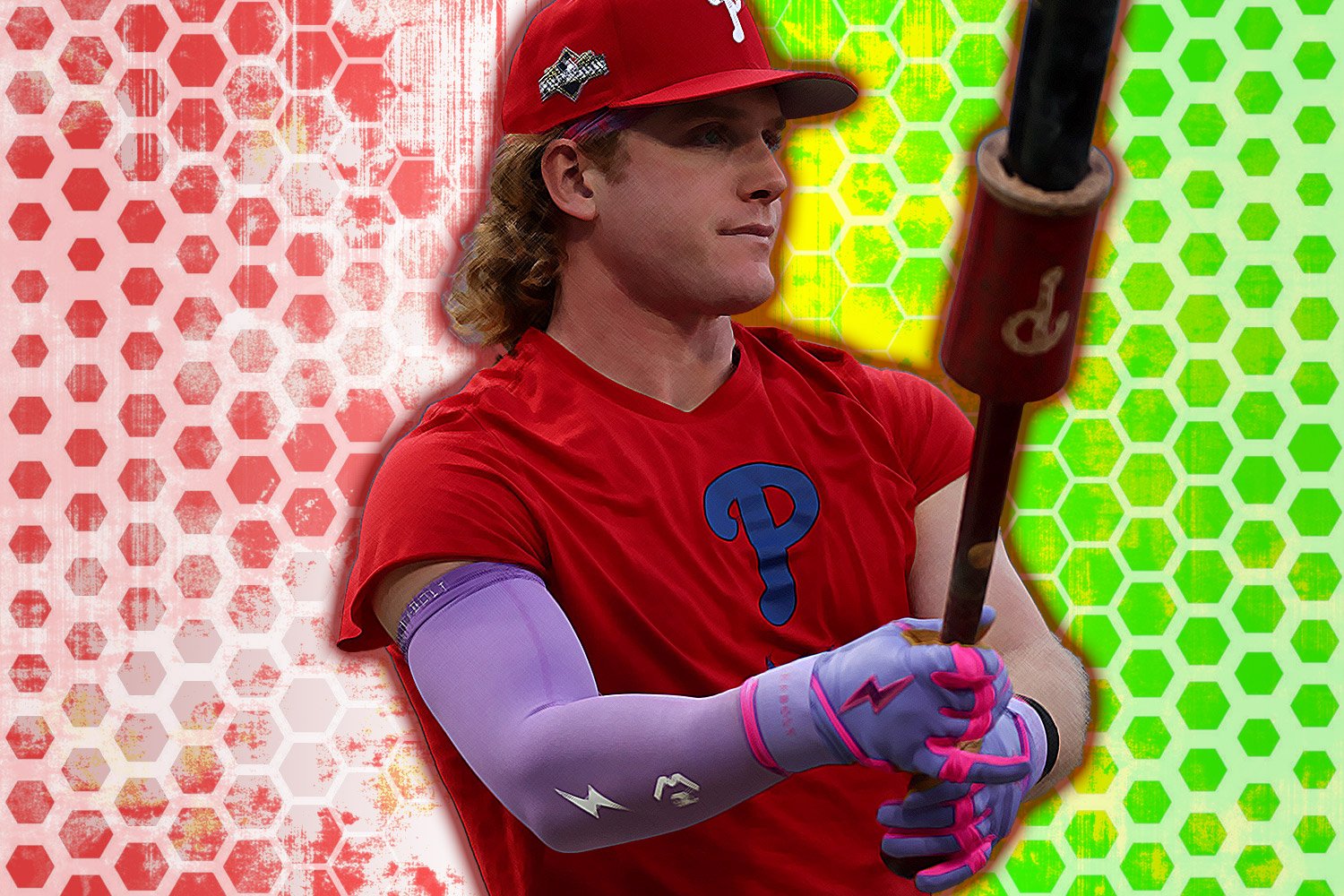
A lot of this year's offseason for Kansas City has circled the team looking for help in the outfield, specifically an everyday left fielder. Harrison Bader is one name that has hit the stove, and while his 2025 campaign was one of his best, the underlying numbers suggest this may not be a gamble the Royals should take.
Bader’s 2025 raw numbers look good; he had a .277 BA to go along with a .796 OPS while hitting 17 home runs and 54 RBI. His wRC+ was a respectable 122, and he had a 3.2 bWAR for the campaign. So what’s not to like? While this sort of performance would undoubtedly be an upgrade for the Royals' outfield, can the expectation be that Bader can repeat this in the upcoming season? The underlying metrics say not so fast. The first indicator to look at is Bader’s BABIP, or Batting Average on Balls In Play. This is sort of the catch-all for a player's “luck factor”. With 9 years and over 3,000 PAs under his belt, Bader has more than enough sample size to understand his normal range of production. His career BABIP is .305, which is right around league average, but his 2025 line shot up to .359. This is an immediate red flag for regression. Diving into the batted ball numbers, not much pops out as to what changed last season. His spray chart was consistent with his career averages; he wasn’t pulling the ball or sending it to the opposite field much more than usual. And his ground ball, line drives, and fly balls ratios were all in tune with what he typically hits. His FB% has come down over the last couple of seasons, which can be a positive for a player like Bader, as he has never been a slugger, but unfortunately, it hasn’t led to more line drives; instead, it has led to an increase in his groundball rate.
| Season | GB/FB | LD% | GB% | FB% | Pull% | Cent% | Oppo% | Soft% | Med% | Hard% |
|---|---|---|---|---|---|---|---|---|---|---|
| 2017 | 1.13 | 16.40% | 44.30% | 39.30% | 38.70% | 37.10% | 24.20% | 17.70% | 48.40% | 33.90% |
| 2018 | 1.19 | 26.80% | 39.80% | 33.50% | 46.50% | 29.60% | 23.80% | 21.50% | 40.80% | 37.70% |
| 2019 | 0.87 | 17.40% | 38.40% | 44.20% | 42.10% | 37.30% | 20.60% | 16.30% | 45.90% | 37.80% |
| 2020 | 0.93 | 15.20% | 40.90% | 43.90% | 41.80% | 32.80% | 25.40% | 23.90% | 40.30% | 35.80% |
| 2021 | 1.04 | 15.80% | 43.00% | 41.20% | 44.40% | 32.40% | 23.20% | 21.50% | 47.90% | 30.60% |
| 2022 | 0.92 | 16.40% | 40.10% | 43.50% | 39.70% | 41.80% | 18.50% | 24.10% | 50.40% | 25.40% |
| 2023 | 0.78 | 16.70% | 36.50% | 46.80% | 42.60% | 34.00% | 23.40% | 20.40% | 50.20% | 29.40% |
| 2024 | 1.19 | 21.10% | 42.80% | 36.10% | 47.00% | 36.40% | 16.60% | 19.20% | 54.30% | 26.50% |
| 2025 | 1.25 | 17.80% | 45.70% | 36.50% | 45.70% | 34.30% | 20.00% | 21.60% | 45.40% | 33.00% |
| Career | 1.03 | 18.70% | 41.30% | 40.10% | 44.00% | 35.00% | 21.10% | 20.70% | 47.70% | 31.60% |
His exit velocity for 2025 sat at 87.2mph, again near his career 86.5, so no real extra juice when making contact other than a slight increase in bat speed which jumped from 70.8 and 71.2 in 2023 and 2024 (the first two years this stat was tracked via Baseball Savant) to 73.5 this past season. Other than his increase in bat speed, his advanced batting numbers from his past three seasons don’t look all that different.

Looking above at his advanced metrics the past three seasons via Baseball Savant, only two things stick out for 2025 improvements: his bat speed and barrel rate. Both jumped up from significantly below to respectfully above league average. For a young player these could be signs of progress, but for a player like Bader who will be turning 32 in this upcoming season, it shows a more likely culprit; an outlier season. His xBA, xSLG, and xwOBA all stayed relatively within his average range, but as mentioned earlier both his raw stats and BABIP took very noticeable jumps. These numbers combined with no strong evidence of an approach change at the plate through his batted ball numbers show 2025 was a good but generally lucky year with no real indications of sustainability. Simply, Bader is a career .247/.313/.401 hitter with a 96 wRC+; the odds would favor him playing closer to these numbers next season versus replicating his 2025 output.
This isn’t written as a hit piece on Harrison Bader, he’s a productive player with good defense posting +13 DRS (Defensive Runs Saved) this last season. But the point is if he is worth the price tag if you are paying a premium for a season that could be hard to repeat. For a team like the Royals with very limited cash to spend, the answer should lean no. Last month, ESPN’s Kiley McDaniel wrote their projections for the top 50 free agents contract numbers and Harrison Bader’s price tag is estimated to be in the two-year, $25 million range. A contract that could eat up a sizeable portion of the Royals funds with the risk of not improving the team at a much needed position.






Recommended Comments
There are no comments to display.
Create an account or sign in to comment
You need to be a member in order to leave a comment
Create an account
Sign up for a new account in our community. It's easy!
Register a new accountSign in
Already have an account? Sign in here.
Sign In Now