


Royals Video
The Kansas City Royals lost their fourth-straight game on Friday, this time to the Texas Rangers at Globe Life Field in Arlington.
The Rangers beat the Royals 9-1 in a game that was never close. Kansas City starter Stephen Kolek gave up four runs in the first inning and six runs overall in five innings of work. On the flip side, MacKenzie Gore shut out the Royals in 6.1 IP, despite only striking out three batters.
At 22-35, the Royals are a team searching for answers. They went 10-17 last month and are now 10-16 in May with two games remaining (they went 2-2 in March). According to Fangraphs, their playoff odds sit at 9.1%, putting them behind other AL Central teams like the Tigers (15.6%) and White Sox (16.4%).
At this point in the season, Kansas City needs to experiment with different strategies to help turn the ship around, or at the very least, build some positive momentum and hope for 2027 and beyond. That could be a coach firing. That could be the release of a veteran player who's not performing.
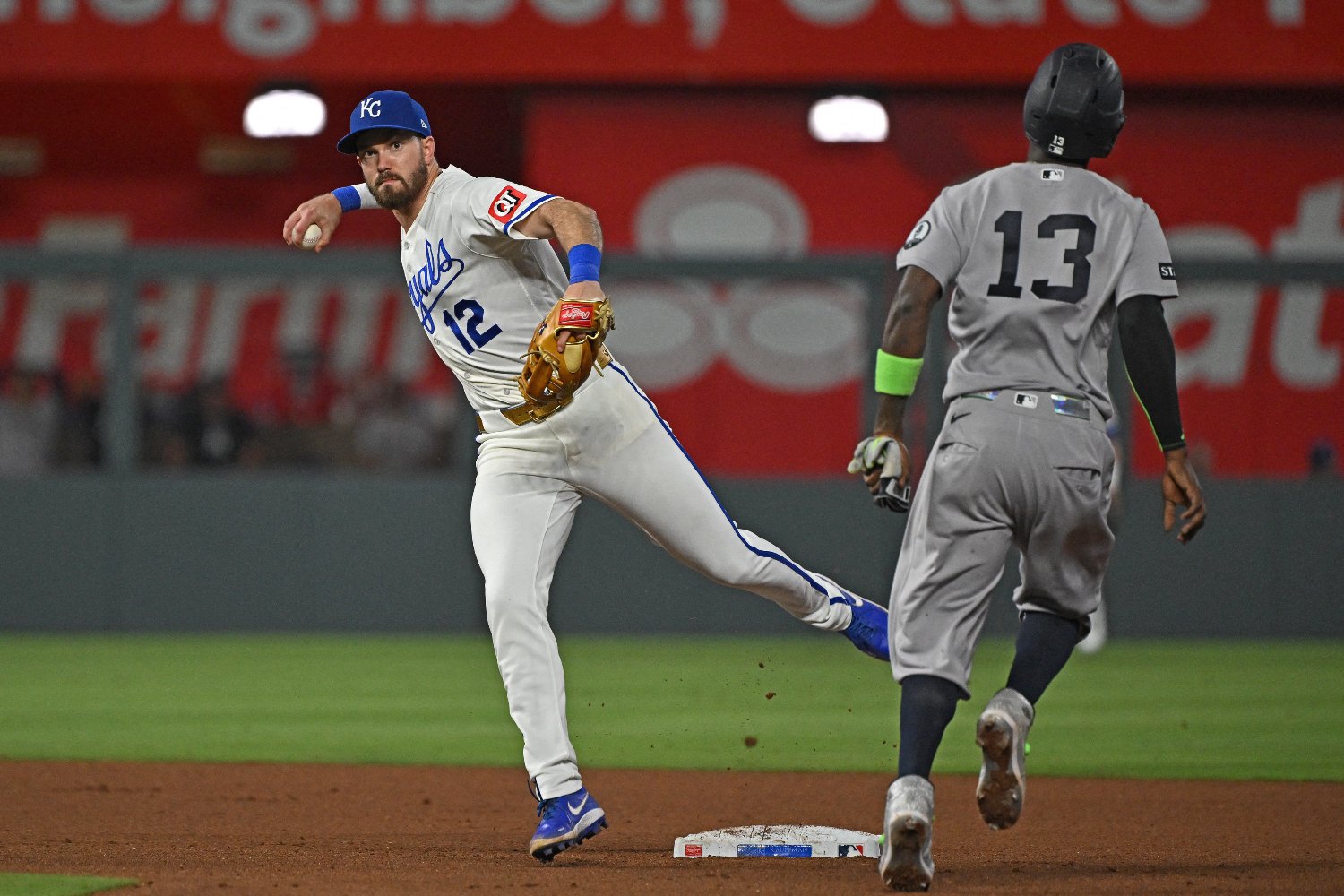
However, one bold strategy the Royals could pursue is to option Isaac Collins and Nick Loftin and move them to different defensive positions.
Both Are Struggling Defensively At Their Positions
When looking at the metrics, Collins and Loftin have fared quite poorly at their respective defensive positions in 2026.
Outs Above Average is Baseball Savant's primary metric that calculates defensive range and success rate. The official definition of OAA can be found below, via Savant's website.
QuoteOuts Above Average (OAA)
A range-based metric of skill that shows how many outs a player has saved over his peers.
In the table below, I have organized and ranked all Royals players with 10 or more field attempts based on OAA. However, the table also includes data such as directional OAA, success rate (plays a player made in the field), estimated success rate (plays that a player SHOULD make in the field), and success rate difference.
I have highlighted Collins and Loftin to show fans how they compare to other Royals players defensively in OAA.
As Royals fans can see above, Collins and Loftin are two of the worst defensive players this season, according to OAA.
Collins has a -3 OAA and -3% difference in success rate. That ranks 10th of 12. As for Loftin? He is by far the worst defensive player on the Royals roster in terms of OAA. Not only is OAA -9, but he also has a -13% difference in success rate. Only Salvador Perez has a larger difference in success rate, at -22% (for his defense at first base, not catcher).
Now, OAA is just one category. How do Collins and Loftin fare in other defensive categories, especially ones available on Fangraphs?
Other defensive categories that measure a player's defense include DRS (defensive runs saved), FRV (fielding runs value), and Def (fielding runs above average). FRV is tied to OAA, so it's primarily available on Savant (FRV includes catchers while OAA does not). However, DRS and Def are pretty exclusive to Fangraphs.
Here's the definition of DRS, according to Fangraphs.
QuoteDefensive Runs Saved (DRS) is a defensive statistic calculated by The Fielding Bible, an organization run by John Dewan, that rates individual players as above or below average on defense. Much like UZR, players are measured in “runs” above or below average, and Baseball Info Solutions data is used as an input. Since DRS is measured in runs, it can be compared easily with a player’s offensive contributions (wRAA or similar statistics).
In terms of Def, it can be defined as follows, via the Fangraphs website.

Thus, I decided to create a table with Royals players who had 10 or more innings in the field at a position and utilized DRS, FRV, and Def as metrics to evaluate them. I organized them by Def, mostly because Def is used in Fangraphs' fWAR, which is my WAR of choice (fWAR is better than bWAR, in my opinion).
Here's how those Royals players fared in that table below, with Collins and Loftin highlighted as well, much like the OAA table above.
As the table above shows, Collins and Loftin are tied for the worst Def at -5.5. Loftin profiles a little bit worse in DRS (-5 to Collins' -2) and FRV (-5 to Collins' -4). That said, they have been poor defenders for the Royals this season, and no other Royals player, especially in the outfield, has been close (even Lane Thomas is 3.4 runs better than Collins and Loftin defensively).
Therefore, the pair has been a defensive drain on the Royals, even though they theoretically can succeed with the glove in some capacity. Both Collins and Loftin are relatively young and are athletic players. Furthermore, they have a better defensive history in years past.
That said, something needs to change with them because they are becoming nearly unplayable defensively for manager Matt Quatraro, who prioritizes defense in both the infield and outfield.
Their Offense Isn't Making Up for Poor Defense
It would be one thing if Collins and Loftin were mashing at the plate. Unfortunately, that hasn't been the case so far in 2026.
In 49 games and 180 plate appearances, Collins is slashing .212/.328/.311 with a .639 OPS. He has three home runs and a 12.8% BB%, but his K% is high at 26.7%, and his wRC+ is mediocre at 85. There's no question that Collins shows a patient approach and doesn't chase much. However, as illustrated by his TJ Statcast summary below, he struggles to make consistent contact and generate positive batted-ball production.
.png.d73dfc3140423b277a0a3e4fbb5055fa.png)
Collins has ideal bat speed, as evidenced by his 73.4 MPH mark, which ranks in the 68th percentile. There's also some potential with his barrel rate (55th percentile) and LA Sweet-Spot% (57th percentile). That said, his whiff (37th percentile) and strikeout (25th percentile) issues have weighed down his overall production this year, as illustrated by his 85 TJ Bat+, .292 wOBA, and .307 xwOBA.
It's been a similar story for Loftin, albeit in fewer plate appearances.
In 76 plate appearances this season, the former Baylor product is slashing .206/.316/.317 with a .633 OPS. Like Collins, Loftin's walk rate is solid at 10.5%. Unlike Collins, however, the former 2020 Royals draft pick has a low K% at 11.8%. That said, Loftin's paltry BABIP (.232) and inability to hit the ball hard or launch it have held him back offensively this year at the Major League level.
Here's a look at his TJ Statcast summary via TJ Stats. While his plate discipline metrics are impressive, the rest of his percentiles are underwhelming, to put it kindly.
.png.31713aceedf8dec60d6c39fafb4a1d3f.png)
Ranking in the 99th percentile in whiff%, 99th percentile in O-Swing%, 94th percentile in K%, and 92nd percentile in Z-Contact% are all positive attributes and should be a foundation for offensive success. Conversely, a 28th percentile hard-hit rate, 20th percentile LA Sweet-Spot%, 14th percentile bat speed, and 6th percentile 90th EV are a recipe for the opposite.
Thus, it's not a surprise that Loftin fares pretty unimpressively in his overall metrics, including TJ Bat+ (83), wOBA (.290), and xwOBA (.293). However, much like Collins, a spark or adjustment for Loftin could not only get him back in the lineup regularly but also positively impact this struggling Kansas City offense, which ranks 28th in runs scored.
Moving to Omaha to Switch Positions?
Both players have Minor League options remaining, with Collins having three and Loftin having one. Thus, with the Royals 13 games under .500, it would make sense to option Collins and Loftin back to Omaha and maybe give some other guys on the 40-man roster a chance, including Kameron Misner or John Rave (or they could call up Brett Squires if they wanted to be really bold).
That said, Collins and Loftin shouldn't be optioned to improve their hitting.
They can hit, and they have the tools to be successful. Both need to make some swing decision adjustments and, honestly, find some better batted-ball luck. The two will gain confidence in Omaha, but ultimately, those changes have to be made against MLB pitching.
Instead, they should go to Omaha to work on playing different positions in the field.
It's obvious that Collins and Loftin don't fit in the outfield and the infield, respectively. Collins has the athleticism and speed, but his instincts are poor, and that has contributed to his poor defensive metrics. The 28-year-old looks like an infielder trying to play the outfield, which makes sense since he initially started as an infield prospect when he was drafted out of Creighton by the Rockies in 2019.
The Royals may be better off moving Collins to second base and letting him get reps there in Omaha. Right now, there is a rotating mix at second base with Josh Rojas, Colton Becker, Connor Kaiser, Kevin Newman, Peyton Wilson, and Dustin Dickerson. Collins wouldn't be blocking any second-base prospect of note.
Furthermore, a move to second base for Collins would not just better utilize his skills, but it could also give them a better long-term option at the keystone. Michael Massey has been solid defensively, with a 1.8 Def rating that ranks fourth-best among Royals players. However, Massey has been mediocre offensively, as evidenced by a .644 OPS and 69 TJ Bat+.
Here's a look at his Statcast percentiles, which mirror Collins and Loftin pretty closely in many areas.
.png.6fe9aa94d4164ffe64b85719fef32047.png)
The Royals would probably be better off with Massey as a utility player who could play all over the field and Collins as the regular second baseman. However, for Collins to do that effectively, he needs more reps and development again at second base, and that needs to happen in a lower-pressure environment in Omaha for a month or two.
A similar defensive move needs to be true for Loftin as well.
Based on his OAA directional data, Loftin simply doesn't have the range to be successful at second base (he particularly struggles on plays up the middle, which we saw in his error on Friday night in Arlington). However, he may be better utilized as a corner outfielder who can play left and right field.
His OAA in LF is -1, and his success rate difference is -25%, according to Savant. That isn't good, but he suffered some poor reads early in the season in the outfield. Moving him back to the outfield full-time and giving him daily reps could help him make the most of his tools and skill set. Going from the infield to the outfield benefited Alex Gordon, who became a Royals Hall of Famer.
It's not out of the question to think that Loftin could be a similar outfielder to Thomas, who specializes against lefties, but has the potential to have a big season when the ball is falling (i.e., a better BABIP). While Thomas is off to an inconsistent start in Kansas City, the former National and Guardian has produced a TJ Bat+ of 95-111 every season from 2021 to 2024. Royals fans would take that kind of production from Loftin, especially if he can improve the defense.
Right now, Collins and Loftin have combined to produce a -0.8 fWAR in 2026. That's untenable, especially for a small-market franchise where every move counts. The Royals shouldn't give up on Collins and Loftin just yet, but they need some kind of major shift to help turn and put them in the right direction in terms of trajectory, both for the remainder of 2026 and beyond.
Going to Omaha for a couple of months, having them switch positions, and then returning to Kansas City after the All-Star break seems to make the most sense for both the pair and the Royals.





Recommended Comments
There are no comments to display.
Create an account or sign in to comment
You need to be a member in order to leave a comment
Create an account
Sign up for a new account in our community. It's easy!
Register a new accountSign in
Already have an account? Sign in here.
Sign In Now