


Royals Video
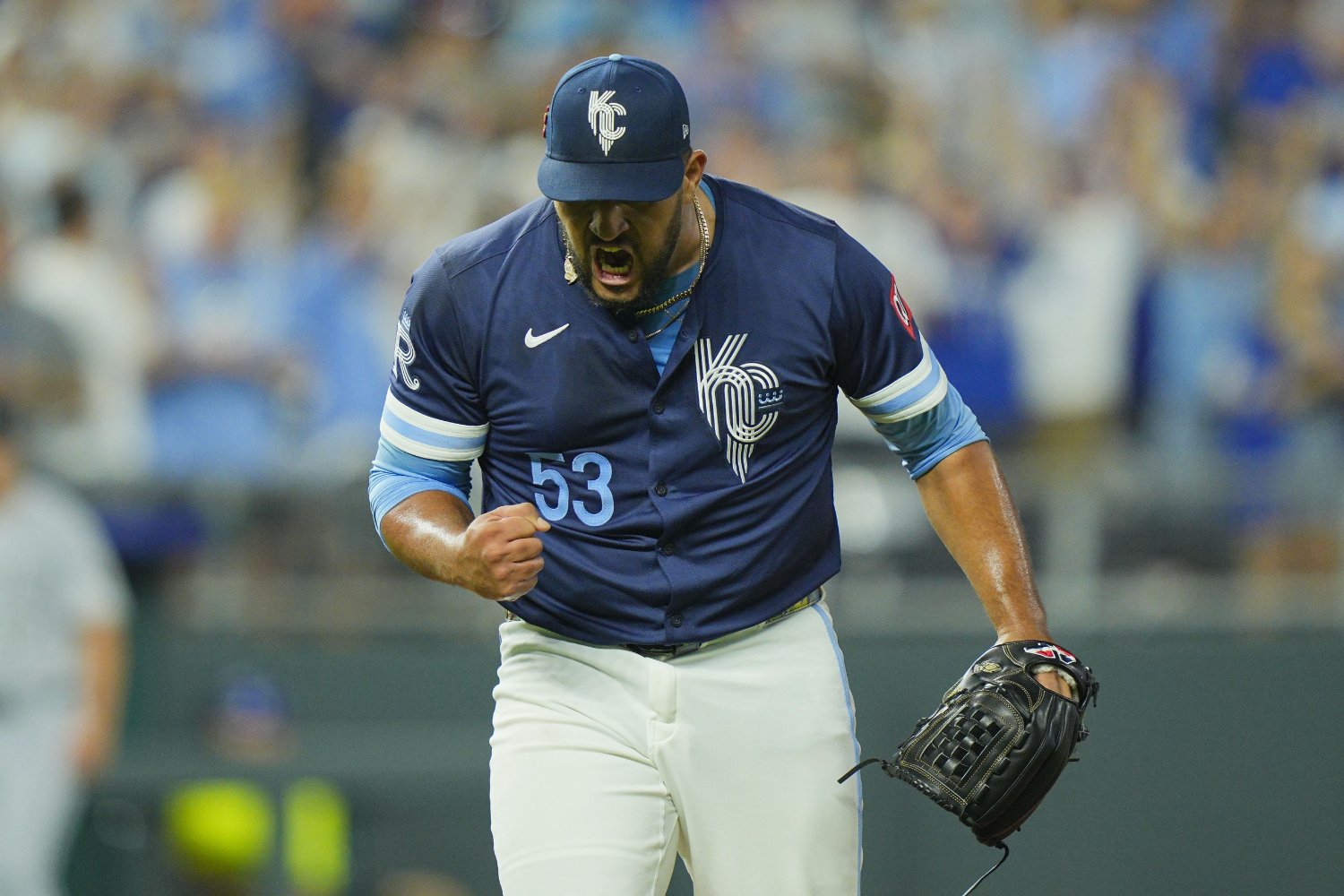
Kansas City Royals closer Carlos Estevez made his 2026 Cactus League debut on Tuesday, February 24th, against the Reds in Goodyear. Safe to say, it didn't go swimmingly.
In one inning of work, Estevez allowed two runs on two hits, back-to-back home runs by Reds sluggers Elly De La Cruz and Eugenio Suarez. He did minimize the damage after those two home runs, retiring Spencer Steer, Will Benson, and Tyler Stephenson in order. However, the 33-year-old Royals reliever allowed four hard-hit balls and an average exit velocity of 99 MPH on batted balls in his lone Spring Training outing thus far.
To make matters worse, MLB.com Royals beat writer Anne Rogers pointed out that Estevez saw a massive drop in his velocity from a season ago (though she said he also showed a similar drop last season).
Of course, Royals fans are solely focusing on every little thing players do right now in Arizona, both good and bad. Hence, some are panicking, thinking that Estevez may be falling off a cliff in 2026 after making the All-Star team and leading Major League Baseball in saves a season ago.
Are fans valid in their feelings that the Royals should be concerned about Estevez's ability to repeat his sensational 2025 campaign? Or is that just an example of Estevez getting warmed up and treating Spring Training in a similar way to how a veteran offensive lineman treats NFL Summer Camp?
Here are three takeaways from Estevez's first outing of Spring Training and why Royals fans should keep their heads cool for now.
Estevez May Have Been Working On A Particular Pitch (i.e., his changeup)
When looking at his TJ Stats pitch plot data, his TJ Stuff+ doesn't look great. All three of his pitches registered TJ Stuff+ marks below 95. That is not an encouraging sign, especially considering his limited repertoire.
.png.5a0f97edf301884510e29bacb99d96ad.png)
His four-seamer, which he threw only once, received the highest grade, 42. Conversely, his two most thrown pitches, the changeup (55% usage) and slider (41% usage), registered grades of 30 and 32, respectively. Those aren't good trends, especially considering what Estevez's stuff looked like last season, according to TJ Stats pitch plot data.
.png.c0459fb5667020f4bb668bb50a7aa543.png)
Estevez only threw the changeup 16% of the time last year, and it was a below-average pitch, according to the data. His main offspeed offering sported a 96 TJ Stuff+ and 49 grade, with limited spin at 1,616 RPM. Still, his TJ Stuff+ was 13 points lower on Tuesday than his overall mark in 2025.
That said, it's entirely plausible that Estevez was trying something new with the changeup in this Spring Training outing, and the TJ Stuff+ metrics were a casualty. Here are some key differences in his changeup against the Reds and what it looked like a season ago.
Last season, his changeup had an iVB of 9.8. On Tuesday, it had an iVB of 11. Thus, it may be that Estevez was trying to get more vertical movement on the pitch, and the quality was inconsistent as he toyed with this difference. A sign of that experimentation could be found in his changeup trends, as shown in both his pitch movement plot and velocity linear chart.
The former, which can be seen in the Spring Training plot above, showed three pitches that are WAY off from the previous group, illustrating "gross mistake" pitches (i.e., super-waste ones). The sheer difference in movement profile from the main group of changeup pitches demonstrates that he tried something different, and it didn't work out (or he couldn't quite get a grip and lost command of it).
In the latter, the changeup shows major dips at a few points in the velocity chart, as shown below. Those illustrate to baseball fans that Estevez messed up with his control against Cincinnati while trying something different on his changeup.

Estevez had three changeups that hovered around 80 MPH or slightly below. That is a far cry from the rest of his changeup pitches, which were around the upper 80's.
The Dominican-born pitcher, who will be pitching for the Dominican Republic in the upcoming WBC, is a veteran who doesn't need to earn his spot in Spring Training. Thus, Estevez trying to tweak his mix mid-game is something a pitcher of his status can afford to do, even if it produces lackluster results. He's not going to lose his closer job after one rough Cactus League game.
Estevez May Be a Slow Starter
The right-hander may just be a slow starter, whether it's in Spring Training or the start of the season. Therefore, this may be something Royals fans just have to get used to with him, or at least pay attention to, in his appearances in Arizona.
Since 2021, Estevez has posted ERA marks in the double digits twice: 2021 with the Rockies (12.38 ERA) and 2023 with the Angels (10.57 ERA). While that looks bad, it's Spring Training, and the sample sizes are so small. One bad outing can sink a player's Cactus League campaign. Vice versa, a good Spring Training outing can correct itself in March/April with more innings and against better competition.
This is what happened to Estevez last year in his first year in Kansas City.
After posting a 1.80 ERA in five IP in the Cactus League, he struggled out of the gate, recovering from a minor back injury. He had a 2.77 ERA in 13 IP in April, but his WHIP was slightly higher than expected at 1.23, and he had eight walks to only 11 strikeouts. He struggled to get strikeouts, and his lackluster fastball velocity in the first two months (April and May) was likely a reason. Here's what his four-seam velocity looked like by month last season, and notice how in July, he looked like his best self, velocity-wise.
.png.d14cfe0d08a2ae636ac6870452b970a8.png)
Obviously, there's a desire for more with Estevez, especially with him signed in free agency last season and making slightly over $11 million this season in the last year of the two-year deal he signed prior to the 2025 MLB season. However, given his size and age, this may just be a sign that things are taking longer for Estevez to get ready for the upcoming season.
A positive difference in this Spring Training, compared to a year ago, is that Estevez is healthy. A healthy Spring Training could help him avoid a slow start in the regular season, especially in April, as was the case in Estevez's first season in Kansas City.
Could Normal Regression Be Happening?
Estevez has become a fan favorite, especially for his Dragon Ball Z-inspired celebration after each and every save. It's becoming a popular trend for Royals fans to follow (and Royals broadcasters to revel in) after a Kansas City victory.
However, while Estevez impressed last season with a 2.45 ERA, his FIP was 3.67, xERA 3.69, and xFIP 4.95. Furthermore, his strikeout rate dropped from 23.6% in 2024 to 20.1% in 2025, and his K-BB% declined from 17.9% to 11.9% over the same period. Hence, it's not a surprise that Estevez had only a 1.1 fWAR last year, which was the same amount he produced in 2024 with the Angels and Phillies, but in 11 fewer innings.
The TJ Stats summary from last year also illustrates a closer with good stuff, but struggles to generate chase and whiffs on a regular basis.
 Estevez had a TJ Stuff+ of 103 overall, with pitch grades of 57 (slider) and 60 (four-seamer). That said, his chase was only 23%, his whiff was only 19%, and his xwOBACON was .386. All of those were below-average marks for Estevez last year, with his whiff rate rating especially low.
ATC is projecting 32 saves in 65 IP for Estevez in 2026, according to Fangraphs. That also includes a 4.15 ERA, 1.27 WHIP, a 21.4% K rate, and 13.1% K-BB%.
There are some improvements from last season expected for Estevez in those projections, especially in terms of K-BB% (his mark last season was his lowest mark in a single season since 2017, his second year in the Majors). Conversely, every other category in ATC's projection of him is a regression, suggesting that Estevez is unlikely to be the 42-save, sub-3.00 ERA reliever he was a year ago.
The struggles this Spring Training may show that some regression is due to Estevez in this upcoming year. Nonetheless, that doesn't mean that Royals fans should automatically give up, especially after one bad outing. Even with a slightly down season, Estevez could still be a 3 to 3.50 ERA pitcher and collect 30+ saves in 2026. That's how good the stuff is (even if the chase and swing-and-miss aren't as good).
This bad performance from Estevez isn't something for the Royals to freak out about just yet. Instead, it should be eye-opening and a sign that he may regress and look more mortal (i.e., less lucky) in 2026. However, he isn't going to fall off a cliff statistically for the Royals. Rather, he will just need to receive more help from other pitchers in the bullpen.
With newcomers Matt Strahm, Alex Lange, and Nick Mears, as well as returners Lucas Erceg, John Schreiber, and Daniel Lynch IV, the Royals have the help Estevez may need more often than a year ago.






Recommended Comments
There are no comments to display.
Create an account or sign in to comment
You need to be a member in order to leave a comment
Create an account
Sign up for a new account in our community. It's easy!
Register a new accountSign in
Already have an account? Sign in here.
Sign In Now