


Kerry Flanagan
-
Posts
24 -
Joined
-
Last visited
-
Days Won
5
Kerry Flanagan's Achievements


-
Agreed re Gozalez vs Ricardo. Gonzales has decent contact ability, but I bet his average EV and max EV are quite low. He has some height so maybe some strength potential left, but at this point, the lack of power is problematic and limits his ceiling.
-
Not completely surprised by the lack of chase. The curve "locked up" most of the hitters and they just watched it regardless of location- not swinging whether it was a strike or a ball. The fastball has elite spin but not velocity, so generates weak contact but not a ton of swing and miss, or chase.
-
Also, Yandel Ricardo seems to have been dismissed or forgotten a bit. He's been on fire since a slow April, and is actually younger than Gamble or Hammond.
-
@Kevin O'Brien I watched Ryan McDonagh pitch for Columbia last night. He had a no hitter and faced the minimum thru 5+ innings. Unrestricted free agent out of Canada. Take a look at the game if you can still access it. He's 20 years old, 6'5", and is basically a fastball/curveball pitcher with high spin rates on the fastball and tremendous feel, control, and shape on his curveball. Velocity is only 90-92 atm. He's had nothing but success so far and you rarely see a curveball that advance for a 20 year old at Single A. He will need to improve on his other offerings (has a slider but was not an impressive pitch at all) and probably bump the FB velocity up a notch or two to be a genuine MLB SP, but I was impressed. Excellent command, control, big SP frame, etc. Single A hitters are completely helpless trying to hit his curveball. His K% on the curveball had to be in the 50-75% range.
-
So it appears with the recent signing of Rabe at basically the slot amount, that the savings from Rose went to sign Slightom. DeVaughan appears to have been a fall back, maybe in case they couldn't sign Slightom. We will see if they still have enough savings but based on the lack of positive news on Devaugham, he's rolling with the Tide.
-
Realistically, the only player here with much of a chance to make a big impact at the MLB level is DeVaughan if they can sign him. Hopefully they will save enough with the Rose pick to do that.
- 4 replies
-
- 1
-

-
- tanner griffith
- lance hartley
- (and 8 more)
-
IMHO, its a lot easier to fix the blocking/PB issues than pop times, framing or arm strength. He can already do the hardest things as a C due to natural ability, the other will improve with experience. Moving Jensen would be more of a move to preserve his offensive ability and value. I think the weight and responsibility of being a regular MLB Catcher in terms of preparation of the defensive/planning/preparation side is underestimated. The toll physically and mentally is considerable. Catching daily reduces offensive production. Nearly all good hitting catchers would hit better without having to catch.
-
I saw Colleran pitch on Saturday Feb 21st. He blew the first two fastballs by the first hitter, so despite the average extension, the velocity is definitely sufficient. He passed the eyeball test with flying colors and appears to have high leverage reliever potential. I would not be surprised at all with a mid year promotion to the bigs.
-
IMHO, he does not have repeatable mechanics. Without that, he will always have problems with command and walk rate. That's why you see the wild misses. Otherwise, sure who doesn't like a lefty throwing near triple digits with a four pitch mix.
-
I'd be surprised if the Royals and Pasquantino don't settle. They're only 500k apart and I get the feeling they want to keep Vinnie around- so its not worth damaging the relationship over what I presume could be splitting the difference to 250k additional. Royals and Bubic will likely not settle and will go to a hearing. Obviously highly unlikely Bubic will be a Royal in 2027 and probably not in 2026 (via trade), so not much reason to settle.
-
Image courtesy of © Mark J. Rebilas-Imagn Images While some of MLB’s future superstars progress through the minors in an uninterrupted and consistently dominant upward trajectory, that is the exception and not the rule. Most MiLB players who eventually make it to “The Show” encounter roadblocks, detours, and delays along the way. Injuries, personal issues, new pitches or pitch grips, batting stance changes, and other tweaks and changes often result in nonlinear development. In other words, just because a player has a poor season doesn’t mean they’ll never become a useful major leaguer. With that in mind, let’s look at five candidates coming off disappointing seasons who possess the raw talent to get back on track in 2026. Blake Mitchell, C The Royals selected Mitchell eighth overall in the 2023 MLB Draft as a high-upside prep catcher with plus power and defensive skills. He performed well in his 2024 full-season debut at Single-A Columbia, earning the organization's George Brett Hitter of the Year award and establishing himself as a top 100 prospect. However, a broken hamate bone in spring training that required surgery derailed his 2025 season. Hamate bone injuries are well known to sap a returning player’s power, and Mitchell was no exception. After slugging 18 homers with a .238/.376/.439 slash line at Single-A in 2024, Mitchell’s output plunged to just two home runs and a .207/.372/.296 line at High-A Quad Cities in 2025 over 49 games and 216 plate appearances. While plate discipline remained a strong suit, his slugging percentage dropped dramatically, and his elevated K% remains a concern. Mitchell was able to reclaim some of his top 100 prospect status with his performance in the Arizona Fall League, which included a home run with an impressive exit velocity of 116.5 mph. He was selected for the AFL Fall Stars Game and led Surprise in the semi-finals, going 2-3 with a double, two walks, and a walk-off single to send his team to the championship. There, he was a key contributor in defeating Peoria with a sac fly, single, and game-tying run scored. With the anticipation of Carter Jensen moving into a starting role in Kansas City, and significant additional organizational depth at the catcher position, a monster season from Mitchell would be huge for the Royals and solidify his status as one of the most valuable trade chips in the organization. Javi Vaz , 2B/OF Vaz, a versatile left-handed hitter known for elite contact skills and on-base ability, posted strong numbers in 2024 at Double-A Northwest Arkansas (.263/.375/.379, and more walks than strikeouts). His disciplined plate approach and defensive flexibility at second base and outfield had positioned him for a potential 2025 MLB debut. A fractured hand in spring training delayed his start and disrupted his season. At age 25 entering the 2026 season, Vaz's high floor as a contact-oriented, defensively versatile, and speedy contributor makes him a candidate to bounce back at Triple-A Omaha, potentially earning him a big-league roster spot as a utility player. Gavin Cross, OF Cross, the ninth overall pick in 2022, debuted in impressive fashion that same year in Single-A Columbia with a slash of .293/.423/.596. However, 2023 turned into an absolute nightmare for Cross after being stricken with Lyme disease. He rebounded impressively in 2024 at Double-A (.261/.342/.428, 15 HR, 30 SB), earning Naturals Player of the Year honors and restoring his prospect stock. Unfortunately, that momentum didn’t carry into 2025. Chronic back issues resurfaced, causing multiple IL stints, and a performance drop. Cross endured an abysmal start to the season with an anemic slash line of .166/.206/.289 in April and May combined. He did turn things around with strong finish to the season (.291/.345/.496 June-September). Cross enters the 2026 season at age 25 and having not yet progressed beyond Double-A. Given his up-and-down history, it is a make-or-break season for him. Strong athletic tools, above-average pop, and a good defensive skillset make Cross a bounce-back candidate and potentially still an MLB contributor. Alternatively, another poor season would push him into non-prospect status. Steven Zobac, RHP Zobac, a former two-way college player, broke out in 2024 (3.64 ERA across High-A/Double-A, 123 K in 126 IP), earning the organization's Paul Splittorff Pitcher of the Year and a 40-man roster spot for Rule 5 protection. Knee tendinitis and other injuries limited him to just 36 1/3 innings pitched at Double-A in 2025. Zobac’s mid-90s fastball and sharp slider, along with strong command and above-average swing and miss stuff (23.8 K%, 5.6% BB%- 2024), are encouraging for potential development. Zobac possesses a ceiling as a mid-rotation starter and a floor as a reliever, where his stuff may play up even more. 2026 will be critical in determining which of those outcomes is more likely. Blake Wolters, RHP Wolters, a highly regarded second-round pick in 2023 as a high schooler, features a mid-90s fastball (touching 99-100) with riding life and a plus slider. His 2024 Low-A debut was solid (4.20 ERA, manageable WHIP). A shoulder issue slowed him in 2025, reducing velocity and impacting command. Still just 21 entering 2026, Wolters has significant projection remaining. A full season at High-A could see him develop his stuff, regain velocity, and rocket him up organizational rankings. With the Royals' improving player development results, 2026 could feature multiple player bounce-backs, providing additional significant future MLB depth and immediate trade value. View full article
-
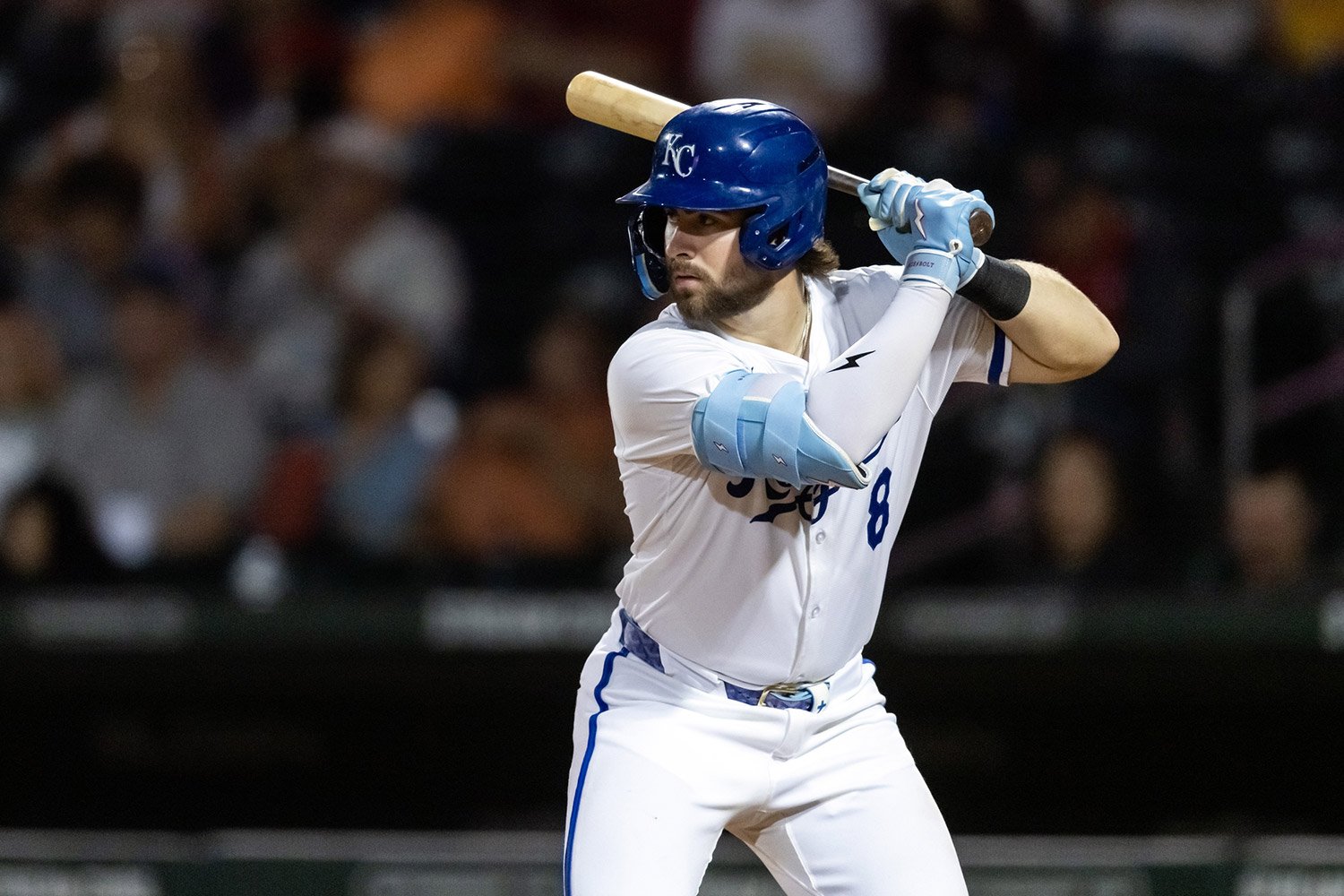 While some of MLB’s future superstars progress through the minors in an uninterrupted and consistently dominant upward trajectory, that is the exception and not the rule. Most MiLB players who eventually make it to “The Show” encounter roadblocks, detours, and delays along the way. Injuries, personal issues, new pitches or pitch grips, batting stance changes, and other tweaks and changes often result in nonlinear development. In other words, just because a player has a poor season doesn’t mean they’ll never become a useful major leaguer. With that in mind, let’s look at five candidates coming off disappointing seasons who possess the raw talent to get back on track in 2026. Blake Mitchell, C The Royals selected Mitchell eighth overall in the 2023 MLB Draft as a high-upside prep catcher with plus power and defensive skills. He performed well in his 2024 full-season debut at Single-A Columbia, earning the organization's George Brett Hitter of the Year award and establishing himself as a top 100 prospect. However, a broken hamate bone in spring training that required surgery derailed his 2025 season. Hamate bone injuries are well known to sap a returning player’s power, and Mitchell was no exception. After slugging 18 homers with a .238/.376/.439 slash line at Single-A in 2024, Mitchell’s output plunged to just two home runs and a .207/.372/.296 line at High-A Quad Cities in 2025 over 49 games and 216 plate appearances. While plate discipline remained a strong suit, his slugging percentage dropped dramatically, and his elevated K% remains a concern. Mitchell was able to reclaim some of his top 100 prospect status with his performance in the Arizona Fall League, which included a home run with an impressive exit velocity of 116.5 mph. He was selected for the AFL Fall Stars Game and led Surprise in the semi-finals, going 2-3 with a double, two walks, and a walk-off single to send his team to the championship. There, he was a key contributor in defeating Peoria with a sac fly, single, and game-tying run scored. With the anticipation of Carter Jensen moving into a starting role in Kansas City, and significant additional organizational depth at the catcher position, a monster season from Mitchell would be huge for the Royals and solidify his status as one of the most valuable trade chips in the organization. Javi Vaz , 2B/OF Vaz, a versatile left-handed hitter known for elite contact skills and on-base ability, posted strong numbers in 2024 at Double-A Northwest Arkansas (.263/.375/.379, and more walks than strikeouts). His disciplined plate approach and defensive flexibility at second base and outfield had positioned him for a potential 2025 MLB debut. A fractured hand in spring training delayed his start and disrupted his season. At age 25 entering the 2026 season, Vaz's high floor as a contact-oriented, defensively versatile, and speedy contributor makes him a candidate to bounce back at Triple-A Omaha, potentially earning him a big-league roster spot as a utility player. Gavin Cross, OF Cross, the ninth overall pick in 2022, debuted in impressive fashion that same year in Single-A Columbia with a slash of .293/.423/.596. However, 2023 turned into an absolute nightmare for Cross after being stricken with Lyme disease. He rebounded impressively in 2024 at Double-A (.261/.342/.428, 15 HR, 30 SB), earning Naturals Player of the Year honors and restoring his prospect stock. Unfortunately, that momentum didn’t carry into 2025. Chronic back issues resurfaced, causing multiple IL stints, and a performance drop. Cross endured an abysmal start to the season with an anemic slash line of .166/.206/.289 in April and May combined. He did turn things around with strong finish to the season (.291/.345/.496 June-September). Cross enters the 2026 season at age 25 and having not yet progressed beyond Double-A. Given his up-and-down history, it is a make-or-break season for him. Strong athletic tools, above-average pop, and a good defensive skillset make Cross a bounce-back candidate and potentially still an MLB contributor. Alternatively, another poor season would push him into non-prospect status. Steven Zobac, RHP Zobac, a former two-way college player, broke out in 2024 (3.64 ERA across High-A/Double-A, 123 K in 126 IP), earning the organization's Paul Splittorff Pitcher of the Year and a 40-man roster spot for Rule 5 protection. Knee tendinitis and other injuries limited him to just 36 1/3 innings pitched at Double-A in 2025. Zobac’s mid-90s fastball and sharp slider, along with strong command and above-average swing and miss stuff (23.8 K%, 5.6% BB%- 2024), are encouraging for potential development. Zobac possesses a ceiling as a mid-rotation starter and a floor as a reliever, where his stuff may play up even more. 2026 will be critical in determining which of those outcomes is more likely. Blake Wolters, RHP Wolters, a highly regarded second-round pick in 2023 as a high schooler, features a mid-90s fastball (touching 99-100) with riding life and a plus slider. His 2024 Low-A debut was solid (4.20 ERA, manageable WHIP). A shoulder issue slowed him in 2025, reducing velocity and impacting command. Still just 21 entering 2026, Wolters has significant projection remaining. A full season at High-A could see him develop his stuff, regain velocity, and rocket him up organizational rankings. With the Royals' improving player development results, 2026 could feature multiple player bounce-backs, providing additional significant future MLB depth and immediate trade value.
 -
Much of what is said in these types of press interactions with a manager is just fluff. There is no organizational benefit for example of saying "India really sucked and we'd love to trade him". The most interesting thing to come out of the interview was the indication that Avila is viewed as a starter. To me, it's a strong indicator that at least one if not more starters/potential starters gets traded. Looking at the 40 man, assuming none of the starting 5 gets moved, Avila is presumably behind Bergert, Kolek, Falter, probably Mason Black, and potentially even Lynch on the depth chart. Kudrna and Zobac aren't far behind either.
- 2 replies
-
- 1
-
-
- carter jensen
- jonathan india
- (and 2 more)
-
Image courtesy of © William Purnell-Imagn Images In my last article, I examined the unusual case of Tyler Rogers (Why The Royals Should Sign Quirky Submariner Tyler Rogers). As discussed there, while Rogers may be an outlier because of his unorthodox mechanics, it is not typically a good strategy to rely on pitchers who lack swing-and-miss stuff and instead rely on generating soft contact to get outs. Despite a bullpen that ranked third in Save%, statistics indicative of swing-and-miss ability, like K% and Whiff%, paint a far less optimistic picture for repeating that success in 2026 with the current cast of candidates. According to FanGraphs, the 2025 Royals bullpen ranked 28th in K% (20.5%), was in the middle of the pack in BB% (8.3%), and ranked 24th in both xFIP (4.21) and K%-BB% (12.2). They benefited from a .284 BABIP (batting average on balls in play; 8th-lowest in MLB) and a 74.6% left-on-base percentage (LOB%; 3rd-highest), well above the league average of 72%. All of this tells me what my blood pressure metrics told me every time Carlos Estevez came in to protect a one-run lead…. The Royals' pen got more than a bit lucky and is ripe for regression. This "luck" in stranding runners and low BABIP added an estimated 0.38 runs to their ERA performance vs. xFIP and represents a major regression risk for 2026 without improvement in peripheral statistics. Estevez is the poster child of the group, posting just a 20.1% strikeout rate, a 77.6% LOB rate, and a .234 BABIP and a xFIP that was more than double his actual ERA (2.45 vs 4.95)! His K% in 2023 and 2024 were much better, at 27.8% and 23.6%, respectively. Unless those K% numbers come back to his 2024/2024 levels, Estevez’s career FIP of 3.99 is very likely a much stronger indicator of his success in 2026 than the identical 2.45 ERAs he has posted the last two years. Estevez’s slider is his best pitch by Stuff+ estimates, and he has increased his usage of it consistently since the 2022 season. His four-seam fastball is average by Stuff+ and was down slightly to 95.9 mph in 2026 from his career average of 97.1. The decrease was mainly due to lower velocity in April, and it increased as the season progressed, but it remains something to keep an eye on in his age-33 season. Also of concern, his SwStr% of 8.2% last year was a career low. Lucas Erceg, number two in Matt Quatraro’s circle of trust, similarly struggled with his peripheral stats while still somehow managing to limit runs scored. After posting strong K/9 numbers in his first two MLB seasons (10.8 K/9), he dropped off significantly to 7.0 K/9 in 2025. Concerningly, his Whiff% dropped from an elite level of 31.9% in 2024 to 24.7% in 2025. As the 2025 season progressed, Erceg never looked quite right, and he went on the injured list first with a back issue in late May and later with a shoulder impingement injury. The Royals need the healthy, bat-missing version of Erceg in 2026. If Estevez regresses, Erceg will need to step back into the closer role. John Schreiber turned in another decent season and will be counted on again in 2026. He led all Royals relievers (with over 50 IP) in K%, 23.4% and K%-BB%, 16.2%. He’s never managed to match his early career K% numbers, and his Whiff% was below average at 23.4%, but he has established himself as an above-average reliever entering his age-32 season. Angel Zerpa returns in 2026. Stuff+ metrics love his sinker and slider. He has middling 21.1 K% and 8.0 BB% numbers, but a 2nd-percentile Whiff% of 16.4. He gets by on a 99th percentile ground ball percentage of 63.7. Despite 96+ mph four-seam/sinker velocities from the left-hander, he misses very few bats. Daniel Lynch IV, like Zerpa, is a left-handed pitcher with high ground-ball rates and low whiff rates, just not as extreme as Zerpa's. His 2025 season 15.5 K% and 9.0 BB% rates are not headed in the right direction, and his roster spot may very well be in jeopardy. Steven Cruz is a big young right-hander obtained in the Michael A. Taylor trade with the Twins, who has struggled with command thus far in his career. He possesses elite fastball velocity along with good extension provided by his 6’7” frame. All three of his pitch offerings in 2025 were rated by Stat+ as well above average. His four-seamer had an average velocity of 98.2 mph and a Stat+ mark of 121, while his cutter had a 107 Stat+ value, and his slider was even better at 125. His Location+ of 83 and his 9.5 BB% are a good indicator of where he had some issues. Despite his impressive velocity and stuff, his Whiff% and K% were both just OK (24.3%, 20.1%). Cruz took some significant steps forward in 2025 before also ending his season on the IL. Unlocking his potential will be important if the Royals' pen is to improve in 2026. The Royals signed local kid Alex Lange to a near league minimum “prove it” contract after he was designated for assignment by division rival, the Detroit Tigers. Lange was a key member of the Tigers' bullpen in 2022 and 2023, saving 26 games in ’23 before suffering a lat injury that required surgery in 2024. When healthy, Lange features a curveball-heavy repertoire along with a 96 mph fastball, a sinker, and a changeup. In 2023, that repertoire led to a whiff rate of 39.1%, which ranked in the 99th percentile. Unfortunately, it was accompanied by a 1st percentile BB% of 15.6%. The signing of Lange should be taken as a tacit admission by the Royals of needing more guys with power swing and miss stuff, even if there is a tradeoff in walks. Former 2nd-round pick Jonathan Bowlan was part of the college pitching-heavy 2018 class that included Brady Singer, Kris Bubic, Jackson Kowar, and Daniel Lynch, along with Jonathan Heasley and Austin Cox. For a time, it appeared that Bowlan might be the best of the bunch. He threw a no-hitter for Wilmington in 2019, starting 23 games between Low A and High A, and striking out 150 in only 146 innings. Bowlan lost the 2020 season to COVID and then appeared in only four games in 2021 before losing that season to Tommy John surgery. He struggled in 2022 and 2023 before regaining some measure of success with Omaha in 2024. Bowlan spent the 2025 season traveling back and forth between Omaha and Kansas City and put up decent numbers at both stops. At 6’6”, Bowlan has good extension and above-average velocity. He features a 5-pitch mix from his starting days, but as a reliever, he is primarily a four-seam fastball and slider pitcher, mixing in a sinker, curveball, and changeup. His Stuff+ metrics are above average for Stuff+, Location+, and Pitching+, with his slider being his highest-rated pitch. Perhaps because he pitched mostly in low-leverage situations, I didn’t realize his metrics were as good as they were. His Whiff Rate was elite at 33.7, his K% good at 25.6, and he got a lot of ground balls. His BB% was high at 9.4, and at 29, the ceiling is somewhat limited, but he has earned the opportunity for a second look. Luinder Avila debuted in 2025 and looked good in doing so. His 2025 Baseball Savant Pitching Percentile rankings are a sea of red, with only his walk rate being poor. It should be noted that these are based on only 14 innings pitched, though. He has a good frame with nasty movement on his breaking pitches, along with more than adequate fastball velocity. He is a potential breakout bullpen candidate this year. Eric Cerantola was added to the 40-man roster last year to protect him from the Rule 5 draft after a successful season at Omaha. He’s another big kid with a big arm. He’s struck out 11.9 batters per nine innings in his minor league career, but also has had his share of command issues with 5.4 BB/9. An athletic Canadian with a background in hockey, he is a fastball-slider pitcher who throws an occasional curve. His slider is arguably the best in the upper-level Royals minor league system and has received 70 grades. He may be this year’s Jonathan Bowlan, shuttling back and forth from Omaha as needed. Relief pitcher performance year-over-year is inherently volatile. Undoubtedly, the Royals got lucky in 2025, which screams regression in 2026. For that not to happen, some of the internal options currently on the roster need to step up. The Royals probably also need to add more options from the free agent and/or trade market. Stay tuned for that in Part II. View full article
-
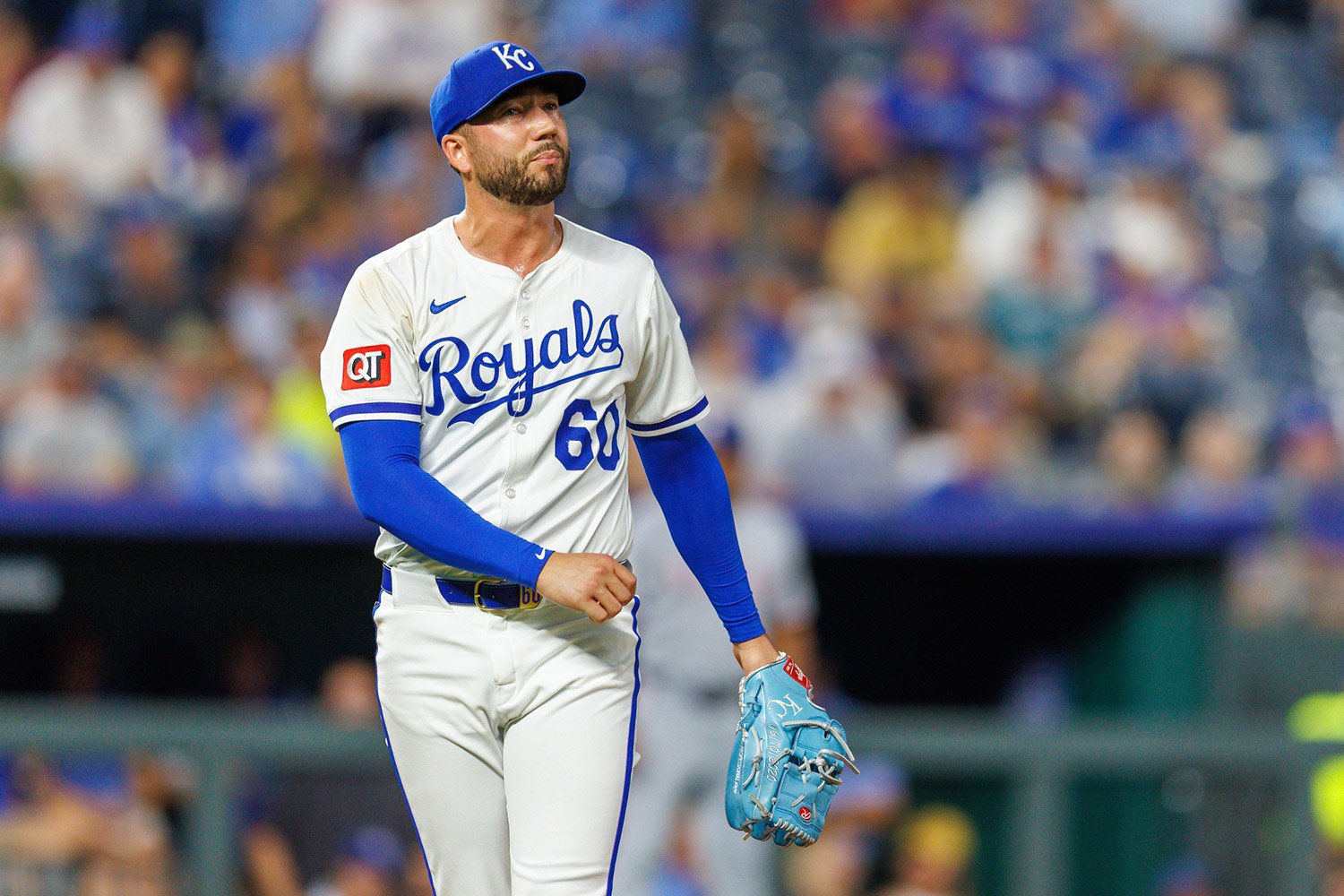 In my last article, I examined the unusual case of Tyler Rogers (Why The Royals Should Sign Quirky Submariner Tyler Rogers). As discussed there, while Rogers may be an outlier because of his unorthodox mechanics, it is not typically a good strategy to rely on pitchers who lack swing-and-miss stuff and instead rely on generating soft contact to get outs. Despite a bullpen that ranked third in Save%, statistics indicative of swing-and-miss ability, like K% and Whiff%, paint a far less optimistic picture for repeating that success in 2026 with the current cast of candidates. According to FanGraphs, the 2025 Royals bullpen ranked 28th in K% (20.5%), was in the middle of the pack in BB% (8.3%), and ranked 24th in both xFIP (4.21) and K%-BB% (12.2). They benefited from a .284 BABIP (batting average on balls in play; 8th-lowest in MLB) and a 74.6% left-on-base percentage (LOB%; 3rd-highest), well above the league average of 72%. All of this tells me what my blood pressure metrics told me every time Carlos Estevez came in to protect a one-run lead…. The Royals' pen got more than a bit lucky and is ripe for regression. This "luck" in stranding runners and low BABIP added an estimated 0.38 runs to their ERA performance vs. xFIP and represents a major regression risk for 2026 without improvement in peripheral statistics. Estevez is the poster child of the group, posting just a 20.1% strikeout rate, a 77.6% LOB rate, and a .234 BABIP and a xFIP that was more than double his actual ERA (2.45 vs 4.95)! His K% in 2023 and 2024 were much better, at 27.8% and 23.6%, respectively. Unless those K% numbers come back to his 2024/2024 levels, Estevez’s career FIP of 3.99 is very likely a much stronger indicator of his success in 2026 than the identical 2.45 ERAs he has posted the last two years. Estevez’s slider is his best pitch by Stuff+ estimates, and he has increased his usage of it consistently since the 2022 season. His four-seam fastball is average by Stuff+ and was down slightly to 95.9 mph in 2026 from his career average of 97.1. The decrease was mainly due to lower velocity in April, and it increased as the season progressed, but it remains something to keep an eye on in his age-33 season. Also of concern, his SwStr% of 8.2% last year was a career low. Lucas Erceg, number two in Matt Quatraro’s circle of trust, similarly struggled with his peripheral stats while still somehow managing to limit runs scored. After posting strong K/9 numbers in his first two MLB seasons (10.8 K/9), he dropped off significantly to 7.0 K/9 in 2025. Concerningly, his Whiff% dropped from an elite level of 31.9% in 2024 to 24.7% in 2025. As the 2025 season progressed, Erceg never looked quite right, and he went on the injured list first with a back issue in late May and later with a shoulder impingement injury. The Royals need the healthy, bat-missing version of Erceg in 2026. If Estevez regresses, Erceg will need to step back into the closer role. John Schreiber turned in another decent season and will be counted on again in 2026. He led all Royals relievers (with over 50 IP) in K%, 23.4% and K%-BB%, 16.2%. He’s never managed to match his early career K% numbers, and his Whiff% was below average at 23.4%, but he has established himself as an above-average reliever entering his age-32 season. Angel Zerpa returns in 2026. Stuff+ metrics love his sinker and slider. He has middling 21.1 K% and 8.0 BB% numbers, but a 2nd-percentile Whiff% of 16.4. He gets by on a 99th percentile ground ball percentage of 63.7. Despite 96+ mph four-seam/sinker velocities from the left-hander, he misses very few bats. Daniel Lynch IV, like Zerpa, is a left-handed pitcher with high ground-ball rates and low whiff rates, just not as extreme as Zerpa's. His 2025 season 15.5 K% and 9.0 BB% rates are not headed in the right direction, and his roster spot may very well be in jeopardy. Steven Cruz is a big young right-hander obtained in the Michael A. Taylor trade with the Twins, who has struggled with command thus far in his career. He possesses elite fastball velocity along with good extension provided by his 6’7” frame. All three of his pitch offerings in 2025 were rated by Stat+ as well above average. His four-seamer had an average velocity of 98.2 mph and a Stat+ mark of 121, while his cutter had a 107 Stat+ value, and his slider was even better at 125. His Location+ of 83 and his 9.5 BB% are a good indicator of where he had some issues. Despite his impressive velocity and stuff, his Whiff% and K% were both just OK (24.3%, 20.1%). Cruz took some significant steps forward in 2025 before also ending his season on the IL. Unlocking his potential will be important if the Royals' pen is to improve in 2026. The Royals signed local kid Alex Lange to a near league minimum “prove it” contract after he was designated for assignment by division rival, the Detroit Tigers. Lange was a key member of the Tigers' bullpen in 2022 and 2023, saving 26 games in ’23 before suffering a lat injury that required surgery in 2024. When healthy, Lange features a curveball-heavy repertoire along with a 96 mph fastball, a sinker, and a changeup. In 2023, that repertoire led to a whiff rate of 39.1%, which ranked in the 99th percentile. Unfortunately, it was accompanied by a 1st percentile BB% of 15.6%. The signing of Lange should be taken as a tacit admission by the Royals of needing more guys with power swing and miss stuff, even if there is a tradeoff in walks. Former 2nd-round pick Jonathan Bowlan was part of the college pitching-heavy 2018 class that included Brady Singer, Kris Bubic, Jackson Kowar, and Daniel Lynch, along with Jonathan Heasley and Austin Cox. For a time, it appeared that Bowlan might be the best of the bunch. He threw a no-hitter for Wilmington in 2019, starting 23 games between Low A and High A, and striking out 150 in only 146 innings. Bowlan lost the 2020 season to COVID and then appeared in only four games in 2021 before losing that season to Tommy John surgery. He struggled in 2022 and 2023 before regaining some measure of success with Omaha in 2024. Bowlan spent the 2025 season traveling back and forth between Omaha and Kansas City and put up decent numbers at both stops. At 6’6”, Bowlan has good extension and above-average velocity. He features a 5-pitch mix from his starting days, but as a reliever, he is primarily a four-seam fastball and slider pitcher, mixing in a sinker, curveball, and changeup. His Stuff+ metrics are above average for Stuff+, Location+, and Pitching+, with his slider being his highest-rated pitch. Perhaps because he pitched mostly in low-leverage situations, I didn’t realize his metrics were as good as they were. His Whiff Rate was elite at 33.7, his K% good at 25.6, and he got a lot of ground balls. His BB% was high at 9.4, and at 29, the ceiling is somewhat limited, but he has earned the opportunity for a second look. Luinder Avila debuted in 2025 and looked good in doing so. His 2025 Baseball Savant Pitching Percentile rankings are a sea of red, with only his walk rate being poor. It should be noted that these are based on only 14 innings pitched, though. He has a good frame with nasty movement on his breaking pitches, along with more than adequate fastball velocity. He is a potential breakout bullpen candidate this year. Eric Cerantola was added to the 40-man roster last year to protect him from the Rule 5 draft after a successful season at Omaha. He’s another big kid with a big arm. He’s struck out 11.9 batters per nine innings in his minor league career, but also has had his share of command issues with 5.4 BB/9. An athletic Canadian with a background in hockey, he is a fastball-slider pitcher who throws an occasional curve. His slider is arguably the best in the upper-level Royals minor league system and has received 70 grades. He may be this year’s Jonathan Bowlan, shuttling back and forth from Omaha as needed. Relief pitcher performance year-over-year is inherently volatile. Undoubtedly, the Royals got lucky in 2025, which screams regression in 2026. For that not to happen, some of the internal options currently on the roster need to step up. The Royals probably also need to add more options from the free agent and/or trade market. Stay tuned for that in Part II.
-
- 1
-
-
- carlos estevez
- lucas erceg
- (and 8 more)

