


Royals Video
With a bullpen that ranks 29th in bullpen ERA and 30th in bullpen WHIP, the Kansas City Royals have been trying to find answers via various trades and free-agent pickups.
One of the most intriguing ones has been righty Nate Pearson, who was acquired on July 22nd for right-handed pitching prospect Max Martin after Pearson was designated for assignment by the Astros on July 19th.
Pearson posted respectable numbers in 16 appearances with the Astros this season. In 20 IP, he posted a 3.60 ERA, 1.40 WHIP, and 4.08 FIP. That said, he struggled to strike out batters (19% K%) and also walked more batters than desired (14.3% BB% and 4.8% K-BB%). When looking at his TJ Stats Statcast percentiles summary, Pearson struggled to generate strikes and CSW, despite elite extension and TJ Stuff+ metrics.
.png.c5edd035fc1c344ced23a15efc71c8ec.png)
Pearson ranked in the 86th percentile in extension, 87th percentile in TJ Stuff+, and 92nd percentile in fastball velocity while a member of the Astros. The 29-year-old did a good job of limiting hard hits in Houston, as evidenced by his 31.5% hard-hit rate (89th percentile) and 84.8 MPH average EV (90th percentile). That said, he struggled to find the strike zone consistently (20th percentile zone rate) and generated CSW (26th percentile). With the Astros competing for a playoff spot and upgrading their bullpen at the Trade Deadline, Pearson ended up being the odd man out in Houston.
However, the move proved to be an opportunity for the Royals, who traded for the former first-round pick.
Since coming over to Kansas City, Pearson hasn't allowed an earned run in eight appearances and 7.2 IP, and his WHIP is 0.65, and his FIP is 2.17. In addition, his K% is up to 28.6%, and he is posting a 21.4% K-BB% with the Royals. The results are better for Pearson with the Royals, and he's maintaining the extension, velocity, and TJ Stuff+ metrics that made him such an intriguing reliever with the Astros, Cubs, and Blue Jays.
Here's a look at his Statcast percentiles with the Royals since July 26th, via TJ Stats.

Interestingly, Pearson has seen a flip in his hard-hit% and average EV since coming to Kansas City, as they rank in the 4th and 12th percentiles, respectively. However, his zone rate ranks in the 83rd percentile, his CSW ranks in the 58th percentile, and his GB% ranks in the 73rd percentile. Those are all significant upgrades from what he was producing in Houston earlier this season.
So what has been the difference for Pearson with the Royals? And can Pearson keep producing like this, not just for the remainder of 2026, but 2027 as well?
Let's take a look at the developments that the Royals have seen with Pearson since coming over to Kansas City less than a month ago.
Using the Sinker More in Kansas City (Despite Questionable TJ Stuff+)
When looking at his pitch mix comparison between his time in Houston and now in Kansas City, there haven't been a ton of differences, as illustrated in his TJ Stuff+ summary comparison below.

That said, there are two key changes that have stuck out: he's increased his sinker usage significantly, and his slider has improved significantly with the Royals.
Interestingly, the sinker rates well via TJ Stuff+. It has a 92 mark, which is actually five points worse than his mark with the Astros. However, the pitch has been a better zone rate pitch with the Royals (60%) than with the Astros (51.5%), and while it doesn't generate much whiff (14.3% with the Royals; 7.7% with the Astros), it has been a good pitch when it comes to generating weak contact. He allowed a .108 xwOBACON on the sinker in Houston, and that has remained the same in Kansas City, as he has a .199 xwOBACON.
With the Astros, he only threw the sinker 9.5% of the time. With the Royals? That sinker usage is up to 20.2%. With a higher usage, he's generating more chase as well, despite it rating worse on a TJ Stuff+ end.
The difference with the sinker is that Pearson has made the pitch more horizontal than vertical.
With the Astros, Pearson's sinker had 12.4 inches of iVB and 14.8 inches of HB with a spin rate of 2,235 RPM. With the Royals, that iVB is 11.1, the HV is 12.8, and its spin is 2,136 RPM. It's also an offering that has less spin and general movement, and it's located lower in the zone than it was in Houston.
Below is a clip compilation of his sinker from an outing in Houston and Kansas City.

As Royals fans can see above, Pearson located the sinker higher and more on the edges in Houston. It also clearly had more vertical rise. With Kansas City, the pitch is located more around the knees and in the middle and fades way more toward the hitter than it did in the Astros clip.
Throwing a pitch with bad TJ Stuff+ doesn't seem like a recipe for success. However, it seems like throwing the sinker more has led to a more "aggressive" mindset for Pearson, which has helped him throw more strikes and limit walks in Kansas City.
More strikes and fewer walks will lead to fewer runs allowed and more strikeouts. Both outcomes are happening for Pearson with the Royals in his short sample so far.
Fewer Breaking Balls Being Thrown in Kansas City
An interesting trend for Pearson with the Royals is that he's throwing fewer breaking offerings. Those pitches are his slider and his curveball.
With the Astros, Pearson's slider and his curve were his second- and third-most-thrown pitches, respectively. He threw the slider 36.1% of the time and the curve 11.6% of the time in Houston. With the Royals, that slider usage has declined to 22.2%, and his curveball usage has fallen to 8.1%. Those are decreases of 13.9% and 3.5%, respectively.
What's interesting about the decline in usage is that the pitches haven't gotten worse for Pearson in Kansas City, at least on a TJ Stuff+ end.
Pearson's slider has a 115 TJ Stuff+, and his curve has a 105 TJ Stuff+. The curve has declined by one point in the move to KC, but his slider TJ Stuff+ has been three points better with the Royals. Thus, he's doing a lot of the same things theoretically with those breaking pitches since moving to Kansas City.
A difference for Pearson and his breaking pitches is that while he's throwing both pitches less, he's throwing them for more strikes. His slider zone% has gone from 45.6% to 54.5%, and his curveball zone% has risen from 27.5% to 37.5%. He's generating fewer whiffs with both pitches in Kansas City (16.7% slider whiff% and 50% curve whiff%), but by throwing the pitch in the zone more, he's keeping hitters honest. They can't lay off those pitches as much as they could in Houston.
Here's an example of Pearson's slider generating a swinging strike out of the zone by the Dodgers' Alex Call in an August 11th outing.
Not only is the pitch on the edge, but if Pearson has been throwing the pitch for strikes, Call has to respect it and try to make contact on it. That wasn't happening in Houston, and it's likely that without the slider zone% change, Pearson wouldn't have gotten Call to chase in a two-strike count.
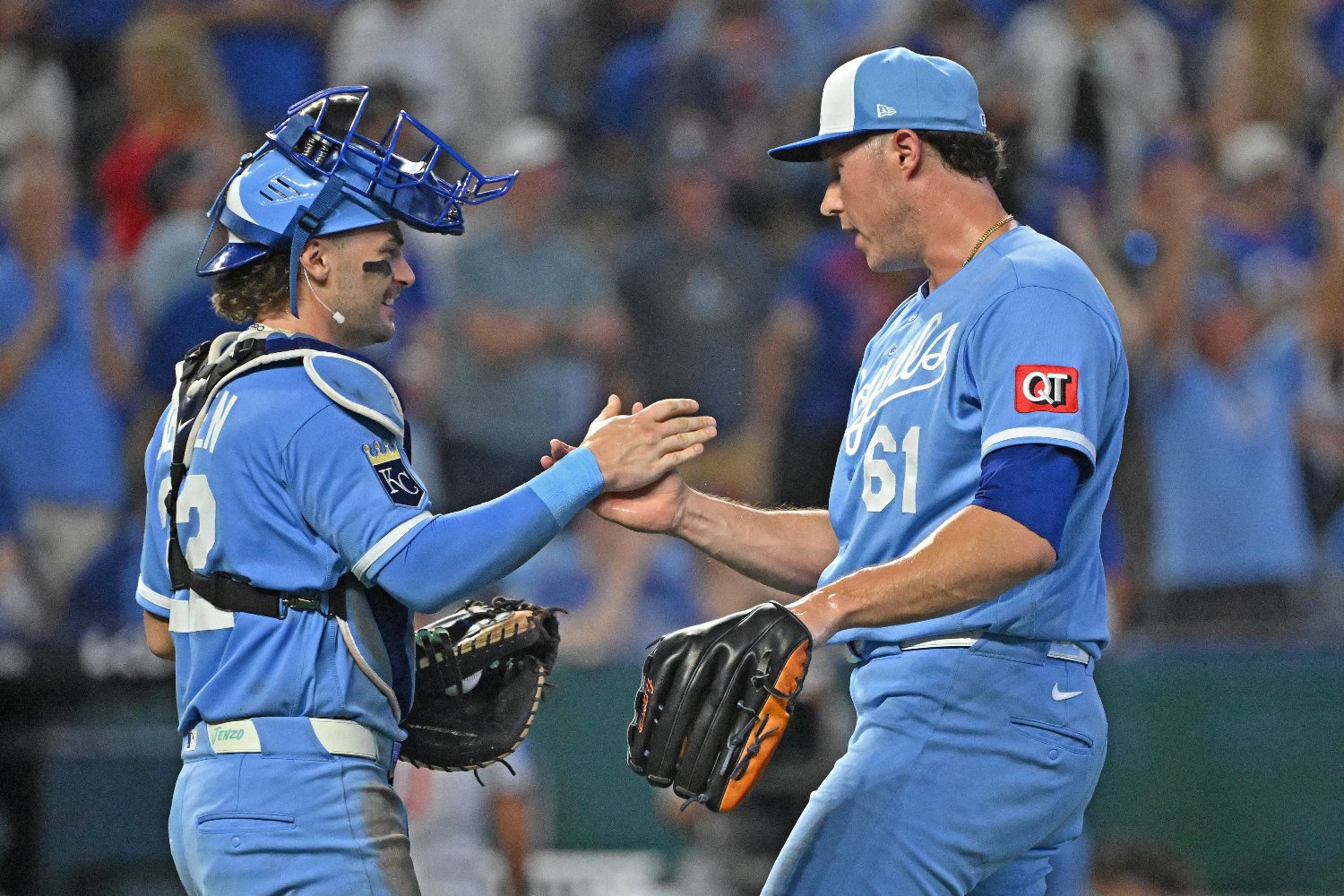
Pearson did something similar with the curve against Pete Crow-Armstrong on August 8th. Crow-Armstrong had to respect the curve because it has been thrown more for strikes, and on an 0-2 count, he chases on a curve down and out of the zone, and Pearson is able to acquire the save.
Pearson's breaking offerings still have flaws. He has a .441 xwOBACON with the slider in Kansas City, which is much higher than .377 xwOBACON on his slider in Houston. Still, his more aggressive approach with his breaking pitches has been key to his early success with the Royals.
Can Pearson Stay Healthy and Consistent?
Pearson has long been a heralded pitching prospect, especially during his tenure in Toronto. He was often listed as the Blue Jays' top prospect, and many scouts thought Pearson could be a prototypical ace when he was drafted 28th overall in the 2017 MLB Draft.
Unfortunately, he has struggled to stay healthy, leading to mediocre numbers and long stretches of missed games.
After pitching a career-high 66.2 IP with the Blue Jays and Cubs in 2024, he only pitched 14.2 innings with the Cubs in 2025. Pearson underwent an offseason arthroscopic elbow cleanup procedure that kept him out until May 20th, and he just never looked the same last season. He posted a 9.20 ERA and was designated for assignment, then released on September 20th.
Pearson hasn't had any major surgeries. However, he seems to get dinged with a lot of minor ones, which have seemed to stunt him from building momentum on the mound. Since debuting in 2020 with Toronto, he has gotten mono (2022), had an adductor strain (2021), and had earlier elbow issues during his rookie season. As a result, Pearson has a career 4.78 ERA and 4.80 FIP in 184.1 IP.
Thus, it will be important for Pearson not just to stay healthy, but to continue building positive momentum with each and every relief outing. He has gotten off to a nice start in Kansas City, and he's getting opportunities, especially in high-leverage spots in the 8th and 9th innings. Thus, this is the best spot for Pearson to turn around his career after being more of a middle-innings, mop-up guy in Houston.
Then again, consistency hasn't always been Pearson's strong suit. That was on display on Saturday as he gave up a hit, a walk, and a run in a 1-0 loss to the Angels on Saturday night. While the stuff was solid from Pearson as usual, he struggled to throw strikes, as evidenced by his 35% zone rate.
.png.3823f0074e5838dbea943ff33212e9bf.png)
Pearson wasn't hit hard on Saturday in the loss (.300 xwOBACON). Unfortunately, he didn't throw enough strikes and wasn't generating the kind of chase (23.1% chase%) or whiffs (11.1% whiff%) to make up for the lack of control. The outing bumped his ERA up to 2.83 and his FIP to 3.57 for the season in 28.2 IP (it was also the first earned run he's allowed as a Royals pitcher).
His pitch chart from Saturday's outing also illustrated that while Pearson was hitting the edges with his four-seamer, he was struggling to locate with his other offerings.

That was just enough for the Angels to squeak out a victory against a Royals offense that couldn't solve Reid Detmers (11 strikeouts in 8.0 IP) or closer Ben Joyce (two strikeouts).
There's no doubt the stuff, velocity, and potential are there for Pearson to be successful. Even though he's nearly 30, he's still a relatively fresh pitcher without a lot of mileage on his arm.
Furthermore, he has the kind of velocity and extension that this bullpen needs. His profile is similar to other big arms in the Royals organization like Steven Cruz and Luinder Avila. According to TJ Stats leaderboards, Pearson's 6.8 extension is the best mark of any Royal currently on the Royals 40-man roster, and his TJ Stuff+ of 107 is second-best, behind only Craig Kimbrel (who has yet to pitch for Kansas City).
The tools are there for Pearson to succeed, and perhaps Kansas City and its smaller market are the kind of scenery changes that Pearson needs to turn his career around.
Will he be a closer or a future setup man for the Royals in 2027? That's undetermined, especially with the Royals likely spending some money in free agency on the bullpen this upcoming offseason.
Nonetheless, Pearson is making his early case that he needs to be considered as part of the Royals' bullpen plans beyond 2026.





Recommended Comments
There are no comments to display.
Create an account or sign in to comment
You need to be a member in order to leave a comment
Create an account
Sign up for a new account in our community. It's easy!
Register a new accountSign in
Already have an account? Sign in here.
Sign In Now