


Royals Video
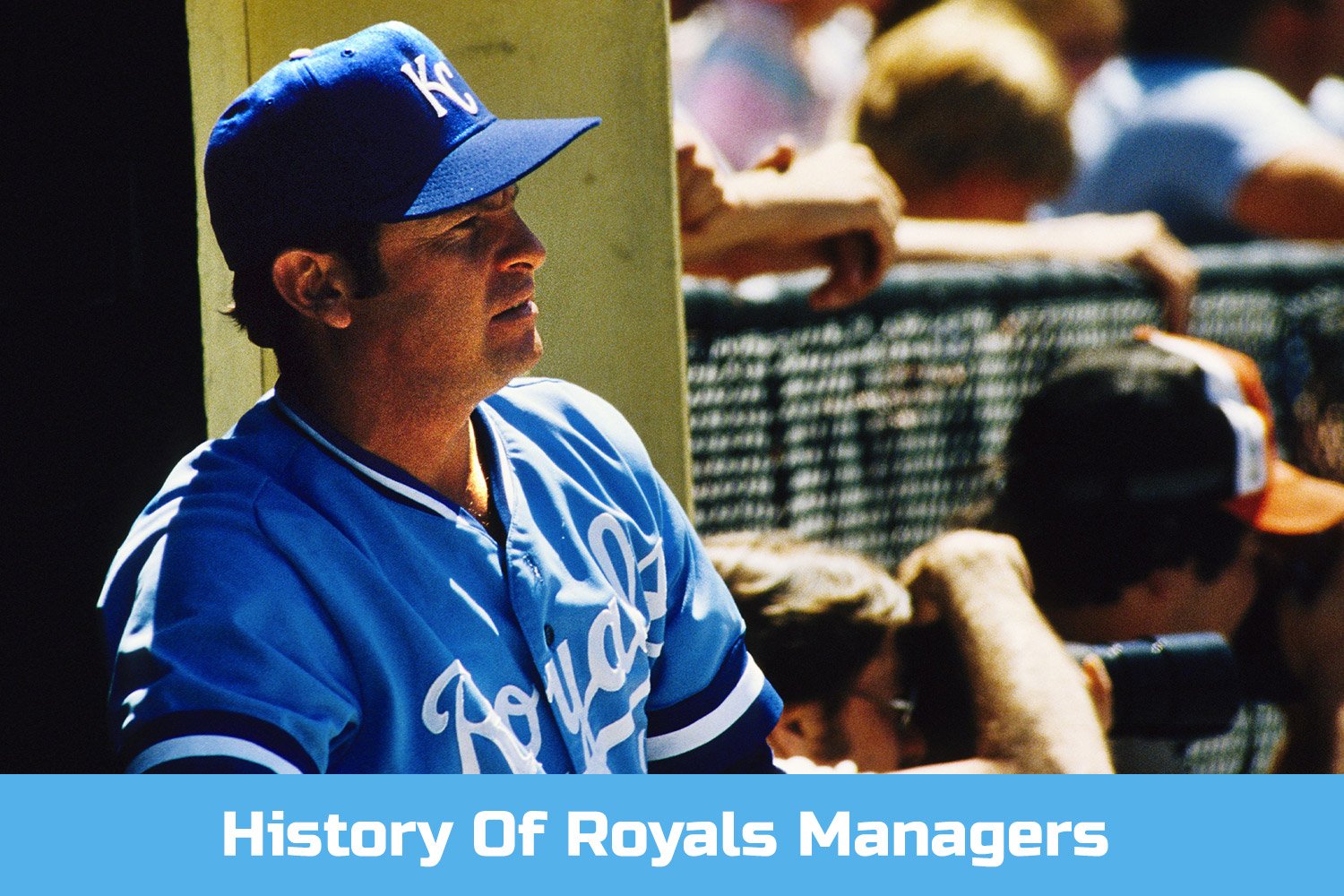
Let’s face it, managing the Kansas City Royals has not always been the easiest job in baseball. There have been a lot of down years when no mere mortal could have led the team to the playoffs, let alone a winning record. But the franchise has also been led by some excellent skippers. Here is a look at them.
Joe Gordon (1969)
Managerial record: 69-93
The expansion Royals embarked on their maiden voyage with a tremendous former player at the helm. Gordon was a nine-time All-Star during his playing days as a second baseman for the Yankees and Indians, and he won the 1942 AL MVP award. Gordon had managed Cleveland, Detroit, and the Kansas City A’s (briefly) but had not been a skipper since 1961. After one season with the Royals, he decided he’d had enough and stepped aside, although he continued working for the team as a scout for the next two years. Gordon was elected to the Baseball Hall of Fame as a player in 2009.
Fun fact: Gordon was apparently quite the violin player; he played with the Portland Symphony Orchestra when he was still a teenager.
Charlie Metro (1970)
Managerial record: 19-33
Metro was hired by Kansas City as director of player procurement ahead of the expansion draft and took over as manager for the 1970 season. But Metro was a very old-school manager; he yanked reigning Rookie of the Year Lou Piniella from a spring training game for what the skipper felt was a lack of hustle. Metro’s strict ways quickly lost the team, and he was fired after just 52 games.
Fun fact: Born in Pennsylvania to Ukrainian immigrants, Metro’s birth name was Charles Moreskonich. His father’s given name was Metro; after years of being called Little Metro, the son legally changed his last name to Metro. Like his father, Charlie worked in the coal mines; unlike his father, baseball gave him a way out.
Bob Lemon (1970-1972)
Managerial record: 207-218
Lemon was a teammate of Gordon’s in Cleveland and was even briefly managed by Gordon in 1958. A seven-time All-Star as a pitcher, Lemon had been a successful minor-league manager before becoming Kansas City’s pitching coach ahead of the 1970 season. He took over when Metro was fired, and posted a 46-64 record the rest of the way. Kansas City, in just its third season of play, would finish 1971 with an 85-76 record. But after the team fell back to 76-78 in the 1972 season, owner Ewing Kauffman decided he would like a younger manager (Lemon was only 51 at the end of the season). Lemon was elected to the Baseball Hall of Fame as a player in 1976.
Fun fact: Lemon was a good enough hitter that he actually reached the majors as an outfielder. But he wasn’t a good enough hitter to stay an everyday player, and was soon moved to the mound. He was still used as a pinch-hitter occasionally and ended his career with 37 home runs.
Jack McKeon (1973-1975)
Managerial record: 215-205
As Kauffman wished, McKeon was nearly a full decade younger than Lemon when he became manager; he was 42 when the 1973 season began. McKeon had been managing the triple-A Omaha Royals since the team began play in 1969, leading them to league titles in their first two seasons. McKeon’s first year in the majors was mostly a success, with an 88-74 mark and a second-place finish, six games behind Oakland. But KC slipped to 77-85 in 1974, and McKeon alienated many players by trying to fire popular hitting coach Charley Lau. McKeon’s relationship with the team continued to deteriorate (star pitcher Steve Busby threatened to quit the team at one point), and McKeon was fired in late July of 1975.
Fun fact: McKeon was hardly done managing; he would skipper Oakland, San Diego, Cincinnati, and two different stints with Florida. He led the Marlins to the 2003 World Series title and served as an interim manager in 2011 at the age of 80.
Whitey Herzog (1975-1979)
Managerial record: 410-304
With McKeon out, the Royals turned to California’s third-base coach. Herzog had played for the Kansas City A’s and still had a home in Independence, just a few minutes from Royals Stadium. Herzog’s first act was bringing Lau back to the team (he had been working as the team’s roving minor league hitting coach). The Royals went 41-25 the rest of the 1975 season, although they couldn’t catch Oakland. But the next three years were different, as Kansas City captured three straight AL West titles, including the franchise’s lone 100-win season in 1977. However, the Royals also lost three straight AL Championship Series, each time to the Yankees. Never afraid to speak his mind, Herzog followed up a couple of those ALCS losses with public complaints about ownership’s refusal to spend money for free agents (particularly in the bullpen, which had proven to be the razor-thin difference between the Royals and Yankees in a couple of those series). When the Royals dropped to 85-77 in 1979 and missed the playoffs, Herzog was let go.
Fun fact: Naturally, Herzog was not unemployed for long. The St. Louis Cardinals hired him partway through the 1980 season. He was then promoted to general manager and then named himself manager for the 1981 season. That made him the first person to hold both jobs in the majors simultaneously since Connie Mack in 1950. Herzog’s managerial success led to his induction into the Baseball Hall of Fame in 2010.
Jim Frey (1980-1981)
Managerial record: 127-105
Frey spent the 1970s as a coach for Earl Weaver’s very strong Baltimore Orioles teams. The Kansas City job was his first managerial role in the majors. Unlike many new managers, he stepped into an enviable situation, heading a good team and expected to win. He also inherited George Brett, who was about to have a season for the ages, making his run at a .400 batting average. The Royals coasted to the AL West title, then finally vanquished the Yankees in the ALCS. But in a close, hard-fought World Series, they came up short against Philadelphia. Frey drew some heavy criticism both inside and outside the locker room for his pitching decisions in the Series; in particular, he basically ignored 14-game winner Paul Splittorff in favor of Rich Gale, who was pulled in the fifth inning of his Game Three start and in the third inning of Game Six. The Royals then went 20-30 before a players’ strike interrupted the 1981 season. After play resumed in August, the team continued to tread water. Twenty games into the second half, Frey was fired.
Fun fact: Frey was a childhood, high school, and American Legion ball teammate of Don Zimmer. After Kansas City, Frey’s next managerial post was with the Chicago Cubs (he was their manager when they won the NL East in 1984, their first postseason appearances since 1945). When Frey became Chicago’s general manager before the 1988 season, he hired Zimmer to manage the team.
Dick Howser (1981-1986)
Managerial record: 404-365
In a fun twist, the Royals helped make Howser available to become their skipper. Howser’s first managerial job in the bigs was leading the New York Yankees to 103 wins in 1980. But after Kansas City swept the Yankees in the ALCS, New York owner George Steinbrenner demanded that third base coach Mike Ferraro be fired. Howser refused, so Steinbrenner fired him (but kept Ferraro). Months later, Howser was in the KC dugout in place of Frey. Under Howser, the Royals finished the 1981 season with a 20-13 mark, sneaking into the Division Series necessitated by the split-season format. KC was quickly swept out of the playoffs by Oakland. The Royals fell just short of the AL West title in 1982, then suffered through a horrible 1983–a losing record, 20 games back of Chicago in the division, and a drug scandal that saw four players get arrested. But with almost an entirely new rotation, Howser and the Royals somehow won the West in 1984. Again, they were swept out of the playoffs, this time by Detroit. Of course, they followed that up with a World Series win over St. Louis in 1985. But shortly after the 1986 All-Star Game, doctors discovered that Howser had a brain tumor. He missed the rest of the season, then made a brief attempt to return in spring training for the 1987 season. But he was in no condition to continue, so he resigned. On June 17, 1987, Howser passed away at the age of 51.
Fun fact: Howser played at Florida State and returned to manage the Seminoles for one season before getting the Yankees job. The stadium at FSU is named in his honor.
Mike Ferraro (1986)
Managerial record: 36-38
Ferraro had the unenviable task of taking over when Howser’s brain tumor was discovered. The Royals went 36-38, which seems pretty good considering the circumstances. But the Royals fired him and hitting coach Lee May shortly after the season ended, an odd move since the plan was for Howser to return in 1987.
Billy Gardner (1987)
Managerial record: 62-64
Gardner was initially hired as Ferraro’s replacement as third base coach. Since Gardner had previous managerial experience (he skippered the Minnesota Twins from 1981 to 1985), perhaps he was brought in as insurance in case Howser couldn’t return. That’s precisely what happened. Gardner had also managed in the Royals’ minor leagues in the 1970s, so he was not a stranger to the organization. However, his time as Kansas City's manager was unsuccessful. Unlike many short-term managerial appointments, Gardner did not lose the clubhouse by being a dictator. Rather, team management felt he was too nice. The Royals were expected to compete for a division title, and they were technically doing that, at 3 ½ games out of first when Gardner was fired on August 26. But the team’s 62-64 record was a disappointment, and Gardner was axed.
Fun fact: While Gardner was managing the Twins, he lived in two hotel rooms at a Super 8 motel near the Metrodome. He also kept an offseason job doing p.r. for a company near his offseason home in Connecticut.
John Wathan (1987-1991)
Managerial record: 287-270
“Duke” (so nicknamed for his spot-on John Wayne impression) had barely retired as a player after 10 years with the Royals before he got the managerial post; his last game as a player was Game Seven of the 1985 World Series. After joining the Royals’ coaching staff for the 1986 season, he began 1987 as the manager at Triple-A Omaha. But when Gardner was canned, Wathan was promoted. The Royals went 21-15 the rest of the season but still missed the playoffs. Kansas City followed that with 84- and 92-win seasons. It appeared to be ready to challenge Oakland for the division title in 1990, particularly after an offseason spending spree that brought in reigning NL Cy Young winner Mark Davis and 19-game winner Storm Davis (no relation). But the Royals got off to a miserable start and never recovered, finishing 75-86. When the Royals continued to struggle at the beginning of 1991, Wathan was fired.
Fun fact: In 1982, Wathan stole 36 bases, breaking a major-league record Ray Schalk set in 1916. The record still belongs to Wathan.
Hal McRae (1991-1994)
Managerial record: 286-277
The Royals went back to the “former player” well by hiring McRae, who had been widely regarded as a team leader pretty much since Kansas City acquired him from Cincinnati in 1972. The Royals went 66-58 for the remainder of the 1991 season. But they began the 1992 season with a horrific 1-16 stretch; although they were better than .500 the rest of the way (74-70), the damage was done. Another slow start in 1993 (7-12) led to one of the most famous postgame press conferences in baseball history, as McRae erupted, throwing just about anything in his office that wasn’t nailed down. But the Royals recovered to post a respectable 84-78 record. The team got off to a better start in 1994 but was only around .500 when, in late July, they rattled off a 16-game winning streak. However, the season ended when the players went on strike, and McRae was fired about a month later. Curiously, the rationale was that the team wanted a manager who would work well with young players. No less an authority than George Brett had long credited McRae with teaching the 1970s Royals how to win.
Fun fact: McRae was the fifth Black manager in major league history. He also joined a select group by managing his son, Brian, who was drafted by the Royals while Hal was still an active player.
Bob Boone (1995-1997)
Managerial record: 181-206
For the third manager in a row, the Royals chose someone who had played for the team. Boone ended a stellar career with two seasons in Kansas City (1989-1990). The Royals, who were dumping as much salary as they could following the double whammy of the strike and owner Ewing Kauffman’s passing, put together a decent season in 1995, finishing 70-74. They finished 75-86 in 1996 and were hovering around .500 midway through 1997 when they began a stretch where they lost 16 of 17, including 13 in a row. Boone was fired after the ninth straight loss, with the Royals at 36-46.
Fun fact: Boone’s next managerial post was in Cincinnati, where he joined McRae in the “fathers managing their sons” club. Aaron Boone was the Reds’ third baseman when Bob got the job in 2001. The elder Boone’s tenure there lasted into the 2003 season; Aaron was traded away just days after Bob was fired.
Tony Muser (1997-2002)
Managerial record: 317-431
Muser was the Cubs’ hitting coach when the Royals hired him. The teams he managed in Kansas City were never good. Still, it was at least an interesting period in team history as players like Carlos Beltran, Johnny Damon, Jermaine Dye, and Mike Sweeney arrived in the majors and established themselves. Of course, none of those guys were pitchers, and that proved to be Muser’s downfall. Kansas City’s high-water mark under Muser was a 77-85 record in 2000, when they scored 879 runs (still the franchise record) but allowed 930 (the team record at the time). After a 67-95 mark in 2001, Muser was on the hot seat. An 8-15 start in 2002 brought his tenure to an end.
Fun fact: Well, maybe not that fun. When Muser was a coach for the Brewers in 1986, a natural gas explosion at the team’s spring training facility in Arizona resulted in Muser being burned on over half his body. He did not return to the dugout until mid-May.
Tony Pena (2002-2005)
Managerial record: 198-285
An exuberant native of the Dominican Republic, Pena is probably most remembered by Royals fans for his antics as much as for his team’s records. The 2002 team he took over became the first one in franchise history to lose 100 games. But the following season, with Pena spending all of spring training projecting optimism, the team stormed out to a 16-1 start and stayed in the AL Central race until late September. The “Nostros Creemos” (“We Believe”) Royals were a rare bright spot in the dark ages of Royals history, and Pena was named Manager of the Year in the AL. But, with actual expectations, the 2004 team never got going and finished with 104 losses. At one point that season, in an odd attempt to lighten the mood, Pena hopped in the shower after a game, in full uniform. When the Royals started slowly in 2005, Pena resigned after 33 games.
Fun fact: Pena was the third Dominican native in major league history to become a manager, and along with Luis Pujols of Detroit, the first to manage against another Dominican skipper.
Buddy Bell (2005-2007)
Managerial record: 174-262
Bell had managed the Tigers for two seasons and most of a third, then the Colorado Rockies for two seasons and 22 games, but was part of Cleveland’s coaching staff when the Royals hired him. Bell thus had a front-row seat for Kansas City’s epic 19-game losing streak that started in late July. The 2006 team lost its first two games, then won two, then lost 11 straight. After loss number 10, Bell uttered a quote that summed up Royals baseball from 1995-2012: “I never say it can’t get worse.” And the team proved him correct, losing 100 games for the third straight season. Even worse, Bell missed the final two weeks of the season after doctors diagnosed him with throat cancer. But he recovered and managed the 2007 season before resigning.
Fun fact: Like Boone before him, Bell was part of a three-generation major-league family. His father, Gus, played 15 seasons, mostly for the Cincinnati Reds. His sons, David and Mike, played in the bigs as well; Buddy was the bench coach for Cleveland when David reached the majors with the Indians.
Trey Hillman (2008-2010)
Managerial record: 152-207
In an outside-the-box move, the Royals hired Hillman based on his managerial success in Japan, where he had piloted the Hokkaido Nippon Ham Fighters to titles in 2006 and 2007. They were hardly the only ones interested, as Hillman had been considered by Texas, San Diego, and the Yankees. The Royals won 75 games in 2008, their best mark since 2003, but fell off the next season. A 12-23 start to the 2010 season cost him his job.
Fun fact: Hillman did not manage again until he was hired by the Korean KBO league’s SK Wyverns in 2016. That made him the first person to manage in MLB, Nippon Professional Baseball, and the KBO. He then became the first foreign manager to win a KBO title in 2018, making him the only manager ever to hold both the Korean Series and Japan Series titles.
Ned Yost (2010-2019)
Managerial record: 746-839
Yost, who the Milwaukee Brewers famously fired during a pennant race in 2008, joined KC’s front office before the 2010 season. Soon enough, he was back in the dugout. As the Royals began bringing the core of the 2014-15 teams to the majors, Yost often took the heat for the youngsters’ growing pains. He also came under fire for his handling of relief pitchers. But Yost went from embattled to beloved as the Royals challenged for a playoff spot in 2013, then went on a scintillating run to the World Series in 2014, and capped it off with the title in 2015. After most of the core of those teams left in free agency, Yost stuck around for a couple of lean years in 2018 and 2019 before retiring. He is now an adviser to Royals GM J.J. Picollo. Yost is the longest-tenured manager in team history, as well as the winningest (and losing-est).
Fun fact: Yost was good friends with NASCAR legend Dale Earnhardt Sr. and changed his uniform number to 3 after Earnhardt’s death in a crash at the 2001 Daytona 500.
Mike Matheny (2020-2022)
Managerial record: 165-219
Matheny, like Yost, had a position in the Royals’ front office before taking over in the dugout. Matheny had managed St. Louis for six seasons before being let go halfway through his seventh, with the 2013 NL pennant to his credit. But he couldn’t duplicate that success in Kansas City, with a high-water mark of 74 wins in 2021. The Royals fired general manager Dayton Moore late in the 2022 season, and Matheny was let go after the season ended.
Fun fact: When the Cardinals hired Matheny before the 2012 season, he had no professional coaching or managerial experience (of course, he played in the majors for 13 seasons). He then became the first manager in MLB history to reach the playoffs in each of his first four seasons.
Matt Quatraro (2023-present)
Managerial record: 224-262
Quatraro was Tampa Bay’s bench coach before taking over in Kansas City. His first year was rough, as the Royals tied the franchise record for losses in a season with 106. But with an upgraded rotation, Quatraro guided Kansas City to its first playoff appearance in almost a decade in 2024 and a Wild Card Series win over Baltimore. The 2025 season was something of a letdown, but Quatraro still guided the team through a bunch of injuries to a winning record, the first time since 2014-15 the Royals had two straight winning seasons.
Fun fact: Quatraro, perhaps unexpectedly given his quiet, analytical nature, is a fan of the Grateful Dead.









Recommended Comments
There are no comments to display.
Create an account or sign in to comment
You need to be a member in order to leave a comment
Create an account
Sign up for a new account in our community. It's easy!
Register a new accountSign in
Already have an account? Sign in here.
Sign In Now