


Royals Video
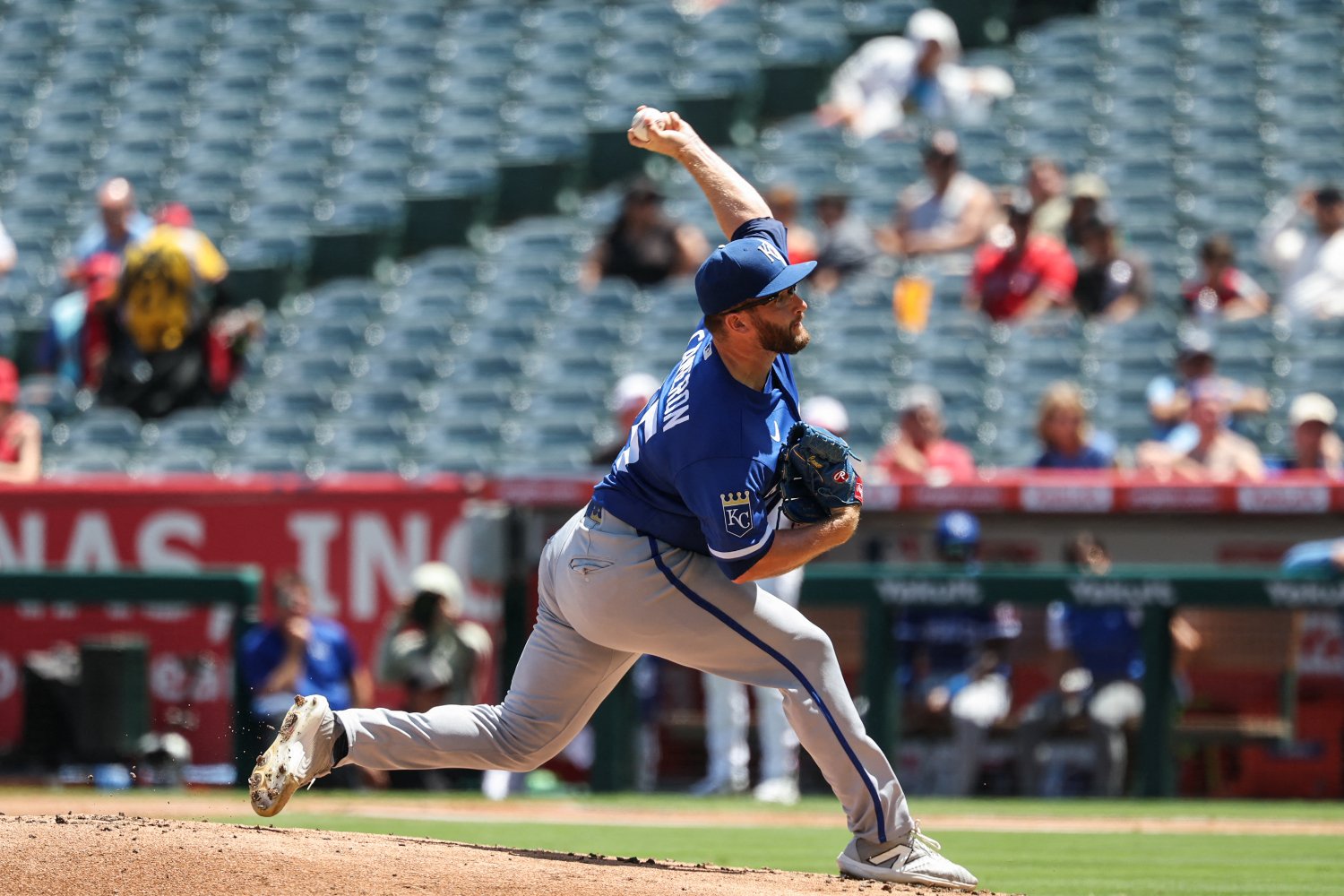
On Sunday, the Royals won the rubber game of the Angels series 3-0. However, the biggest story of the game was Noah Cameron throwing a one-hit shutout, the first complete-game shutout of his career.
It was another stellar start for Cameron, who bounced back from a mediocre outing against the Dodgers on August 10th (5.2 IP, 4 ER, 6 H, 2 BB, 2 K). Since a seven-run performance against the Padres at home on July 19th, Cameron has gone seven or more innings in four of his last five starts. He has not allowed runs in three of those outings: July 24th against Detroit, July 30th against Minnesota, and Sunday against the Angels.
In addition to allowing only one hit (a bloop single by Vaughn Grissom with an exit velocity of 65.8 MPH), the lefty out of St. Joseph, Missouri struck out eight and only allowed one walk. He also produced a 37% whiff rate, a 32% CSW, and was in strong command of his stuff all afternoon long in Anaheim.
So what clicked for Cameron in his immaculate outing? Let's take a look at his pitch breakdown and how he set up his success on Sunday against the Angels with that pitch mix.
Cameron Leaned Heavily on His Slider and Changeup
When looking at his TJ Stuff+ summary via TJ Stats, Cameron utilized his slider (21.7% usage) and changeup (20.9% usage) the most of his six-pitch mix on Sunday. He threw the offspeed and breaking offerings 49 times, for a 43% usage rate.
.png.7f0a30d6f7eafb30e38901a68d6ca0eb.png)
Overall, Cameron did an excellent job limiting hard contact, as shown by his .173 xwOBA on balls in play. That said, he not only induced a .238 xwOBACON on his slider and .045 xwOBACON on his changeup, but also 46.2% and 53.3% whiff rates on his slider and changeup, respectively. Those two whiff rates were the best marks of the six pitches he threw on Sunday.
With the slider, the 27-year-old lefty did an excellent job of locating the pitch glove-side and low, as illustrated in his slider pitch description chart via Baseball Savant.

Cameron did a good job of avoiding the middle with his slider, and even when it found the zone, he was able to generate batted-ball outs. Furthermore, most of his whiffs came at the edge or below the strike zone. Two of his whiffs were on pitches that were in or touched the zone, and three were on sliders thrown out of the zone. Those whiffs showed Cameron had Angels hitters guessing badly, and he made them pay with that slider, even when it wasn't particularly close to the strike zone (his 33.3% chase rate rated as above average).
While his slider was good, Cameron's changeup was even better, as illustrated by the pitch's pitch description chart.

Cameron generated eight whiffs on the changeup, with three of those whiffs coming inside the strike zone and five coming on changeups outside of the zone. Cameron really pounded hitters armside with the offspeed pitch, and as a result, he was extremely successful, not just generating whiffs, but a profound amount of chase as well (50% chase%).
Interestingly enough, his four-seamer was his second-worst-rated pitch on a TJ Stuff+ end on Sunday with a 90 TJ Stuff+. However, it generated a 44.4% whiff rate, the third-best whiff rate of his six pitches. That was surprising to see, especially considering the pitch's lackluster TJ Stuff+ mark, velocity (93.1 MPH), and extension (6.2 feet).
Cameron's four-seamer pitch description chart was peppered with light purple, orange, and green dots along the edges of the strike zone, representing whiffs, called strikes, and foul balls.

The strong four-seamer command, lower usage of the four-seamer (16.5%), and the pairing with the changeup, especially in the armside area of the strike zone, seemed to drive success for Cameron on Sunday.
Changeup Key to Success?
Since moving to calling his own pitches after his July 19th start, Cameron has leaned heavily on the changeup. When looking at his pitch mix rolling chart via Savant, he has seen a tremendous spike over the last month in his changeup usage compared to his other offerings.
.png.d89921863bf5afe8bd93a1ca431ed916.png)
In 37.2 IP, it's been not just his most-thrown offering (21.7% usage), but most successful in terms of generating whiffs and weak contact, as illustrated below in his TJ Stuff+ summary since July 20th.

His changeup has the best pitching grade of his six offerings at 57, and in addition to a stellar whiff rate (45.3% whiff%), it has also produced a .265 xwOBA since July 20th. That's a solid mark for his most-thrown offering. When breaking down the splits and heatmap of his changeup, it's been an even stronger offering against righties than lefties since he began calling his own pitches.
.png.4627007be3a16fc35a98a5fff61011a4.png)
Against righties, the changeup is producing a 30.3% CSW%, a 44.6% whiff%, a 31.6% O-Swing%, and a .168 xwOBACON. He's producing similar metrics against lefties in terms of CSW (38.5%), whiff% (50%), and O-Swing% (50%), but it got hit much harder (.785 xwOBACON).
Below is an example of Cameron's changeup making Minnesota's Alex Jackson chase badly on a two-strike count.
The movement on the changeup dives a little more toward righties, which is different than most changeups and plays well off his four-seamer better. Below is an example of his four-seamer located down against the Dodgers' Miguel Rojas on August 10th. Notice how it has similar movement to the changeup, but is 12 MPH faster than Cameron's primary offspeed pitch.
Most pitchers will lead with the four-seamer and then use the changeup as a change of pace. Cameron seems to be opting for the opposite: setting the tone with the changeup and then utilizing his four-seamer as his change-of-pace pitch.
Michael Wacha has used this strategy successfully before, particularly in 2024, his first season in Kansas City, when he posted a 3.35 ERA in 164.1 IP. Here's a look at his pitch mix breakdown that season via TJ Stats.

Will Cameron's pitch-mix strategy lead to long-term success, like Wacha's? That is to be determined. Wacha has over 12 years of MLB service time under his belt, after all.
Nonetheless, what Cameron is doing is intriguing and is working, with Sunday's shutout in Anaheim being the pinnacle of this newfound approach.
For a Royals team building for 2027, those two qualities are more than enough.
Are you optimistic about the Royals right now?

Follow Royals Keep For Kansas City Royals News & Analysis



-
 2
2



Recommended Comments
There are no comments to display.
Create an account or sign in to comment
You need to be a member in order to leave a comment
Create an account
Sign up for a new account in our community. It's easy!
Register a new accountSign in
Already have an account? Sign in here.
Sign In Now